
What to Pack for Korea: A Season-by-Season List
A local's packing list for your first Korea trip: clothes for every season, the right plug, shoes you can slip off, masks, medicines and cash.
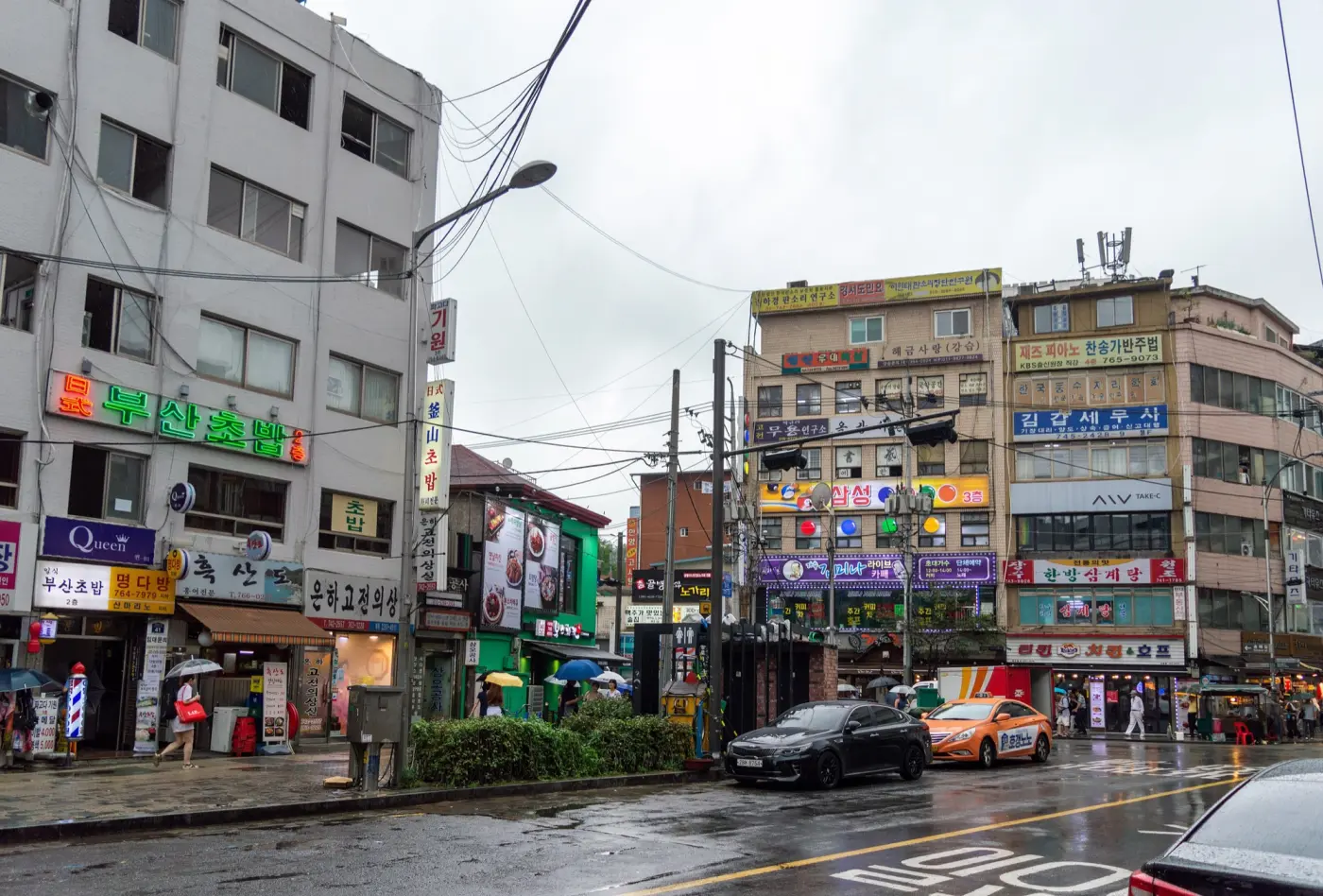
Packing for Korea is easier than most first-time visitors fear. The cities are modern, convenience stores sit on almost every block, and if you forget a toothbrush or a phone cable you can usually replace it within an hour of landing. What you cannot pick up at the corner shop is the right coat for a January wind, a pair of shoes that has already walked a few hundred kilometres without complaint, or the paperwork for a prescription medicine.
This list is written by people who live here and pack for Korean weather every year. It starts with clothes, season by season, and then covers the things that tend to catch visitors out: the plug, shoes you will take off far more often than you expect, masks for dusty days, medicines, money and toiletries. Every rule and number comes from an official Korean source listed at the end, and where we could not confirm something officially, we say so or leave it out. At the bottom there is a checklist you can print or screenshot.
The short version
| Season | Clothes | Don't forget |
|---|---|---|
| Spring (March to May) | A light jacket or trench coat for cold mornings and evenings; thin layers; short sleeves by May | A few masks for dusty days, a compact umbrella, sunglasses |
| Summer (June to August) | Breathable, quick-drying clothes; one light long-sleeved layer for air-conditioned trains and cafés | An umbrella or light raincoat, sun protection, a refillable water bottle |
| Autumn (September to November) | Light layers plus a jacket; a warmer coat for evenings from late October | Walking or hiking shoes with grip if you plan to see the foliage |
| Winter (December to February) | A thick coat, hat, gloves and scarf; thermal layers you can peel off indoors | Non-slip shoes, lip balm and hand cream for the dry air |
| All year | Comfortable shoes that slip on and off easily; socks you are happy to show | A plug adapter for two round pins (220 V), your medicines and their paperwork, a little cash |
If you only have a minute, that table is the whole idea. The rest of this guide explains the reasoning behind each line, so you can adjust it for your own dates and plans. For a fuller picture of the weather month by month, including the rainy season, typhoons and the two big holidays, read our guide to the best time to visit Korea.
Spring (March to May): layers, and a mask in your pocket
Spring in Korea starts later than many visitors expect. March still feels like the tail end of winter: in the Korea Meteorological Administration's 1991–2020 climate normals, Seoul averages 6.1°C in March, then 12.6°C in April and 18.2°C in May. VisitKorea's own packing advice follows the same curve. It suggests a light jacket or a trench coat in March, because temperatures drop in the morning and evening, and some outerwear plus short-sleeved clothing by May.
The practical answer is layers. A T-shirt, a thin knit or shirt, and a jacket you can carry over your arm at lunchtime will cover most spring days, from a chilly early start at a palace to a warm afternoon by the river. If your trip is timed for the cherry blossoms in late March or early April, pack for both: blossom evenings can be cold.
Spring is also when Korea gets its seasonal dust. KMA's observers in Seoul recorded an average of about seven yellow-dust days a year in spring between 1991 and 2020, most of them in April. Most spring days are clear, but it is worth having a few masks in your bag, which we come back to below.
Summer (June to August): rain gear and breathable clothes
Summer is hot, humid and, for a few weeks, very wet. The rainy season, jangma, normally runs in the central region, which includes Seoul, from about 25 June to 26 July, and July is the city's wettest month, with an average of 414.4 mm. August is the hottest month, averaging 26.1°C with daytime highs around 30°C. VisitKorea's summer advice is short and sensible: breathable clothing, sun protection products, and an umbrella or a raincoat.
A few local habits help. Choose clothes that dry quickly, because humid air and sudden downpours mean things rarely dry overnight on a hotel chair. Sandals or shoes that can survive a soaking are more useful than canvas trainers. Keep a compact umbrella in your day bag rather than at the hotel, since the heaviest bursts often arrive with little warning. And pack one light long-sleeved layer: after the heat outside, an air-conditioned subway car, café or long-distance bus can feel surprisingly cold.
Late summer is also typhoon season. In KMA's normals, about 3.4 typhoons a year affect Korea, nearly all of them between July and September. Most pass with a day or so of strong wind and rain, but if your trip falls in this window, keep island and mountain days flexible rather than packing extra gear for them.
Autumn (September to November): the easiest suitcase of the year
Autumn is the season locals love, and it is also the easiest to pack for. September is still warm, averaging 21.6°C in Seoul; October is crisp and clear at 15.0°C; November cools to 7.5°C. VisitKorea notes that temperatures can swing a lot during the day in autumn and recommends lightweight layers or a jacket or coat. Seoul's normal first frost comes on 28 October, so if you are travelling in late October or November, add a warmer layer for the evenings.
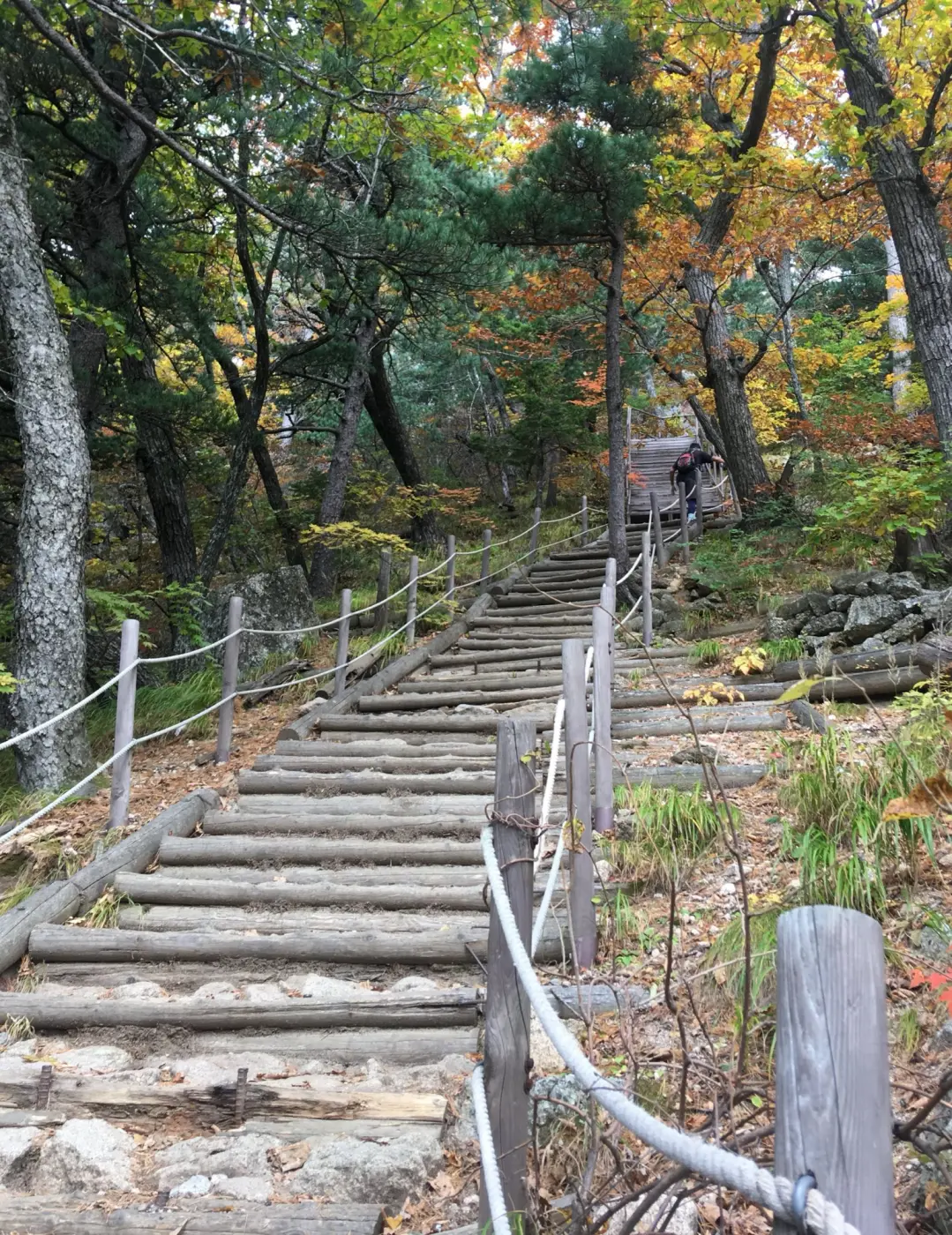
The big reason to bring good shoes in autumn is the foliage. Korea's mountains turn red and gold from late September, and KMA's normal peak for Seoraksan, the benchmark mountain in Gangwon, is 17 October. Even the hills at the edge of Seoul have proper trails: steep, rocky in places, and with long staircases like the one above. If a hike is on your list, pack shoes with real grip, a windproof layer for the top, and a water bottle. The mountains are colder and windier than the city streets below them.
Winter (December to February): dress for the wind
Korean winters are cold but usually bright. January is the coldest month in Seoul, averaging -1.9°C, with an average daily low of -5.5°C. Winter is also very dry: December to February together bring only around 5 per cent of the city's yearly precipitation. VisitKorea is blunt about it, saying you need to wear thick outerwear at all times, and it lists winter jackets, gloves and scarves, plus non-slip shoes for walking on snow.
The trick is to dress like the locals, in layers you can take off. Outside, the wind is what catches people out, so a hat and gloves matter more than an extra sweater. Inside, Korean buildings are heated generously and many homes and guesthouses have heated floors, so a thermal top under a jumper and a coat you can unzip will keep you comfortable in both. The dry air is hard on lips and hands; lip balm and a small tube of hand cream are among the most useful things in a winter bag.
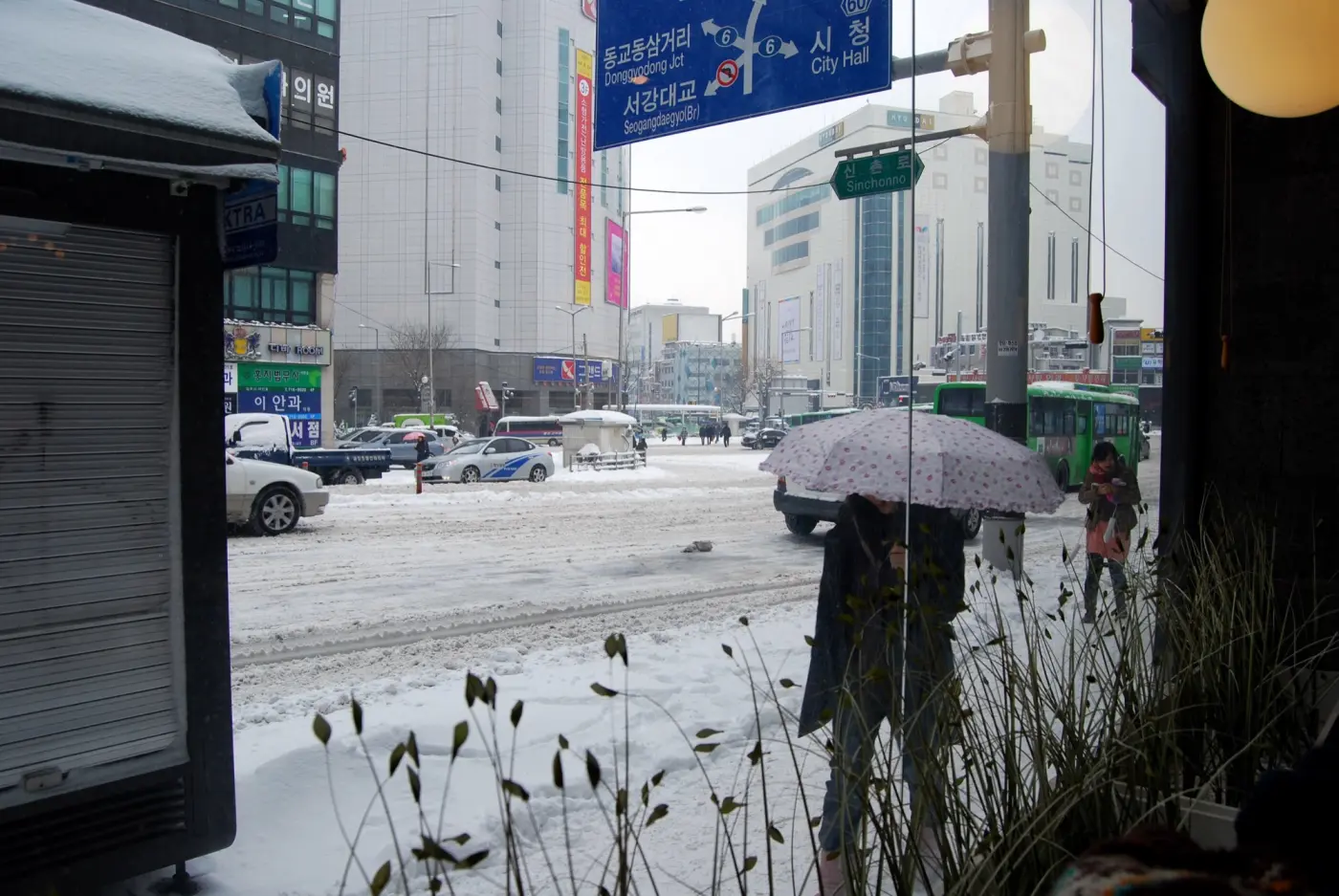
Do not count on snow. Seoul's first snow normally comes around 20 November, but a heavy fall like the one in the photo is a treat rather than a fixture. If you want reliable snow, the mountains of Gangwon are where the ski resorts are; pack for them separately rather than for Seoul.
Plugs and voltage: one adapter, then read your chargers
This is the item most often forgotten, and the official answer is simple. According to VisitKorea, the standard voltage in Korea is 220 volts at 60 hertz, and the outlet has two round holes. If you do not have a multi-voltage travel adapter, the same page says you can ask to borrow or buy one at your hotel's front desk, and that adapters are also sold at the airport, in retail stores, at major duty-free shops and even in convenience stores.
So the plug itself is easy to solve. The more important question is voltage. Most phone, tablet and laptop chargers are labelled with an input range such as 100–240 V, and those need only a plug adapter. Devices built for 100–120 V alone, which often includes hair dryers, hair straighteners and older small appliances from North America or Japan, should not be plugged into a 220 V socket through a simple adapter. Check the small print on each charger before you pack it, and if something is single-voltage, either bring a proper converter or leave it at home. One adapter with a couple of USB ports usually covers a whole family's phones overnight.
Shoes: built for walking, easy to slip off
Korea is a walking country. Subway transfers can involve long corridors and plenty of stairs, palace courtyards are wide and often gravelled, neighbourhoods like Bukchon climb steep lanes, and the mountain trails start at the edge of the city. Most visitors walk far more here than they do at home. Bring shoes that are already broken in; a new pair on day one is how blisters happen.
The second thing to know is that your shoes come off more often than you might expect. Visit Seoul's etiquette guide puts it plainly: take your shoes off at the door when entering any residence, temple or guesthouse. The same applies in many restaurants with floor seating, on a templestay, and in a jjimjilbang, the Korean bathhouse. Boots with long laces quickly become a chore when you are taking them off and putting them back on several times a day.
The ideal travel shoe for Korea is something comfortable enough for a long day on foot that you can also slip on and off without sitting down: trainers with elastic laces, loafers, or a pair you can loosen easily. Pack socks you are happy for strangers to see, without holes, because you will spend time in them on temple floors and restaurant cushions. In summer, a pair of sandals is useful, but keep a pair of socks in your bag for the moments when bare feet feel too casual.
Masks for fine dust days
Air quality is something people here check every morning, alongside the weather. It is reported as one of four grades, and our fine dust guide explains what each word means. On days when the grade is bad, AirKorea, the national air quality service, advises people to cut down on time outdoors and, when going out, to wear a health mask certified by the Ministry of Food and Drug Safety, graded KF80, KF94 or KF99. It also advises people with lung conditions to talk to a doctor before using one.
You do not need a suitcase full of masks. A handful in a zip bag is enough for most trips, and if you would rather buy them here, look for the KF mark on the packet. Spring is the season when you are most likely to need them, but a bad-air day can happen at other times of year too, so it is worth keeping one or two in your day bag whatever the month.
Medicines: bring your own, and check before you fly
Pack enough of any regular medication for the whole trip plus a few spare days, in its original packaging, with a copy of the prescription or a letter from your doctor. That is not a Korean rule so much as good practice: brand names differ from country to country, and a labelled box answers questions at customs and at a pharmacy far faster than loose tablets in a pill case. A small kit of the basics you already use at home, such as pain relief, plasters and anything for an upset stomach, saves a search on your first evening.
Two official points matter. First, the Korea Customs Service lists medicines that may be misused or abused among the goods travellers must declare on arrival, and VisitKorea's list of restricted items includes the same category. Second, if any of your medicines contains a narcotic or psychotropic substance, Korea's Ministry of Food and Drug Safety requires you to get its approval before you bring it in. That rule has applied since 23 October 2009, it covers everyone regardless of nationality, and since 27 December 2024 you can apply online. If you are not sure whether a medicine falls into that group, ask your doctor or pharmacist, and do it weeks before you travel, not at the airport.
Cash and cards
You can pack light on cash. VisitKorea's shopping guide says that at most Korean stores you can use an international credit card, naming Visa, Mastercard, JCB, American Express and UnionPay, without any purchase limit. The same page also says that some businesses, such as traditional markets and street shops, may only accept cash, and advises visitors to carry a little. A modest amount in small notes covers markets, street food and topping up a transit card. Bring two cards from different networks and tell your bank you are travelling. Our money guide explains ATMs, exchange counters and transit cards in detail, so we will not repeat it here.
Toiletries: what your room may not have
If you are used to hotels laying out a toothbrush, a razor and little bottles of shampoo, Korea has changed. Under the Act on the Promotion of Saving and Recycling of Resources, from 29 March 2024 lodging businesses with 50 or more rooms may not give out disposable items such as toothbrushes for free. Hotels can still sell them, but they are no longer something to rely on. Smaller guesthouses and hanok stays set their own policies, which vary a lot.
The easy fix is to pack a small wash bag with a toothbrush, toothpaste and razor, plus any shampoo or skincare you are particular about. Everything else, from sunscreen to face masks, is easy to find in Korea, and many visitors deliberately leave space in the suitcase for Korean skincare on the way home.
What you can easily buy after you land
Do not overpack for emergencies. The Korea Tourism Organization notes that many convenience stores, restaurants and ATMs are open 24/7 all year round, so you can buy food and drinks, withdraw cash and charge a transportation card even in the small hours. Transit cards such as T-money can be bought and loaded at convenience stores nationwide, plug adapters are sold in convenience stores, and VisitKorea says the major convenience store chains also sell physical SIM cards, although stock varies by branch.
In practice, that means your carry-on only needs one day's worth of essentials: your medicines, a charger and adapter, a change of clothes and your documents. If your checked bag is delayed or you forgot something, a short walk to the nearest store marked 24시 will usually solve it. Our convenience store guide explains what is on the shelves and how to use them, and our first-hours guide walks through your arrival step by step. If you want everything for day one in a single place, our PDF guide Korea, The Basics collects it.
Printable packing checklist
- Passport, with a photo or copy stored separately on your phone.
- Clothes for the season, packed as layers (see the table above).
- Comfortable walking shoes that are already broken in.
- Shoes or sandals you can slip on and off easily, and socks without holes.
- A plug adapter for two round pins; check every charger says 100–240 V.
- A compact umbrella (essential from June to September).
- A few KF80 or KF94 masks, especially in spring.
- Your regular medicines in original packaging, with a prescription copy; MFDS approval first if any contains a controlled substance.
- A small first-aid kit with the basics you use at home.
- Toothbrush, toothpaste and razor, since larger hotels no longer hand them out free.
- Two payment cards from different networks, and a little cash in small notes.
- Sun protection and sunglasses (spring and summer).
- Hat, gloves, scarf, lip balm and hand cream (winter).
- Hiking shoes with grip and a windproof layer if you are heading into the mountains.
- A refillable water bottle.
- Some empty space in your suitcase for the things you will buy here.
That is genuinely all you need. Korea rewards travellers who arrive with comfortable shoes, the right layers and a plan for the plug, and it is forgiving about almost everything else. Pack light, leave room for what you find here, and spend your first evening walking rather than shopping for things you left at home.
Comments
Sign in to leave a comment.
Sign in ·No account? Create one
Confirm your email address to comment — it takes one click.
No comments yet.