
Money in Korea: Cash, Cards and Transport Cards
Where foreign cards work in Korea, where cash still wins, how to get won and top up T-money, and why you never need to tip. A practical guide from locals.
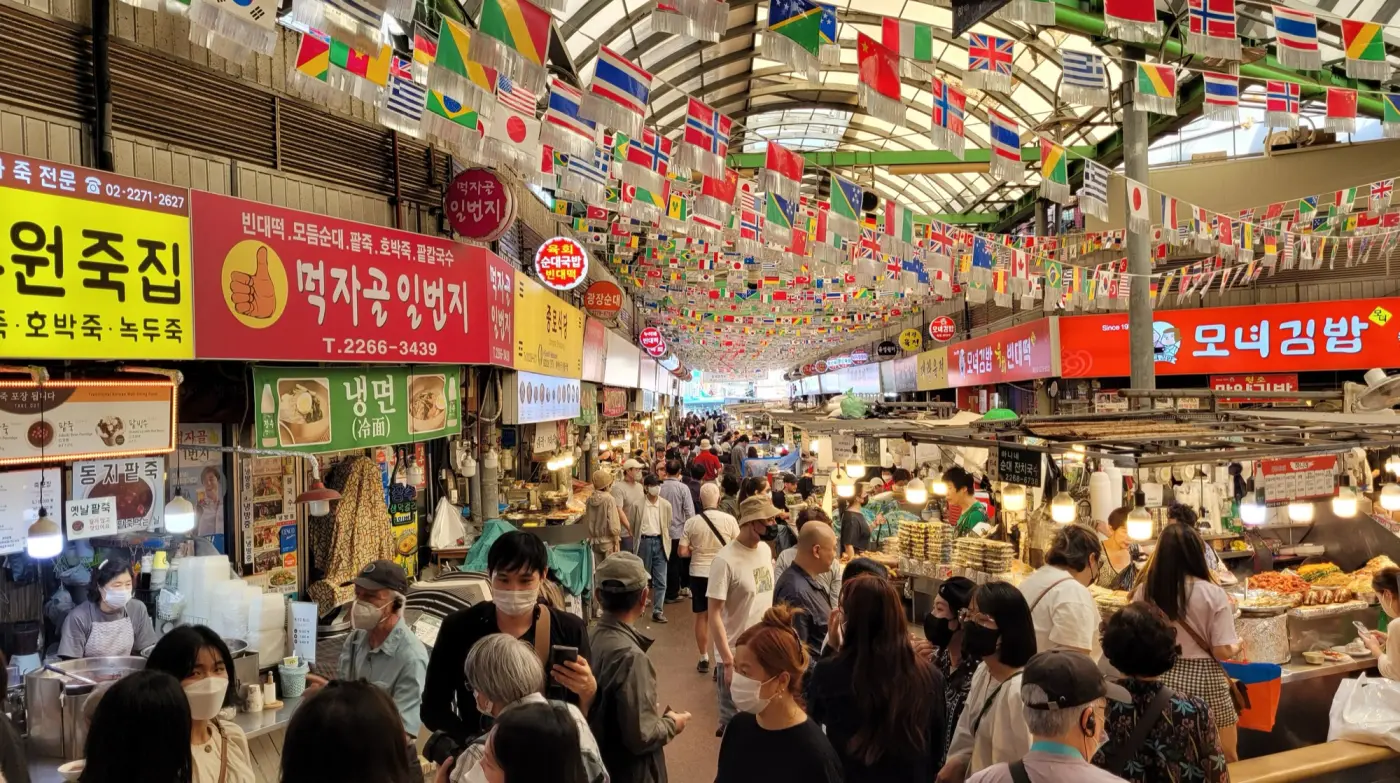
Most first-time visitors arrive in Korea with one of two worries: that they will need a wallet full of cash, or that their card will be refused somewhere awkward. The truth sits in between. In cities, you can pay for almost everything with a card, from a convenience-store coffee to a department-store jacket. But there are still a few places, mostly small and old and often the most interesting ones, where cash is what people expect.
This guide is written by people who live here and pay for things here every day. It covers where your foreign card works and where it may not, how to get Korean won without stress, how transit cards fit in, what to do about tips and split bills, and the small habits that keep you out of trouble. Wherever we give a rule, a number or a date, it comes from an official Korean government or tourism page, listed at the end. Where we could not confirm something on an official page, we have left it out rather than guess.
The one-minute version
| Situation | Card OK? | Cash? | Tip |
|---|---|---|---|
| Convenience stores, chain cafés, department stores | Usually yes | Accepted | No |
| Sit-down restaurants | Usually yes, paid at the counter | Accepted | No; upscale places may add a service charge to the bill |
| Traditional market stalls | Sometimes; some are cash only | Bring small notes | No |
| Street food carts | Often cash only | Bring small notes and coins | No |
| Taxis | Most accept cards or a transit card | Accepted | Not expected; letting the driver keep the change is appreciated |
| Subway and city buses | Not by tapping a foreign card; you tap a transit card | Used to top up the transit card | Not applicable |
| Topping up a T-money card | Usually not | Yes, the simplest way | Not applicable |
| Seoul Climate Card short-term pass | Yes, at the new machines on Lines 1 to 8 (since 17 March 2026) | Also accepted | Not applicable |
| Large hotels | Yes | Accepted | Not expected; a service charge may be on the bill |
Cards: where they work, and where they stop
Korea is one of the easiest places in Asia to travel on plastic. The Korea Tourism Organization's own shopping guide says that at most Korean stores you can use an international credit card, naming Visa, Mastercard, JCB and American Express among others, without any purchase limit. In practice that means you can buy a single bottle of water with a card, and nobody will sigh at you for doing it. Chain coffee shops, convenience stores, supermarkets, cinemas, museums and most restaurants in the cities all take cards as a matter of course.
Paying usually happens at a counter rather than at your table. In a restaurant you take the bill to the cashier near the door when you leave; in a shop you hand the card over or insert it yourself and follow the screen. Using both hands to hand over a card or cash is a small courtesy that Koreans notice, and it costs nothing.
The same VisitKorea page is honest about the exceptions: some businesses, such as traditional markets and street shops, may only accept cash, and it advises visitors to have a little cash on hand before going. That matches what we see every week. A modern stall in a famous market may have a card reader taped to the counter; the grandmother selling vegetables three rows back may not. Neither is being difficult. It is simply how small, family-run trade has always worked.
Two things are worth doing before you fly. Tell your bank you are travelling, so the first payment in Seoul is not blocked as suspected fraud, and bring a second card from a different network in case one is refused. Neither is a Korean rule; both are the kind of preparation that saves an evening.
Why some places still want cash
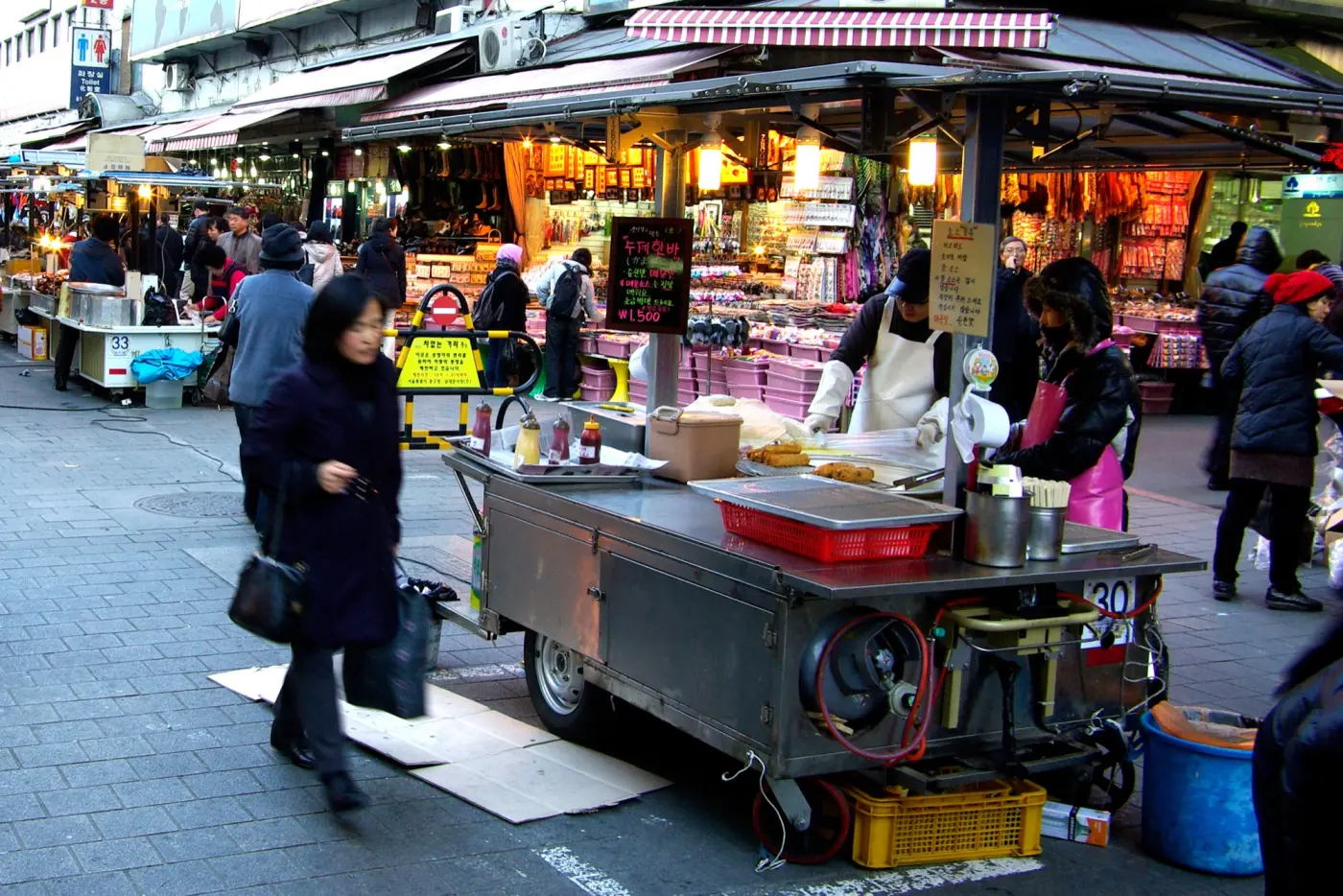
Think of cash in Korea as something you need for a handful of situations rather than every day. The common ones are traditional markets, street food carts, some very small family restaurants, and occasionally an older shop where the owner simply prefers it. None of these are rules. Plenty of market stalls take cards now, and plenty of carts do not. The polite move is to ask before the seller starts wrapping things up, not after. "Kadeu doenayo?" (Do you take cards?) is the phrase, and a shake of the head is not rude; it just means cash.
Taxis are less of a worry than many visitors expect. VisitKorea's taxi guide says passengers can pay with cash, a credit card or a transportation card, and that most taxis charge by the meter and do not require tips. Still, keep a few notes on you in case a card reader is not working. It happens rarely, but it always happens late at night.
Korean money comes in notes of 1,000, 5,000, 10,000 and 50,000 won, and coins of 10, 50, 100 and 500 won. Visit Seoul notes that 1 and 5 won coins exist but are not widely circulated, so you will probably never see one. The notes worth hoarding are the 1,000 and 5,000 won ones. Paying for a single skewer of fish cake with a 50,000 won note is possible, but it can empty a street vendor's change box, and you will feel it in the look you get.
Getting won: ATMs and currency exchange
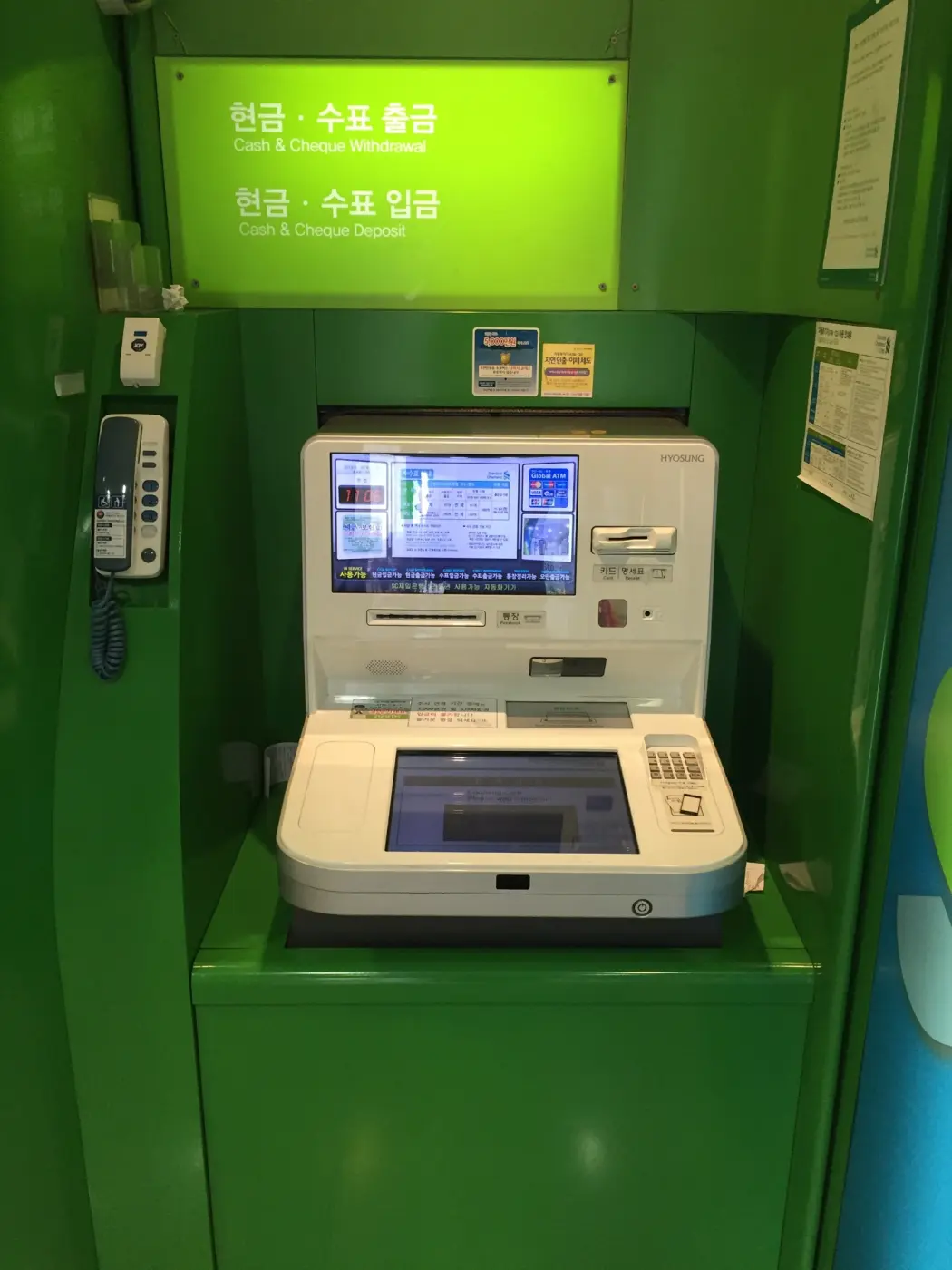
The easiest way to get won is usually an ATM. Visit Seoul, the city's official tourism site, says ATMs that accept international cards are common and are marked with a "Global" sign or the logos of the card networks they accept, and that most offer menus in English, Chinese and Japanese. You will find them in bank branches, subway stations and shopping areas. The same page says ATMs typically run until 23:00 and many are open around the clock, while ATMs in convenience stores often charge higher transaction fees. Your own bank will charge its own fees too, so it is worth checking before you leave home rather than at the machine.
If you prefer to bring cash from home, exchanging it is easy. Visit Seoul says banks usually offer the best exchange rates, and that most banks keep hours of roughly 09:00 to 16:00. Outside those hours, government-certified exchange booths, usually found where international visitors gather, display a sign with the word "Certified" and currency symbols. The advice on the official page is plain: avoid uncertified booths.
At Incheon International Airport, VisitKorea says money exchangers standardly open from 06:00 to 22:00, with some locations open 24 hours (the page was last updated on 11 September 2026). Changing a modest amount on arrival, enough for a transit card top-up and a market lunch, and doing the rest later is a comfortable plan. We do not print exchange rates or fees here: they move daily and differ by counter.
Transit cards: T-money and the rest
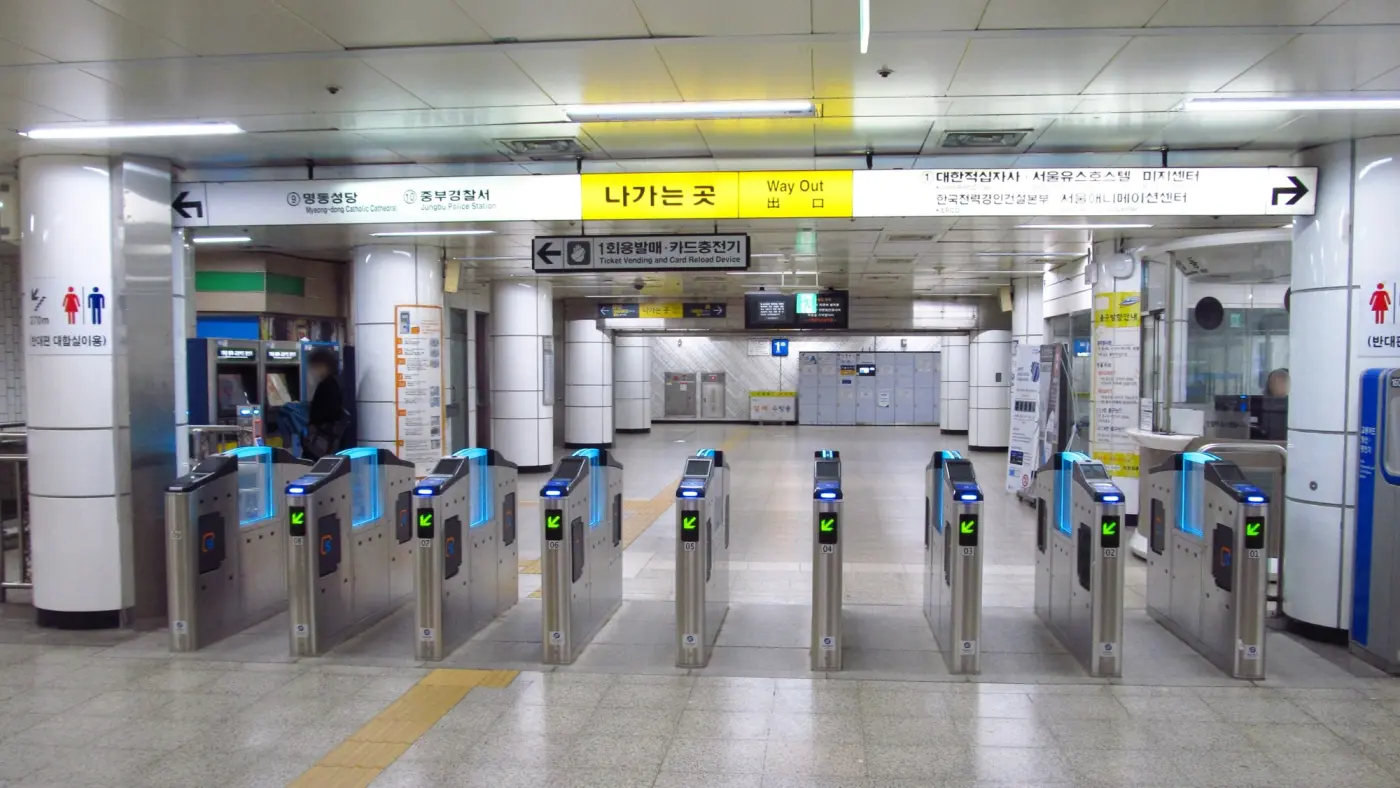
Here is the one place where your foreign contactless card will not simply work: you cannot yet tap it on a Seoul subway gate or bus reader the way you might in London or New York. The Seoul Metropolitan Government announced in October 2025 that it will move gradually, between 2025 and 2030, to an open-loop system that accepts overseas cards directly. Until that arrives, you ride with a prepaid transit card.
The best known is T-money. According to VisitKorea, you can buy one at convenience stores across the country and at information centres in Seoul subway stations on Lines 1 to 8, and reload it at convenience stores or at the ticket machines inside subway stations. It works on public transport, in taxis, and at shops showing the T-money logo. Think of it like a Suica or Oyster card: you load money first, then tap.
Topping up is where cash matters. In that same October 2025 announcement, the Seoul government itself acknowledged that travellers still had to buy and reload transit cards with cash. Since 17 March 2026, 440 new machines at 273 stations on Lines 1 to 8 accept internationally issued credit and debit cards, but Seoul says this applies to buying Climate Cards, recharging their short-term passes and buying single-journey tickets. For an ordinary T-money top-up, a few 10,000 won notes at a convenience-store counter or station machine remain the simplest route. Seoul also said in 2025 that Android phone users could already reload transit cards with an overseas card through a T-money app; we could not confirm an equivalent for iPhone on an official page, so we would not plan around it.
Two small things save trouble later. Tap your card when you get off a bus as well as when you get on, because fares and transfers depend on it; our transit guide explains why. And do not overload the card: VisitKorea notes that a remaining balance above 50,000 won can only be refunded at the T-money office near Seoul Station, so load what you expect to spend.
Seoul's Climate Card short-term pass
If you will be riding a lot inside Seoul, the city's Climate Card offers short-term passes of 1, 2, 3, 5 and 7 days with unlimited rides on Seoul's subway lines and Seoul-licensed buses. Since 1 October 2026, Seoul says the short-term passes cover travel within Seoul plus trips ending at Incheon International Airport, while the neighbouring Gyeonggi cities that used to be included are no longer covered. The city's main page also lists exclusions such as the Sinbundang Line and intercity and airport buses, and if you get off outside the service area, the station staff collect the fare. On the airport railway you may get off at Incheon Airport Terminals 1 and 2, but you cannot board there with it.
The fine print matters. A short-term pass starts on the day you load it, so you cannot charge it in advance; a 1-day pass loaded on a Monday runs until that Monday's last bus or train. The physical card is sold separately from the pass. Since 17 March 2026 you can buy and recharge it with an international card at the new machines, with Seoul stating an average service fee of about 3.7 per cent. If you forget to tap off twice, use is suspended for 24 hours. Note too that the new Climate Pass launched in September 2026 is a separate product based on Seoul residence, not a tourist pass. Rules for these cards changed several times in 2026, so check the official Seoul page just before you travel.
Prepaid tourist cards and mobile payments
VisitKorea also lists prepaid cards made only for foreign visitors. WOWPASS, for example, is bought with a passport, can be loaded with won or with foreign currencies such as US dollars and Japanese yen at its kiosks, and then works as a transit card and a payment card at affiliated stores. Whether one suits you depends on how you like to travel; a regular T-money card plus your own credit card covers most trips perfectly well.
Korean mobile wallets and many Korean apps are a different story. They are largely built around a Korean phone number and a card issued in Korea. VisitKorea makes the point directly when describing taxi apps: other apps can require a Korean number to register and only accept bank cards issued in Korea, which is why it points visitors to foreigner-oriented taxi apps that accept overseas cards. If an app asks for a Korean resident number or a Korean bank card at sign-up, it is not built for short visits, and that is not something you have done wrong.
Tipping, service charges and splitting the bill
"Tipping is not required or expected in Korea." — VisitKorea
That line from the Korea Tourism Organization is the whole policy. The price on the menu is what you pay, and leaving coins on the table is more likely to send a server running after you than to please anyone. Visit Seoul adds two useful details: many major hotels and upscale restaurants add a 10 per cent service charge to the bill, on top of VAT, and taxi drivers do not expect tips but do appreciate it if you let them keep the change.
Splitting a bill works differently from many Western countries because payment happens at the counter. Very often one person pays for the whole table and the others settle up later; that is how Korean friends and colleagues commonly do it. If you would rather pay separately, it is usually fine to say so at the counter, ideally before the cashier has rung up the whole table. In a busy lunch spot, having one person pay and splitting by bank app or cash afterwards is the kinder option for the queue behind you.
Tax refunds, briefly
Many purchases include a 10 per cent VAT, and foreign visitors can claim some of it back at shops displaying a "Tax Free" sign. The basic idea, as Visit Seoul describes it, is to show your passport when you pay, keep the paperwork the shop gives you, and present it with the goods at customs when you leave. Some purchases are refunded on the spot instead. Our tax refund guide walks through the three steps and the limits, including why the goods should stay in your hand luggage until customs has seen them.
Scams and slip-ups to avoid
Korea is a low-hassle place to handle money, and most problems are mistakes rather than crimes. A few habits cover nearly everything:
- Exchange money only at banks, airport counters or government-certified booths showing a "Certified" sign. Visit Seoul specifically advises against uncertified booths.
- At the airport, take a taxi from the official stand outside arrivals, and politely ignore anyone who approaches you inside the terminal offering a ride.
- Use ATMs in bank branches, stations or busy areas, shield your PIN, and take your card and receipt before you walk away.
- Look at the amount on the card terminal screen before you confirm, and keep the receipt for anything large.
- Count your change at market stalls without making a show of it; a quick look is normal, not rude.
- If something goes wrong, the Korea Travel Hotline answers 24 hours a day on 1330 inside Korea, or +82-2-1330 from abroad.
A simple money plan for your first trip
- Before you fly: tell your bank, pack two cards from different networks, and check your bank's overseas ATM fees.
- At the airport: change a modest amount or use a Global ATM, buy a T-money card, and load it with cash.
- In the city: pay by card almost everywhere, but keep 1,000 and 5,000 won notes for markets, street food and top-ups.
- If you are staying in Seoul and riding a lot, compare a Climate Card short-term pass with plain T-money.
- Before you leave: use up or refund your transit card balance, and finish any tax refund at customs before checking your bags.
Get those few things right and money stops being something you think about. You tap in, you pay at the counter, you skip the tip, and the only cash you really need is the handful of notes that buys you the best hotteok in the market.
Comments
Sign in to leave a comment.
Sign in ·No account? Create one
Confirm your email address to comment — it takes one click.
No comments yet.