
How to Eat Korean BBQ Like a Local: A First-Timer's Guide
Pork or beef, portions, who grills, how to wrap a ssam, what to drink and how to finish: a local walkthrough of your first Korean barbecue dinner.
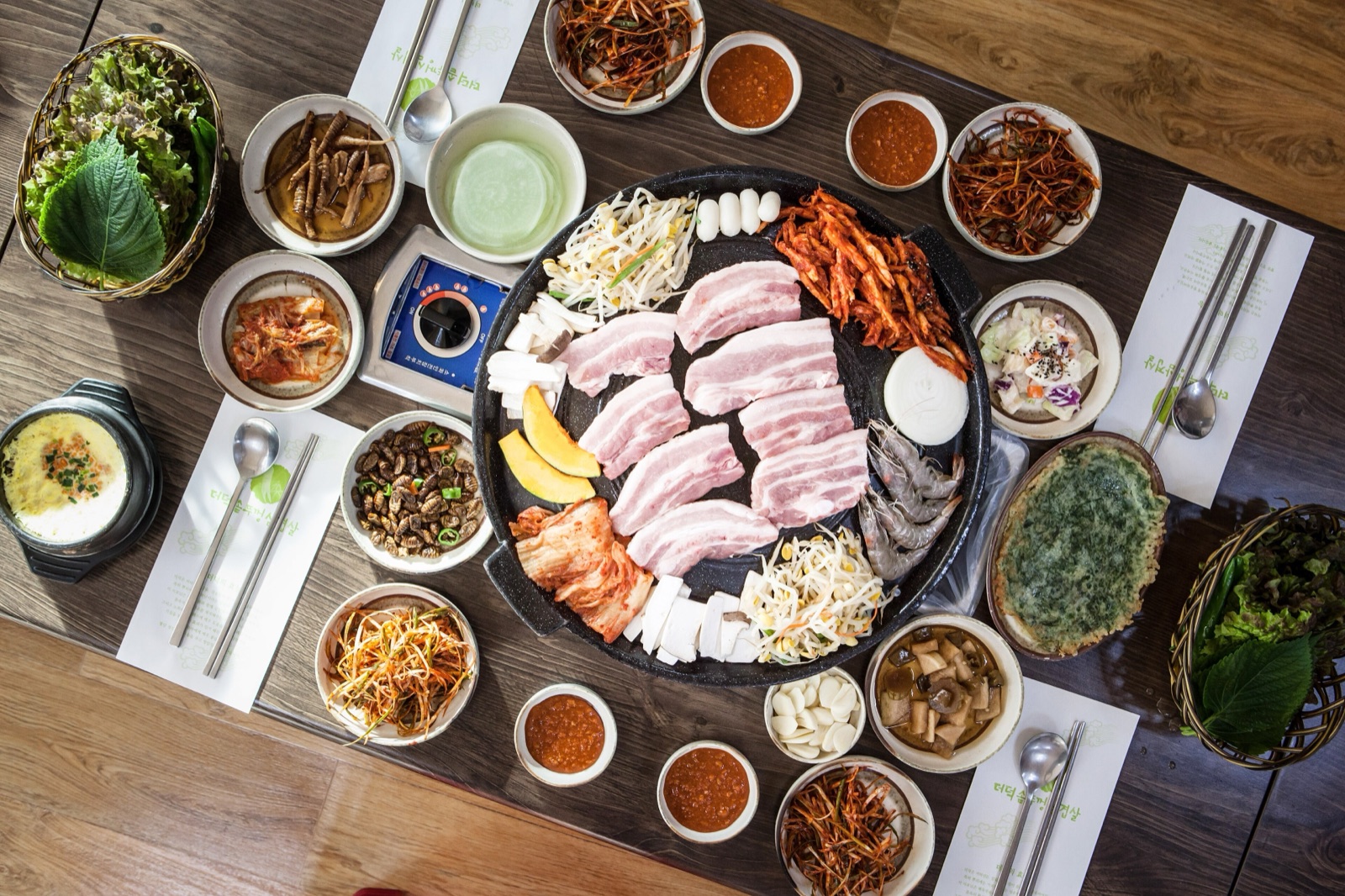
Korean barbecue is probably the meal you decided to eat before you even booked the flight. It is also the one that confuses first-timers most. There is a grill in the middle of the table, a dozen small dishes arrive that nobody ordered, someone hands you a pair of scissors, and the menu does not seem to have a simple "one person" option. Locals move through all of it without thinking. This guide walks you through a typical evening at a Korean barbecue restaurant, from choosing where to go to walking back out of the door, so that you can do the same.
Koreans call these places gogi-jip, which simply means "meat house". The Korea Tourism Organization describes them as more than restaurants: a whole culture in which you grill meat at your own table and eat it with side dishes, stews and noodles. The reassuring part is that the culture is friendly to beginners. Staff are used to helping, and almost every step below has an easy fallback if you get it wrong.
First decide: pork or beef
Most barbecue restaurants specialise. The sign outside, or the first lines of the menu, usually tell you whether a place is built around pork or beef. Pork houses are the everyday option: busy, loud, often full of colleagues after work, and the kind of place where samgyeopsal, grilled pork belly, is the default order. VisitKorea notes that pork belly is a popular choice for company get-togethers, and you will see exactly that on any weekday evening. Beef houses, especially those built around galbi (short ribs) or Korean hanu beef, tend to be calmer, more expensive and more of an occasion.
If you are unsure, start with pork. Samgyeopsal is not marinated, so you taste the meat and the dips, and it is hard to ruin on the grill. Moksal, the shoulder cut, is the leaner alternative that many Koreans order alongside it. Marinated meats such as galbi are wonderful but burn more easily, which is one reason staff often take over the grilling at galbi restaurants.
| Korean name | What it is | How it is usually eaten |
|---|---|---|
| 삼겹살 samgyeopsal | Pork belly, unmarinated, with layers of fat and meat | Grilled plain, dipped in ssamjang or in sesame oil with salt, wrapped in lettuce with garlic |
| 목살 moksal | Pork shoulder; less fat than belly, firmer and chewier | Grilled with coarse salt, or dipped in sesame oil and salt |
| 돼지갈비 dwaeji-galbi | Pork ribs, usually in a sweet marinade | Grilled with care because the marinade chars; often followed by cold noodles |
| 양념갈비 yangnyeom-galbi | Beef short ribs marinated in soy sauce, sugar and garlic | Cut into bite-size pieces, eaten as is or wrapped in lettuce or perilla |
| 차돌박이 chadolbagi | Very thinly sliced beef brisket | Cooks almost instantly; eaten straight off the grill |
Ordering: think in portions
Barbecue menus list meat by the portion, called inbun (인분). One portion is one person's share of a single cut, and you order by saying how many you want: "i-inbun juseyo" means "two portions, please". Many restaurants expect a table to start with at least two portions, and some will not light the grill for a single one. This is a house habit rather than a rule, it varies from place to place, and it is sometimes written at the bottom of the menu. Ordering one portion per person to start is the safe default. You can always add more of the same cut, or try a different one, once the first plate is gone.
Notice how the number works: Koreans say "i" (two, from the Sino-Korean set of numbers) for portions, not "du". Our phrase page explains why. If the words will not come, pointing at the menu and holding up two fingers works perfectly well.
What arrives at the table
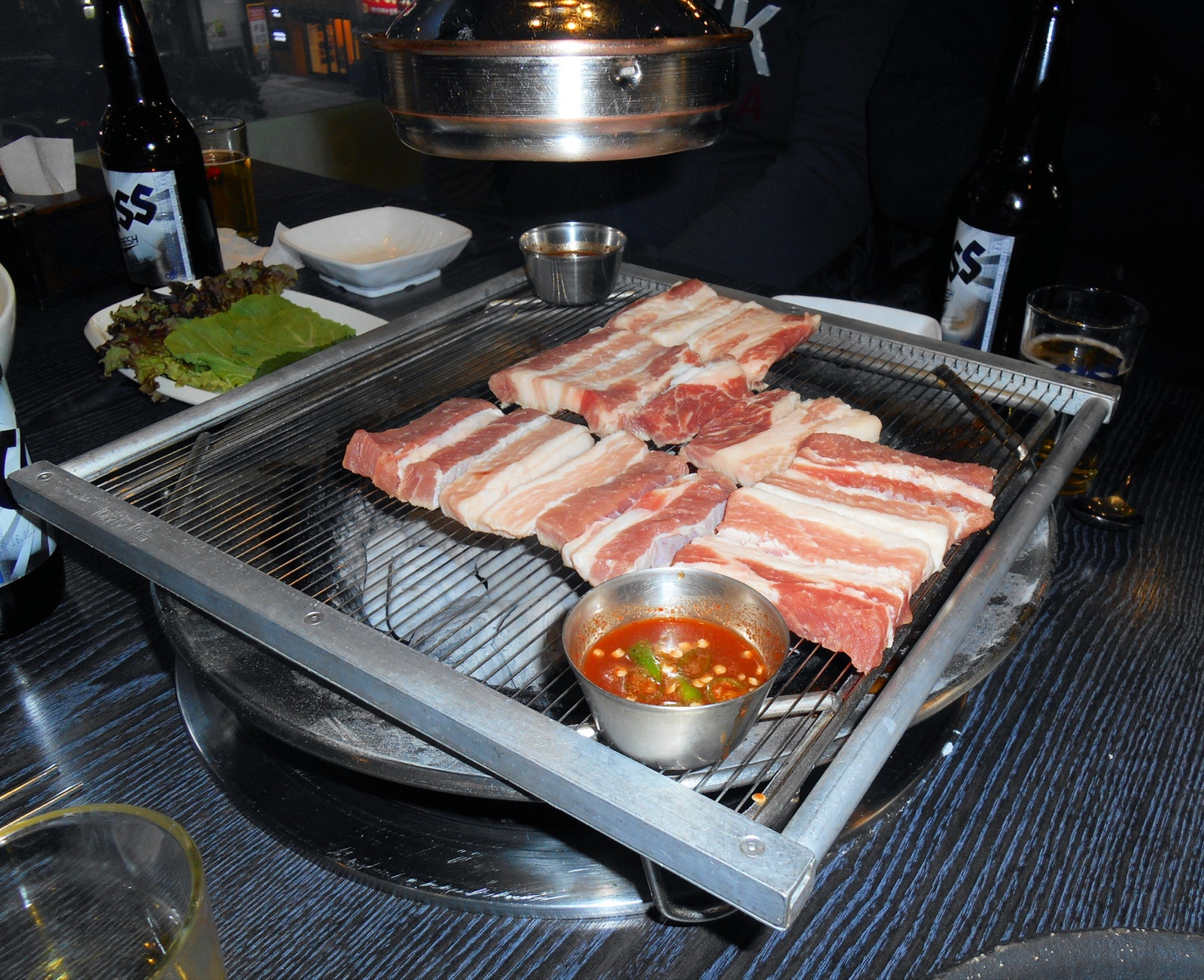
Before the meat arrives, the table fills up. A grill sits in the centre, over charcoal or gas, and most barbecue tables have an extractor hood or a vent that pulls the smoke away. VisitKorea points out a few details that make life easier: a call button on the table for summoning staff, a small drawer at the edge of the table holding spoons, chopsticks and napkins, and, at many barbecue places, chairs whose seats lift up so you can store your coat inside, away from the smoke.
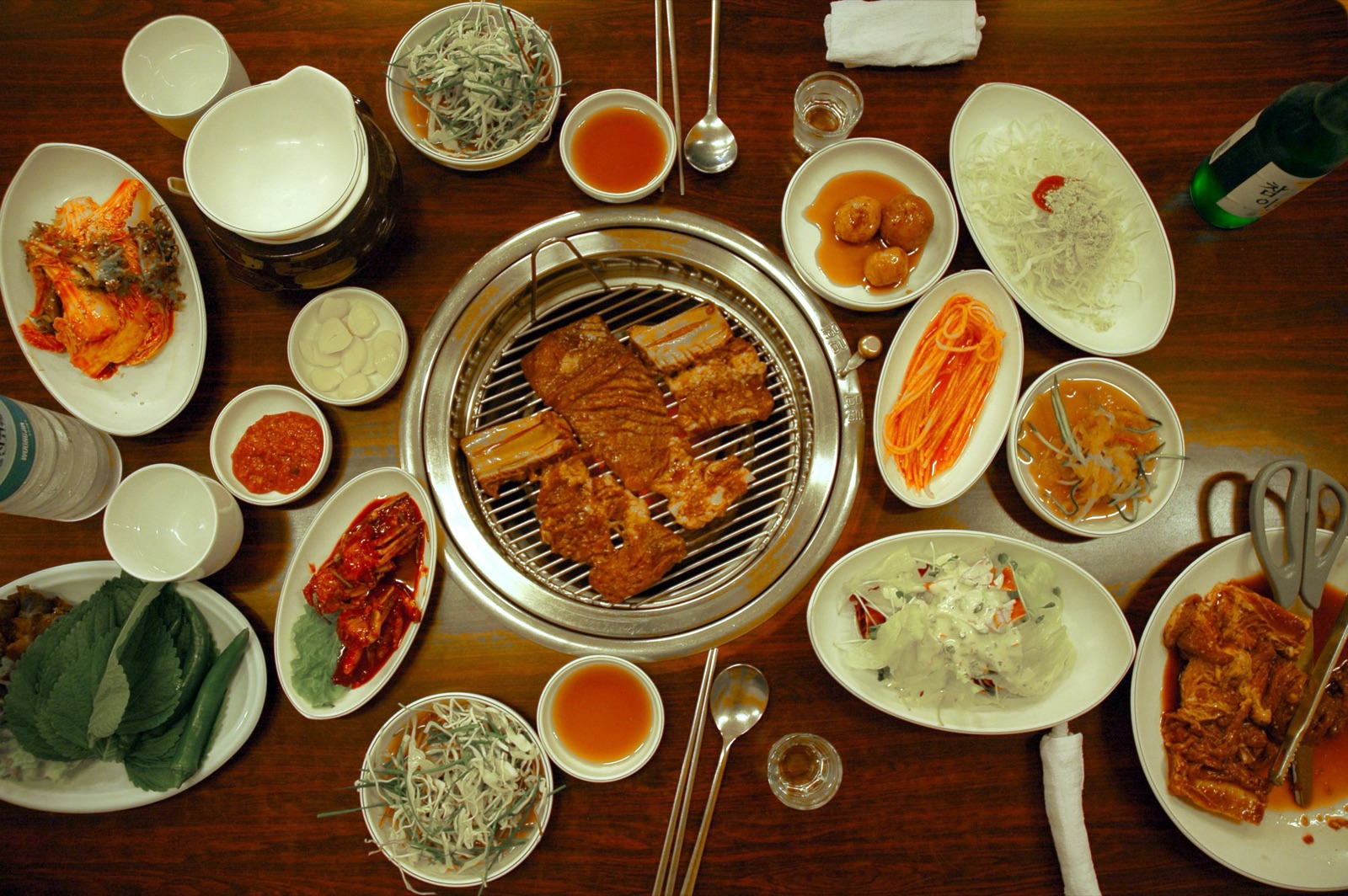
Then come the banchan, the small side dishes. At a barbecue restaurant they typically include kimchi, a dressed green-onion salad, pickles, raw garlic and green chilli, a basket of lettuce and perilla leaves, and two or three dips. They come with the meal; you did not forget to order them. VisitKorea states that asking for more water or more side dishes does not cost extra, and that a growing number of restaurants let customers serve themselves. If you spot a fridge or a counter of side dishes near the kitchen, that is what it is for.
Who does the grilling?
This is the question that worries first-timers most, and the answer depends on the restaurant. At many neighbourhood pork places you grill the meat yourself, with tongs and a pair of kitchen scissors. At galbi houses and at pricier beef restaurants, staff often cook the meat for you, at least to begin with. VisitKorea describes the moment nicely: at some places staff grill the meat, and when they tell you it is ready, you start wrapping. Even at self-grill places a server will often step in to turn and cut the first round, especially if they can see you are new. That is help, not a correction. Let them.
The scissors surprise almost every visitor. Large pieces go onto the grill whole, and once they are browned someone holds them with tongs and snips them into bite-size pieces right over the heat. A German food journalist interviewed by Korea.net after a barbecue tour said the most impressive thing on his trip was simply the scissors, and he pointed out the logic: you eat with chopsticks, so meat has to be cut before it reaches you. If your table did not get a pair, ask for scissors.
A few grilling habits worth copying: let the grill heat up before you lay the meat down; turn pork belly only once or twice so it browns rather than steams; push cooked pieces to the cooler edge so they do not burn; and put the garlic, kimchi or mushrooms that came with the set onto the grill too, where they soften in the pork fat. If the grill plate turns black and sticky, staff will usually swap it for a clean one when you ask.
How to build a ssam
Ssam means "wrap", and it is the heart of the meal. VisitKorea calls it a uniquely Korean way of eating: meat placed on fresh lettuce or perilla leaves with ssamjang, a paste of red chilli and soybean paste, and eaten in a single bite. Visit Seoul's etiquette guide even makes an exception for it: at a Korean table you avoid touching food with your fingers, except when you are wrapping food in leaves. Here is the routine.
- Lay a lettuce leaf on your open palm. Add a perilla leaf on top if you like its minty, slightly bitter taste.
- Add one piece of meat, dipped first in salt and sesame oil or topped with a small dab of ssamjang.
- Add extras: a slice of raw or grilled garlic, a piece of green chilli, a little green-onion salad or kimchi.
- Fold the leaf into a small parcel and eat it in one bite. Biting a wrap in half usually ends with the filling on the table.
The one-bite part matters. VisitKorea's own tip is to open your mouth wide and put the whole thing in at once. Make your wraps smaller than you think, and by the second round you will look like a local. Ssamjang is much stronger than it looks, so use a dab rather than a spoonful. Between wraps, eat a piece of meat on its own now and then; nobody wraps every single bite.
What to drink
The classic pairing is soju, the clear spirit in the green bottle, drunk from small glasses and often alongside beer. Many tables mix the two. Pouring follows the same customs as anywhere in Korea: you pour for others rather than for yourself, and you hold your glass with both hands when someone older pours for you. None of this is compulsory. Soft drinks and lemon-lime soda (called saida) are on almost every menu, and not drinking alcohol at all is completely normal. If you do drink, our guide to drinking rules explains the legal age and where you can and cannot drink.
The second act: noodles, rice or stew
Koreans rarely end a barbecue meal with the last piece of meat. A Korea.net feature on Suwon galbi describes the pattern: meat first, then noodles or rice afterwards. VisitKorea likewise talks about the soybean paste stew or fried rice you enjoy to finish. There are three common ways to round things off.
- Naengmyeon, cold buckwheat noodles, either in an icy broth (mul-naengmyeon) or tossed in a spicy sauce (bibim-naengmyeon). It is the classic finish after galbi, and the long noodles are cut with scissors in the bowl.
- Bokkeumbap, fried rice made on the grill plate itself with leftover meat, kimchi and the fat in the pan. Not every place offers it, so look for it on the menu.
- Doenjang-jjigae, soybean paste stew, usually with a bowl of rice. At many pork houses it is the default way to finish.
Order your finisher when you are down to the last few pieces of meat, so it arrives just as the grill is cleared. If you are full, sharing one bowl of noodles between two people is perfectly normal.
Calling staff, paying, and not tipping
Nobody will drop by to ask whether everything is all right, and that is not neglect. When you need something, press the call button on the table or say "jeogiyo" (excuse me) at a normal speaking volume; "yeogiyo" is used the same way. Both are ordinary here, not rude. Use the same call to order another portion, more lettuce, or another bottle. Note that VisitKorea warns the call bell can be louder than you expect.
When you are done, take the bill slip from your table, or simply walk to the counter by the door, and pay there; at most barbecue restaurants nobody brings a card machine to your seat. Often one person pays for the whole table and the group settles up later. And there is no tip. The Korea Tourism Organization puts it in one line: "Tipping is not required or expected in Korea." A cheerful "jal meogeotseumnida" (I ate well) on the way out is the local way to say thank you.
About the smell
Even under a good extractor hood, you will leave smelling of barbecue. Koreans know this, which is exactly why so many barbecue restaurants have chairs with storage under the seat. Put your jacket away as soon as you sit down, leave your favourite wool coat at the hotel, and avoid planning barbecue right before a smart dinner or a show if it bothers you. Airing your clothes overnight usually takes care of the rest.
Eating Korean barbecue alone
Barbecue is a group meal by design, and the two-portion habit is the main obstacle for a solo traveller. It is not an absolute barrier. Honbap, eating alone, has become an accepted part of Korean life, and Korea.net has reported on meat restaurants with bar seating and a small grill for each solo diner, appearing particularly in university districts and in Gangnam. Your best options are a place that lists single portions or a solo set, a lunch set at a galbi restaurant, or simply ordering two portions and enjoying a generous dinner. Avoid the busiest dinner hour, when a crowded pork house would rather give a four-seat table to a group, and if in doubt, ask at the door: "honjayeyo, gwaenchanayo?" (I'm on my own, is that okay?).
A first-timer's checklist
- Pick pork for an easy, lively first night; save beef galbi for an occasion.
- Order in portions, and expect many places to want two to start.
- Let staff grill if they offer; otherwise turn the meat rarely and use the scissors.
- Build small wraps and eat each one in a single bite.
- Side dishes and water are refilled at no charge; just ask.
- Finish with cold noodles, fried rice or soybean paste stew.
- Call staff with the button or "jeogiyo", pay at the counter, and do not tip.
Korean barbecue looks complicated from the doorway, but it is one of the most relaxed meals in the country. The grill does the work, the staff fill the gaps, and the people at the next table are doing exactly what you are doing: talking, wrapping and ordering one more portion. Sit down, watch for a minute, and join in.
Comments
Sign in to leave a comment.
Sign in ·No account? Create one
Confirm your email address to comment — it takes one click.
No comments yet.