
Seoul at Night: Night Views and Evening Things to Do
Where to spend an evening in Seoul: Namsan, Naksan Park, Cheonggyecheon, palaces open until 9 p.m., DDP, night markets, and getting back after the last train.
Seoul does not shut down when the sun goes down. Office districts empty out, but the stream through downtown fills with people walking, two palaces stay open until nine, a mountain in the middle of the city keeps its cable car running until late, and old industrial alleys turn into some of the busiest drinking streets in town.
This guide is a practical map of Seoul after dark: where to see the city lit up, which places are open at night and until when, which ones are seasonal and ticketed, and how to get back to your hotel once the subway stops. Opening hours below come from official pages that were checked in October 2026, and where official sources do not agree, the guide says so instead of picking a number. The Han River parks and the Banpo Moonlight Rainbow Fountain are not repeated here; they have their own guide.
Seoul at night at a glance
| Place | What it is like at night | Nearest station and exit | When |
|---|---|---|---|
| Namsan: N Seoul Tower and cable car | The whole city spread out below the tower at the summit | Chungmuro (Lines 3/4) Exit 2, then Namsan Circular bus 01 | Cable car 10:00–23:00. Tower 10:00–22:30 on weekdays, 10:00–23:00 at weekends |
| Naksan Park and the City Wall | The old stone wall on a low hill, with the city lights below | Hyehwa (Line 4) Exit 2, about 15 minutes on foot to the top of the park | Open 24 hours, free |
| Cheonggyecheon | A sunken stream path under city lights, with free media art near Gwanggyo Bridge | City Hall (Lines 1/2) Exit 4; Jonggak (Line 1) Exit 5 for the media art | Path open 24 hours (may close in rain). Media art 18:00–22:00 until 31 Dec 2026 |
| Deoksugung Palace | A palace open into the evening, between office towers | City Hall (Lines 1/2) Exit 1 | 09:00–21:00, last entry 20:00. Closed Mondays |
| Changgyeonggung Palace | Evening visitors are moved to a lit zone around the main hall, pond and glasshouse | Hyehwa (Line 4) Exit 4, about 780 m | 09:00–21:00, last entry 20:00. Closed Mondays |
| Gyeongbokgung and Changdeokgung night programmes | Ticketed evening entry, with lanterns and performances at Changdeokgung | Check the programme notice | Seasonal only. The autumn 2026 programmes have ended |
| Dongdaemun Design Plaza (DDP) | A curved silver building lit up, with seasonal light shows | Dongdaemun History & Culture Park (Lines 2/4/5) Exit 1 | Indoor spaces about 10:00–20:00, varying by space |
| Ikseon-dong | Small hanok houses turned into cafés and restaurants, lit after dark | Jongno 3-ga (Lines 1/3/5) Exit 4 | Evenings; each shop sets its own hours |
| Euljiro and Nogari Alley | Tool shops close, neon comes on, plastic tables fill the street | Euljiro 3-ga (Lines 2/3) Exit 3 | Evenings; busiest after work |
Namsan: the classic night view
Namsan is the mountain in the middle of Seoul, and N Seoul Tower at its summit is the obvious place to see the city at night. Visit Seoul describes the tower as 236.7 metres tall on a 262-metre mountain, with its observation level about 480 metres above sea level. It lists the tower as open every day of the year, from 10:00 to 22:30 on weekdays and 10:00 to 23:00 at weekends, with last entry 30 minutes before closing. Visit Seoul names the Locks of Love railings among its best-known sights.
There are three usual ways up. The Namsan cable car, which its operator says opened on 12 May 1962 as Korea's first passenger cable car, covers about 600 metres in roughly three minutes each way. The operator lists it as running from 10:00 to 23:00 every day, with the last ticket sold 30 minutes before closing, and warns that it can stop or close early in bad weather. The second option is the Namsan Circular bus 01, which Visit Seoul says you can catch from Chungmuro Station (Lines 3 and 4), Exit 2, to the stop near the tower. The third is to walk up on Namsan's park paths, which takes longer.
If you want both the daylight and the night view, go up a little before sunset and stay until the city lights come on. Our 3-day Seoul itinerary builds a whole evening around exactly that, with Myeongdong beforehand, so there is no need to repeat the details here. On a low-cloud or hazy evening the view can be limited, so look at the sky before you commit to the trip up.
Naksan Park and the City Wall: the quieter view
If Namsan is the famous night view, Naksan is the lower, quieter alternative. Naksan was one of the four mountains inside the walls of Joseon-era Seoul, and at 124 metres it is the lowest of them, according to the Seoul City Wall site. The old fortress wall still runs along its ridge, and Visit Seoul describes the park as famous for its night views and the wall: after dark you can walk beside the stones and look out over the lit-up rooftops of the city at the same time.
Visit Seoul lists Naksan Park as open 24 hours a day and free. The official City Wall site rates the Naksan section, from Hyehwamun Gate to Heunginjimun (Dongdaemun Gate), as one of the easier ones: about 3.2 km, around an hour, two stars out of five for difficulty. For the top of the park, it suggests Hyehwa Station (Line 4) Exit 2 and about 15 minutes on foot, uphill through the streets of Daehak-ro. Coming from the other end, Dongdaemun Seonggwak Park is about two minutes from Dongdaemun Station Exit 10, and the wall leads you up from there.
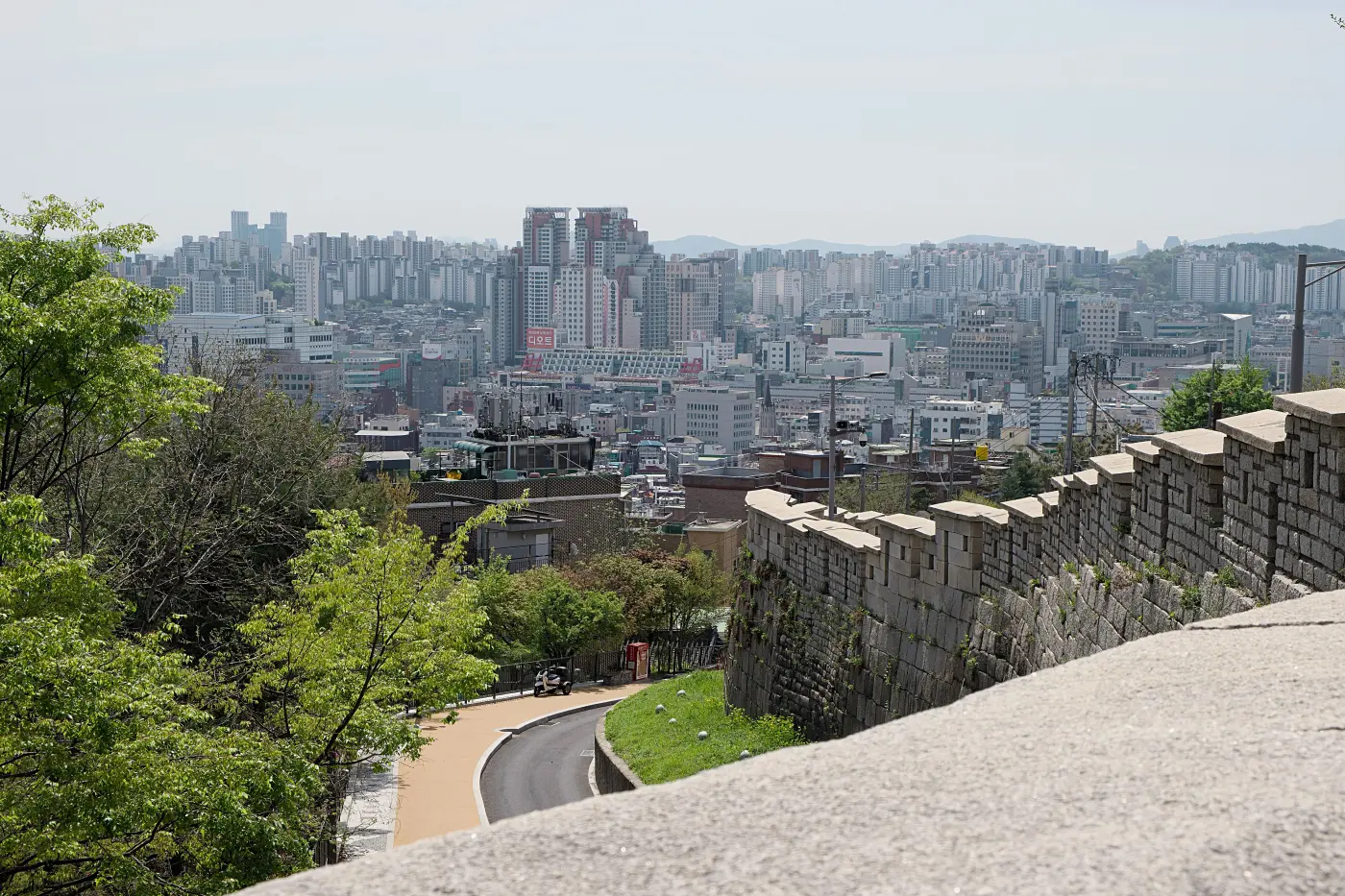
Two things are worth knowing. First, the path runs past homes, including Ihwa Village on the inside of the wall, and the City Wall site asks walkers to keep their voices down for the residents. At night that matters even more. Second, the hill is low but the streets up to it are steep, so wear shoes you can climb in. Hiking fans can continue along other sections of the wall in daylight; our Seoul hiking guide covers them.
Cheonggyecheon: a downtown stream walk
Cheonggyecheon is the easiest night walk in Seoul. According to Visit Seoul, the 11 km stream was covered by an elevated highway after the Korean War, and the highway was removed in 2003 to restore it. It starts at Cheonggye Plaza, passes under 22 bridges and eventually flows into the Han River. The promenade sits below street level, so the traffic noise fades as soon as you walk down the steps, and the stone banks are made for sitting.
The promenade is open 24 hours a day, but Visit Seoul notes that access may be restricted in rain for safety reasons. On a wet evening, stay at street level. The nearest station to the start is City Hall (Lines 1 and 2), Exit 4, and Visit Seoul lists eleven stations along the stream in total, so you can walk as far as you like and simply climb out at the next one.
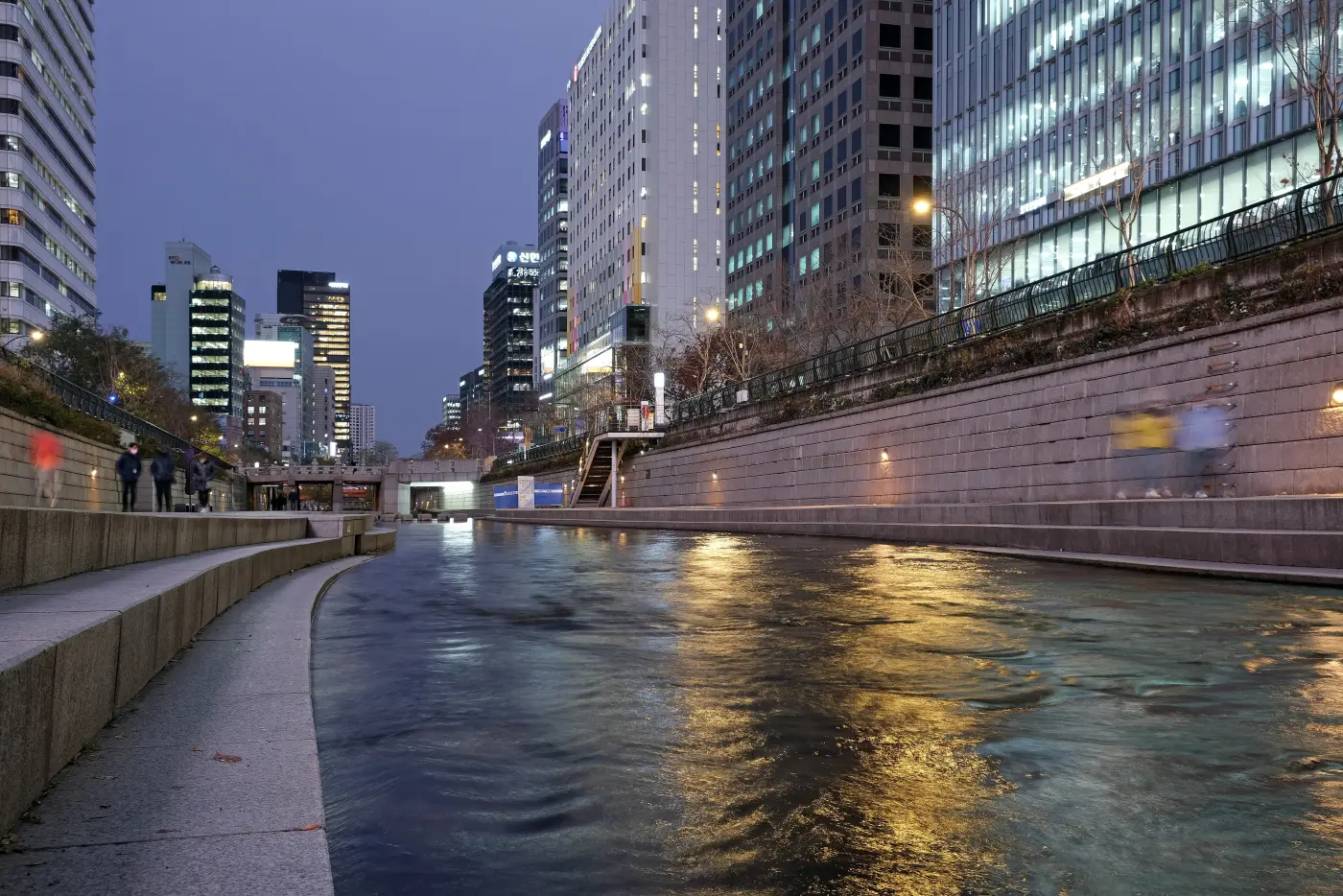
Two seasonal extras make the stream worth timing. Near Gwanggyo Bridge, the Seoul Tourism Organization runs Cheonggye Soul Ocean, a free media art show projected onto the water. Visit Seoul lists it from 15 May to 31 December 2026, from 18:00 to 22:00 (19:00 to 22:00 in June to August), closed in heavy rain, with Jonggak Station (Line 1) Exit 5 as the nearest stop. At the end of the year, the Seoul Lantern Festival lines the stream with large lit installations; the 2025 edition ran from 12 December 2025 to 18 January 2026, from 18:00 to 23:00, with free admission. The 2026 dates had not been published on the official pages at the time of writing.
Night markets: what is running, and when
Seoul's best-known open-air night market is the Seoul Bamdokkaebi Night Market, which the Seoul Metropolitan Government launched in 2015. The name comes from the dokkaebi, a goblin from Korean folk tales that appears at night and is gone by morning, and the market follows the same idea: food trucks, handmade goods and performances that appear in the evening and pack up before midnight. In past seasons it has run on weekend evenings in the warmer months at venues including Yeouido Hangang Park, Cheonggye Plaza and DDP.
The honest caveat is that its locations, days and season have changed from year to year, and we could not find a 2026 schedule on an official Seoul page. Treat any list of dates you see online as unconfirmed, and check Visit Seoul's events listings or the Seoul city site before planning an evening around it. If what you really want is market food at night, the food alleys inside the big traditional markets are a safer bet; our Seoul markets guide covers which ones stay busy into the evening.
Palaces after dark
Two of Seoul's palaces open into the evening as a matter of routine. According to the Royal Palaces and Tombs Center, Deoksugung and Changgyeonggung are both open from 09:00 to 21:00 all year, with last entry at 20:00, and both close on Mondays. Staff start guiding visitors towards the exits about 30 minutes before closing, so arrive with time to spare.
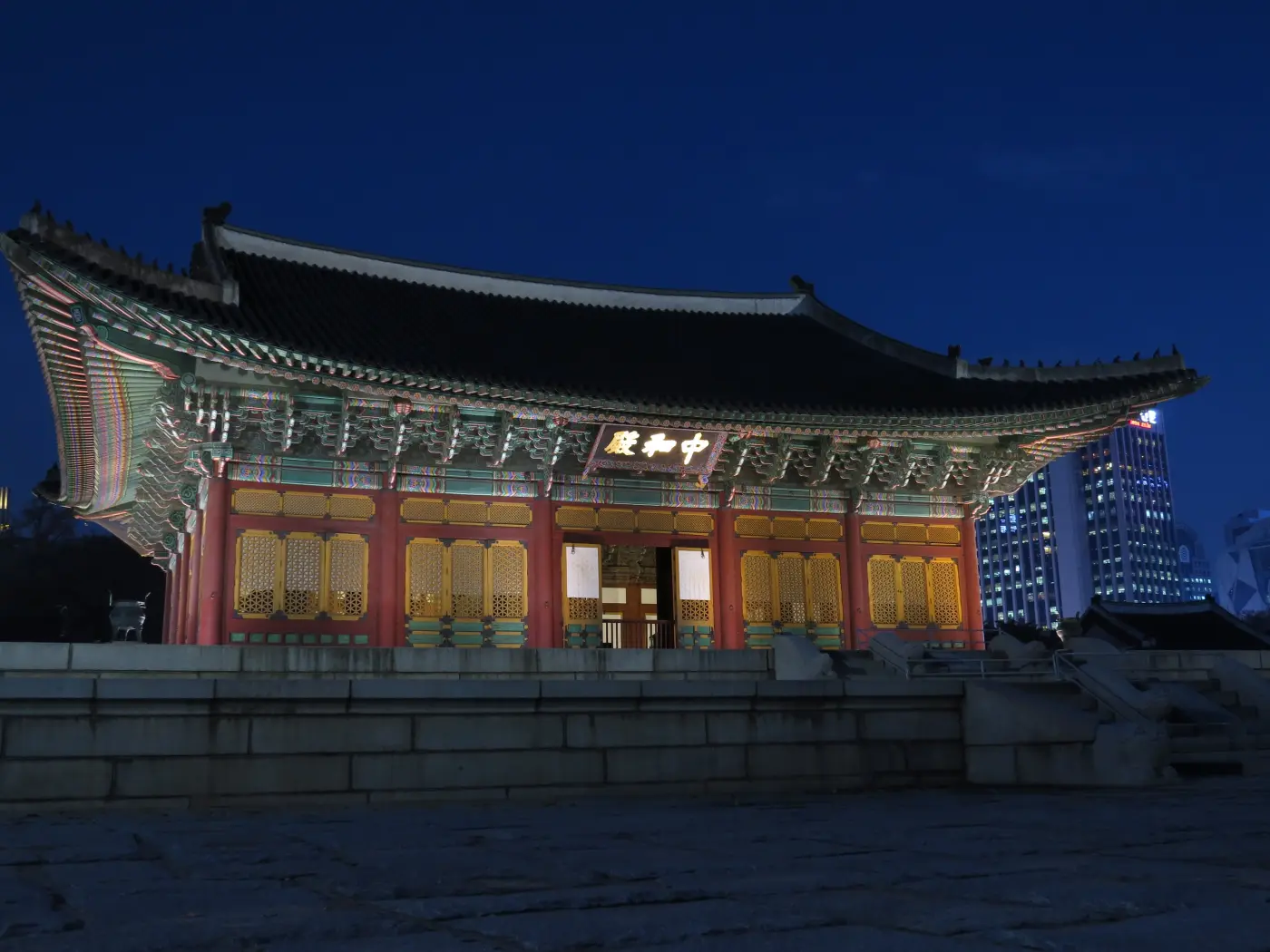
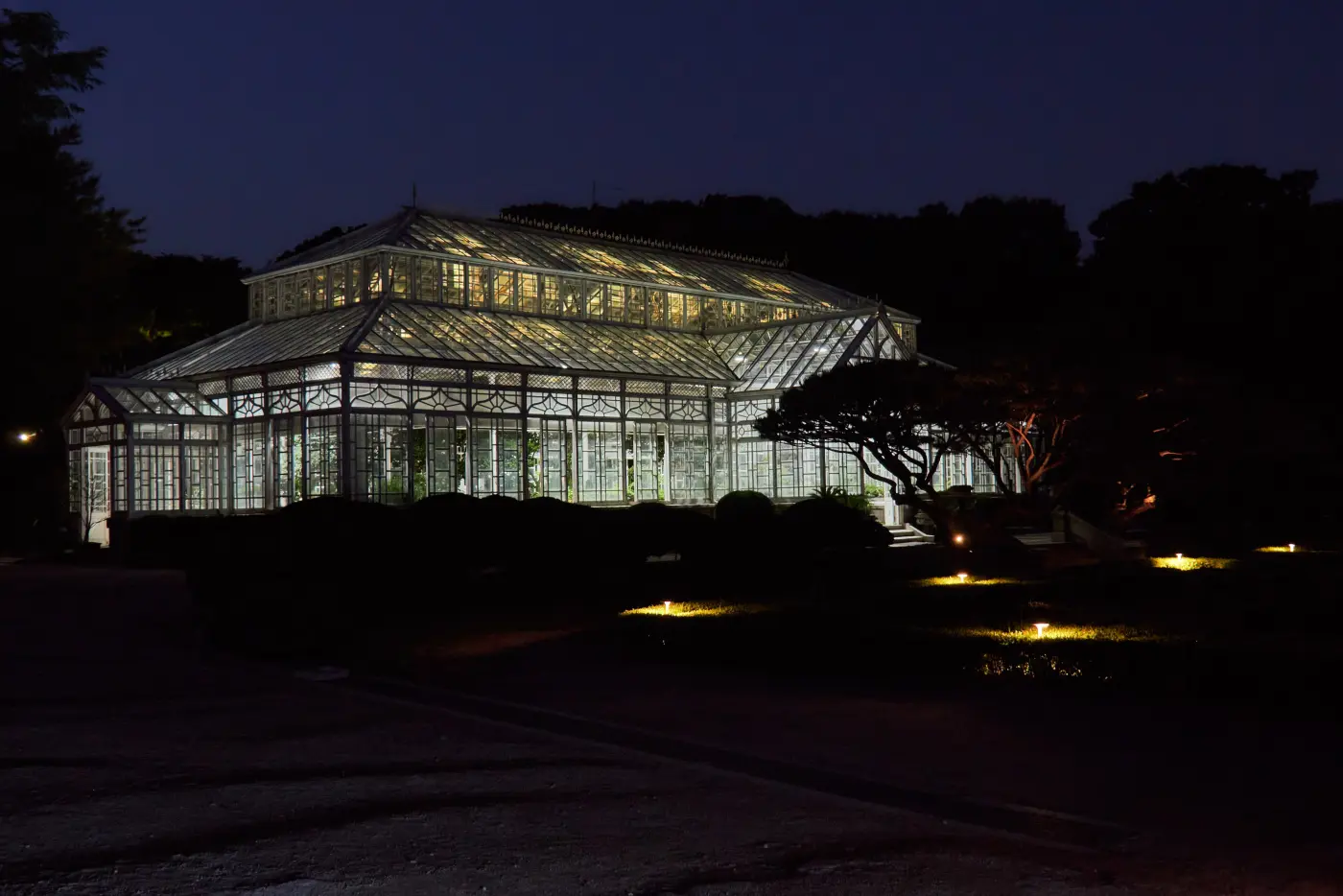
Deoksugung sits right beside City Hall Station (Lines 1 and 2), Exit 1, which makes it easy to combine with the start of the Cheonggyecheon walk. Its main hall, lit against the office towers around it, is the image on the cover of this article. Changgyeonggung is quieter. After a set time in the evening, visitors are moved into a night-viewing zone around Honghwamun Gate, the main hall Myeongjeongjeon, Tongmyeongjeon Hall, Chundangji Pond and the large glasshouse. The official schedule puts that move at 17:30 from November to February, 18:00 in spring and autumn and 18:30 in summer, and the glasshouse interior closes from 18:00 in December, January and February to protect the plants. The nearest station listed by Visit Seoul is Hyehwa (Line 4), Exit 4, about 780 metres away.
Gyeongbokgung and Changdeokgung are different: they normally close in the late afternoon, and their night openings are special, ticketed programmes that run only for limited periods. In 2026, the Changdeokgung Moonlight Tour ran in spring (16 April to 31 May, according to Visit Seoul) and again in autumn, while Gyeongbokgung held a Nighttime Viewing programme from 2 September to 2 October with traditional court music performances. On the Moonlight Tour, small groups walk through the palace and its rear garden carrying traditional silk lanterns, with a guide, music and tea along the way. Tickets sell out fast and the booking rules differ by programme: in autumn 2026, Korea.net reported that Changdeokgung places were allocated by lottery, with separate tour dates in English and Japanese, and that some same-day Gyeongbokgung tickets were kept for foreign visitors with a passport.
Both autumn 2026 programmes have now ended, and dates for the next season had not been announced at the time of writing. If your trip falls in spring or autumn, watch the notices on the official Royal Palaces and Tombs Center site (royal.khs.go.kr) a few weeks before you travel. For daytime visits, closing days and which palace suits you, see our guide to Seoul's five palaces.
Dongdaemun Design Plaza (DDP)
DDP looks like something that landed in the middle of Dongdaemun's fashion district, and it is at its most striking after dark, when the aluminium panels on its curved walls catch the light. Visit Seoul says it opened on 21 March 2014 and lists its indoor spaces as open from 10:00 to 20:00, varying by space, closed on 1 January, Seollal and Chuseok. You do not need to go inside to enjoy it: the walkways around and over the building are the main attraction at night. The station is Dongdaemun History & Culture Park (Lines 2, 4 and 5), Exit 1, which opens almost directly onto the building.
The building is also a screen. Visit Seoul notes that the seasonal Seoul Light event turns DDP's exterior into a giant projection surface, and in late 2025 the Seoul Metropolitan Government announced a separate light show called Dream in Light, with displays every hour from 18:00 to 22:00 on the 222-metre main facade, planned to run year-round from January 2026. Shows like these can pause for events and maintenance, so check the DDP or Visit Seoul event pages before you make a special trip.
Ikseon-dong and Euljiro: evening streets
For an evening of wandering and eating rather than looking at a view, two downtown neighbourhoods are a short walk apart. Ikseon-dong is a pocket of small hanok houses near Jongno 3-ga Station (Lines 1, 3 and 5), Exit 4. Visit Seoul describes it as a network of narrow alleys, around 800 metres long in total, filled with cafés, restaurants and shops in converted hanok. It is pleasant at night, when the shop lights glow under the tiled roofs, but the alleys are narrow and popular places can have queues. It is still a neighbourhood where people live, so keep the volume down in the side lanes.
Euljiro, which stretches between City Hall and Dongdaemun, was for decades the city's workshop district, full of print shops and tool stores. Visit Seoul describes how, in the evening, the hardware shops roll down their shutters and the neon signs come on one by one. The best-known spot is Nogari Alley, near Euljiro 3-ga Station (Lines 2 and 3), Exit 3, where open-air beer halls that date back to the 1980s serve dried pollack and cold beer at plastic tables in the street. In the evenings, Visit Seoul notes, even the outdoor tables fill up. It is loud, cheerful and very local; if you are drinking, our guide to Korea's drinking rules covers the basics.
Getting back late: last trains, night buses and taxis
The one thing that catches visitors out at night is the last train. Visit Seoul describes the subway as running from about 5:30 a.m. until around midnight, with times varying by station. In 2025, the Seoul Metropolitan Government announced that it would move first trains on Lines 1 to 8 thirty minutes earlier and shorten last-train times by 30 minutes for maintenance, within Seoul. Because the exact time depends on your line, station and direction, check the last train for your own station on a subway app or the station timetable before you settle in for a long evening, and treat 11 p.m. as the point to start paying attention.
- Night buses: Seoul's late-night buses have route numbers starting with N, and the city describes them as running through the small hours, from around midnight until about 4 a.m. Routes and real-time arrivals are on the city's TOPIS service and on bus stop displays.
- Transfers: Seoul Metro says the free transfer window between subway and bus is 30 minutes after you get off, extended to one hour between 9 p.m. and 7 a.m. Tap your card when getting on and off every time.
- Taxis: since December 2025, Seoul taxi receipts show the final fare and the boarding and drop-off times in English, and say whether a late-night or out-of-city surcharge was applied. Ask for the receipt at the end of the ride.
- Plan B: if you know you will be out past midnight, choose a hotel within walking distance of where you will be, or save its address in Korean so you can show it to a driver.
Our getting-around guide explains transport cards, fares and taxi apps in more detail.
Staying safe and comfortable after dark
Central Seoul is busy late into the night, and the places in this guide are well lit and full of people in the evening. The ordinary precautions still apply: keep your phone and wallet zipped away in crowds, watch your step on stairs and steep lanes such as the climb to Naksan, and keep away from the water's edge at Cheonggyecheon after heavy rain.
Save the emergency numbers before you go out. In Korea, 112 is the police and 119 is fire and ambulance, according to the Ministry of the Interior and Safety. For non-emergency help, the 1330 Korea Travel Hotline, which the Seoul city site lists as available 24/7, gives travel information in several languages and takes complaints. Our emergency guide lists what to say and where to go, and our honest guide to safety in Korea answers the questions most first-time visitors ask about walking around at night.
Putting an evening together
A simple first evening: walk Cheonggyecheon from Cheonggye Plaza around sunset, step up to Deoksugung before last entry at 20:00, then eat in Euljiro. A second: Ikseon-dong for dinner, then the 15-minute climb from Hyehwa to Naksan Park for the view. A third: Namsan by cable car around sunset, then DDP on the way back. Pick one per night and leave time for dinner; trying to fit in more mostly means more time on the subway. If you would rather not work out opening hours, seasons and last trains yourself, Haeva can build a day-by-day plan around your own dates.
Comments
Sign in to leave a comment.
Sign in ·No account? Create one
Confirm your email address to comment — it takes one click.
No comments yet.