
Han River Parks in Seoul: A Visitor's Guide
Which Han River park to pick in Seoul, the subway exit for each, renting a Ttareungyi bike, delivery zones, the fountain season and the rules that carry fines.
The Han River runs right through the middle of Seoul, and both of its banks are lined with public parks: lawns, cycle paths, sports courts, pools, convenience stores and long stretches of open space where people spread a mat, eat and watch the sun go down over the bridges. For a visitor, the parks are free, open around the clock and reachable by subway, which makes them one of the easiest ways to see how the city spends its time off.
This guide explains how the park system works, which of the parks suit which kind of visit, the subway exit to use for each one, how to rent a public bike as a foreigner, how food delivery to the riverside works, and the rules that can earn you a fine. Hours, exits and rules come from official Seoul pages read in October 2026; event dates change every year, so treat them as a guide to what happens rather than a timetable.
What the Hangang Parks are
According to the Seoul Metropolitan Government, the parks grew out of riverbank redevelopment that began in 1982, and the name Hangang Park was adopted in 1992. Today the city counts 11 of them along the river: Gwangnaru, Jamsil, Ttukseom, Jamwon, Ichon, Banpo, Mangwon, Yeouido, Nanji, Gangseo and Yanghwa. They are managed together by the city's Future Hangang Project Headquarters, whose website lists each park's facilities, parking and directions, mostly in Korean.
Think of them as one long linear park cut into sections rather than eleven separate attractions. A continuous cycle path links them, so you can ride from one to the next, and each section has its own character: some are big event spaces, some are built around sport, and some are mostly grass and trees. Visit Seoul lists Yeouido, Ttukseom and Banpo as open 24 hours with free admission, and the park information centres keep office hours of 9:00 to 18:00 while patrols run around the clock. The pools, boats and rental shops inside the parks have their own seasons and charges.
The six parks most visitors choose
| Park | Known for | Nearest station and exit | Good for |
|---|---|---|---|
| Yeouido | Large lawns beside the business district; spring flower festival and the fireworks festival; summer pool | Yeouinaru (Line 5), Exit 2 or 3, about 1 minute on foot; lift near Exit 2 | A first visit, picnics, delivery food, big events |
| Banpo | Moonlight Rainbow Fountain on Banpo Bridge; Seoraeseom island; Moonlight Square | Express Bus Terminal (Lines 3, 7, 9), Exit 8-1 or 8-2, about 15 minutes; or Sinbanpo (Line 9), Exit 1 | An evening walk and the fountain show (April to October) |
| Ttukseom | Water sports, a summer pool that becomes a sledding slope in winter, the Jabeolle building | Jayang (Line 7), Exit 2 or 3, about 1 minute | The quickest access, an active afternoon, bike rental |
| Mangwon | Open lawns and riverside paths, Seoul Battleship Park, close to Mangwon Market | Mangwon (Line 6), Exit 1, then local bus Mapo 09 or Mapo 16; or walk in through the Mangwon underpass | Market snacks followed by a picnic |
| Nanji | Nanji Camp for camping and barbecue, a shallow riverside water playground, bridges to Haneul and Noeul parks | Mapo-gu Office (Line 6), Exit 7, about 20 minutes along the Hongjecheon stream | Camping, long bike rides, pairing with World Cup Park |
| Jamsil | Nature study garden, the fishway at Jamsil weir, a natural-style water playground, cruise pier | Jamsillaru (Line 2), Exit 3 or 4, then the footbridge, about 8 minutes | Families, and combining with Olympic Park or the Jamsil sports complex |
Yeouido Hangang Park: the classic picnic
Yeouido is the park that hosts the city's biggest riverside events. The official introduction describes Yeouido Hangang Park as a favourite of office workers and residents thanks to its subway and bus links, and as the venue for the spring flower festival, the Seoul International Fireworks Festival, concerts and marathons. Exits 2 and 3 of Yeouinaru Station on Line 5 open almost straight onto the park, about a minute's walk, and there is a lift near Exit 2 for anyone with a stroller or heavy bag.
Beyond the lawns there are three bike rental points (Mapo, Wonhyo Bridge and Yeouinaru), a seasonal outdoor pool, and the Bamseom Ecological Experience Centre near the southern end of Mapo Bridge, where you can look at the protected Bamseom islets through telescopes. Bamseom itself is a Ramsar wetland and closed to the public. Fishing is banned throughout Yeouido Hangang Park.
Banpo Hangang Park and the Moonlight Rainbow Fountain
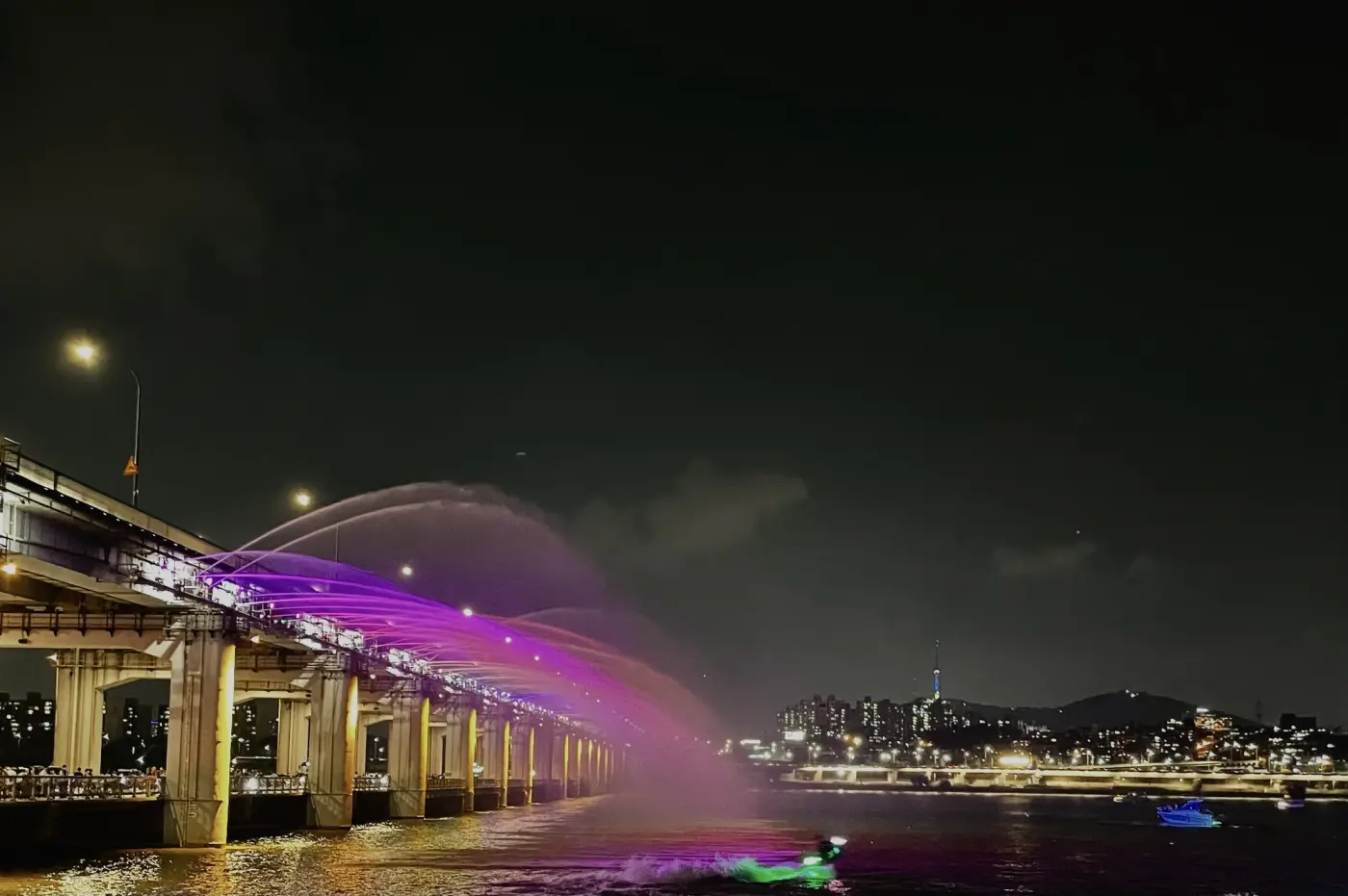
Banpo, on the south bank around Banpo Bridge, is the park to choose for an evening visit. Its centrepiece is the Moonlight Rainbow Fountain, which runs along both sides of the bridge for a total of 1,140 metres and was registered with Guinness World Records in 2008 as the world's longest bridge fountain, according to the park's official page. Coloured lights and music play with the water jets.
The fountain runs from April to October. Each show lasts about 20 minutes, and the number of shows changes through the season: the city's autumn 2026 festival notice gives six a day in September and five in October. Because official pages list different clock times for different periods, and shows can be cancelled for rain, strong wind or river conditions, check the Hangang Parks website on the day rather than relying on a timetable copied from elsewhere.
The lower deck of Banpo Bridge is Jamsugyo, a low bridge that sits just above the water. On Sundays in spring and autumn the city has closed it to cars for a walking festival; the autumn 2026 edition ran on eight Sundays until 25 October, and the city says the bridge is planned to become fully pedestrian in the second half of 2027. Seoraeseom, a small island between Banpo and Dongjak bridges, is planted with rapeseed and buckwheat flowers that make it a popular walking loop when they bloom.
For the fountain, the official directions suggest Express Bus Terminal Station (Lines 3, 7 and 9), Exit 8-1 or 8-2, then about 15 minutes on foot towards Banpo Bridge. Sinbanpo Station (Line 9), Exit 1, is a similar walk through the Banpo underpass, and Dongjak Station (Lines 4 and 9), Exits 1 and 2, puts you on the riverside path heading towards Seoraeseom.
Ttukseom Hangang Park: straight off the subway
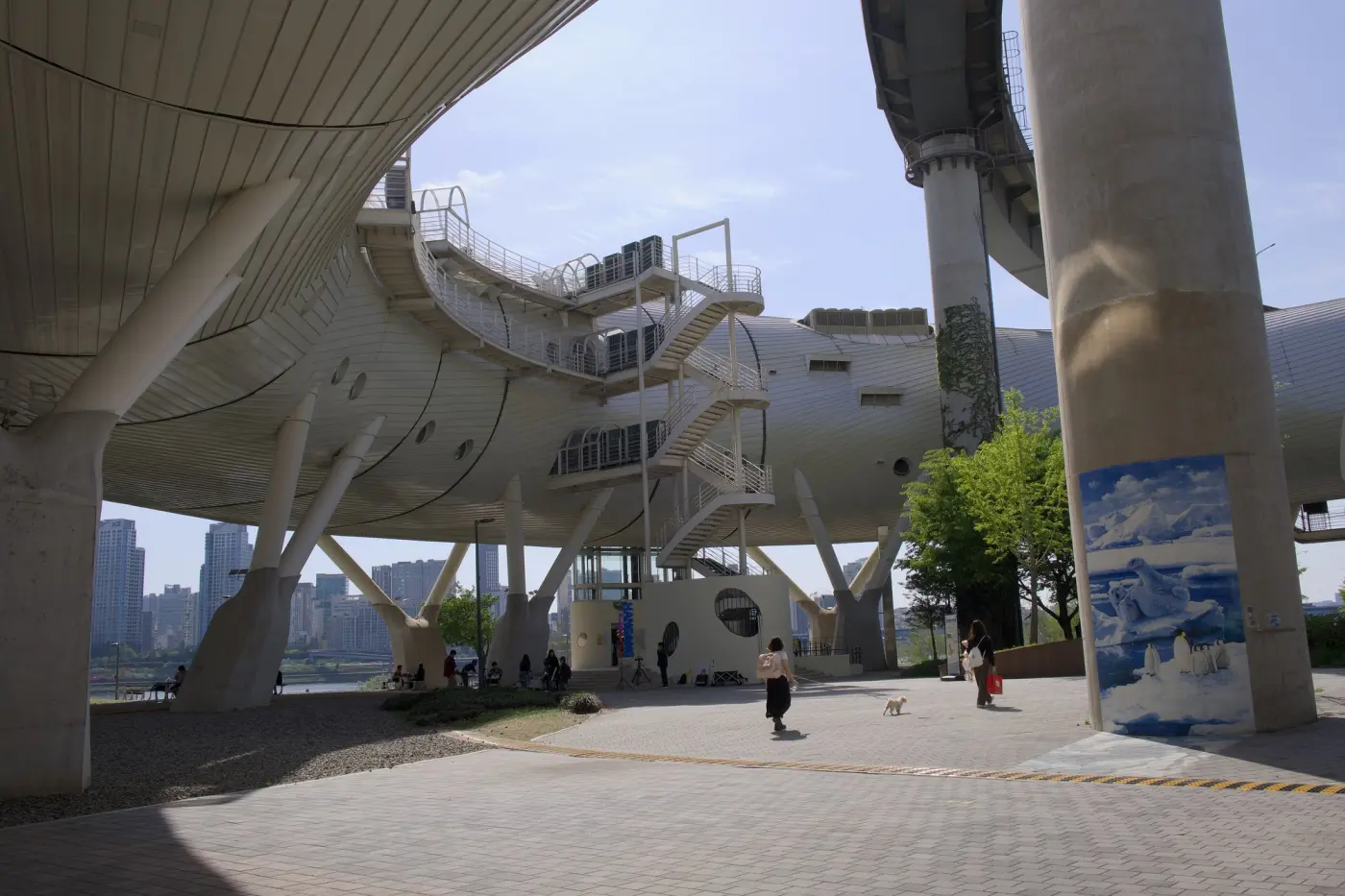
Ttukseom is the easiest park to reach: Exits 2 and 3 of Jayang Station on Line 7 connect straight to the park, about a minute's walk. Some official pages still use the station's older name, Ttukseom Resort (Ttukseom Yuwonji), so do not be surprised to see both. The park's own page calls Ttukseom a riverside resort that was famous long before the Hangang Parks were created, and today it is the place for water sports such as windsurfing, waterskiing and motorboating.
Next to the station exits you will find a bike rental shop and a long, tube-shaped building called Jabeolle, which the park lists as a cultural facility with an open-mic busking programme. The outdoor pool, with room for 3,500 people, opens every summer, and in winter the same site is turned into a sledding slope. Ttukseom also hosted three of the five sessions of the city's spring 2026 drone light shows.
Mangwon Hangang Park: market first, then the river
Mangwon sits on the north bank between Wonhyo Bridge and Seongsan Bridge, in Mapo-gu. Its official description is modest: wide lawns, well-planned walking paths and rest areas, water sports on the river, and historic sites such as the Mangwonjeong pavilion and Jeoldusan Martyrs' Shrine nearby. Its special feature is Seoul Battleship Park, the city's first ship-based theme park, built around three decommissioned navy vessels just downstream of the northern end of Seongsan Bridge.
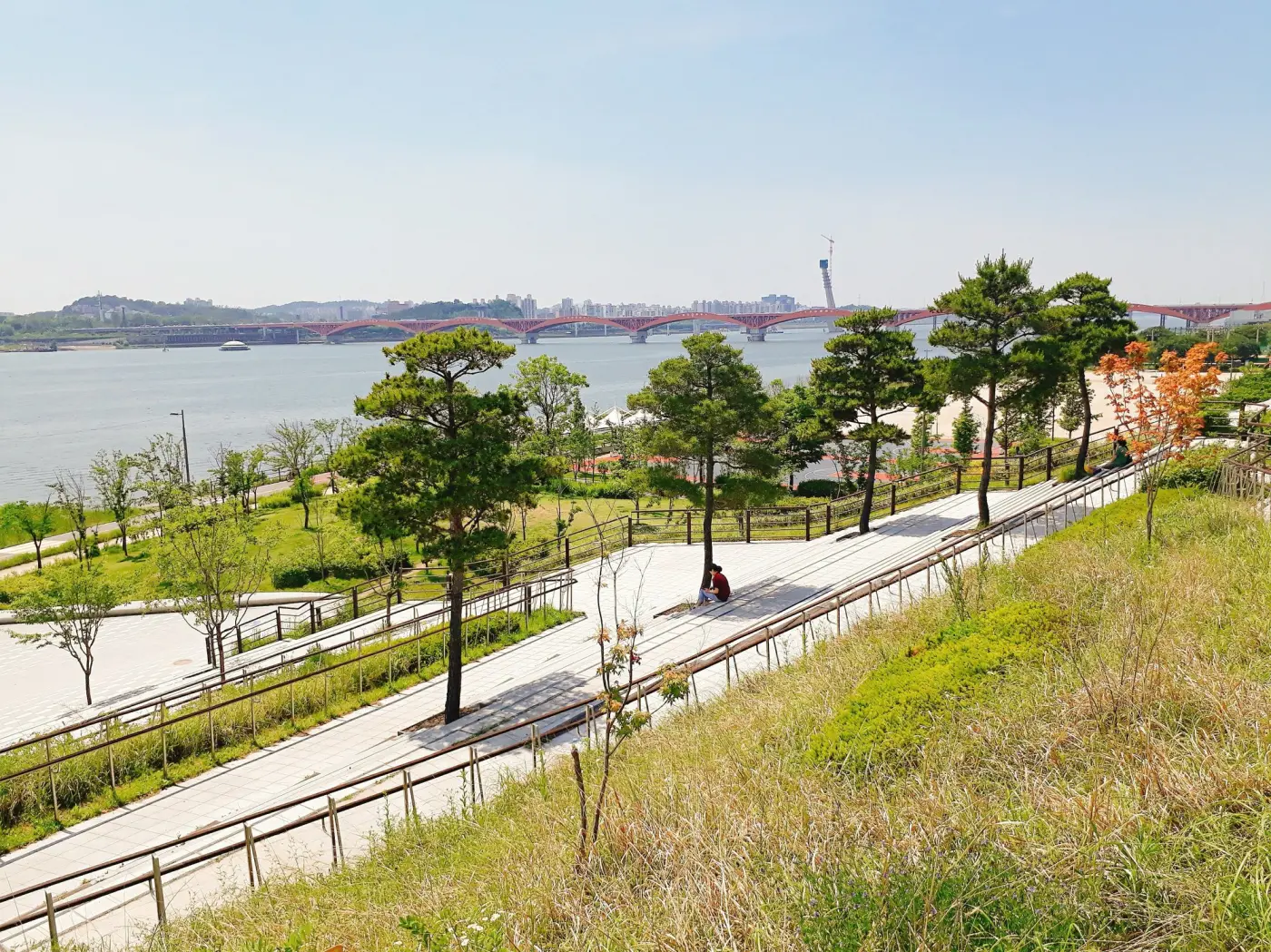
The official directions send you from Mangwon Station (Line 6), Exit 1, onto local bus Mapo 09 or Mapo 16, but many people walk in through the Mangwon underpass (nadeulmok) instead. The real reason to come this way is Mangwon Market, a short walk from the station. Our traditional markets guide covers what to eat there; VisitKorea suggests buying snacks at the market and carrying them down to the river for a picnic.
Nanji and Jamsil: the two ends of the city
Nanji Hangang Park, in Sangam-dong at the western edge of the city, is the one to choose for camping. Nanji Camp has sites for tents and barbecue, booked through the city's public reservation service, and in summer a riverside water playground with a maximum depth of 80 cm suits young children. Footbridges link the park to Haneul Park and Noeul Park, the hilltop parks beside the World Cup Stadium. On foot, the official directions give about 20 minutes from Mapo-gu Office Station (Line 6), Exit 7, following the Hongjecheon stream, or about 30 minutes from World Cup Stadium Station, Exit 1.
Jamsil Hangang Park, on the south bank in the east, sits next to the Jamsil sports complex and close to Olympic Park. The official page highlights a nature study garden of flowers, wildflowers and crops that is popular with families, and a fishway at the Jamsil weir where you can watch fish moving upstream. The old pool has been rebuilt as a natural-style water playground that is ticketed in June to August and left open the rest of the year. From Jamsillaru Station (Line 2), Exits 3 and 4 lead to a footbridge and into the park in about eight minutes.
Getting around by bike: Ttareungyi
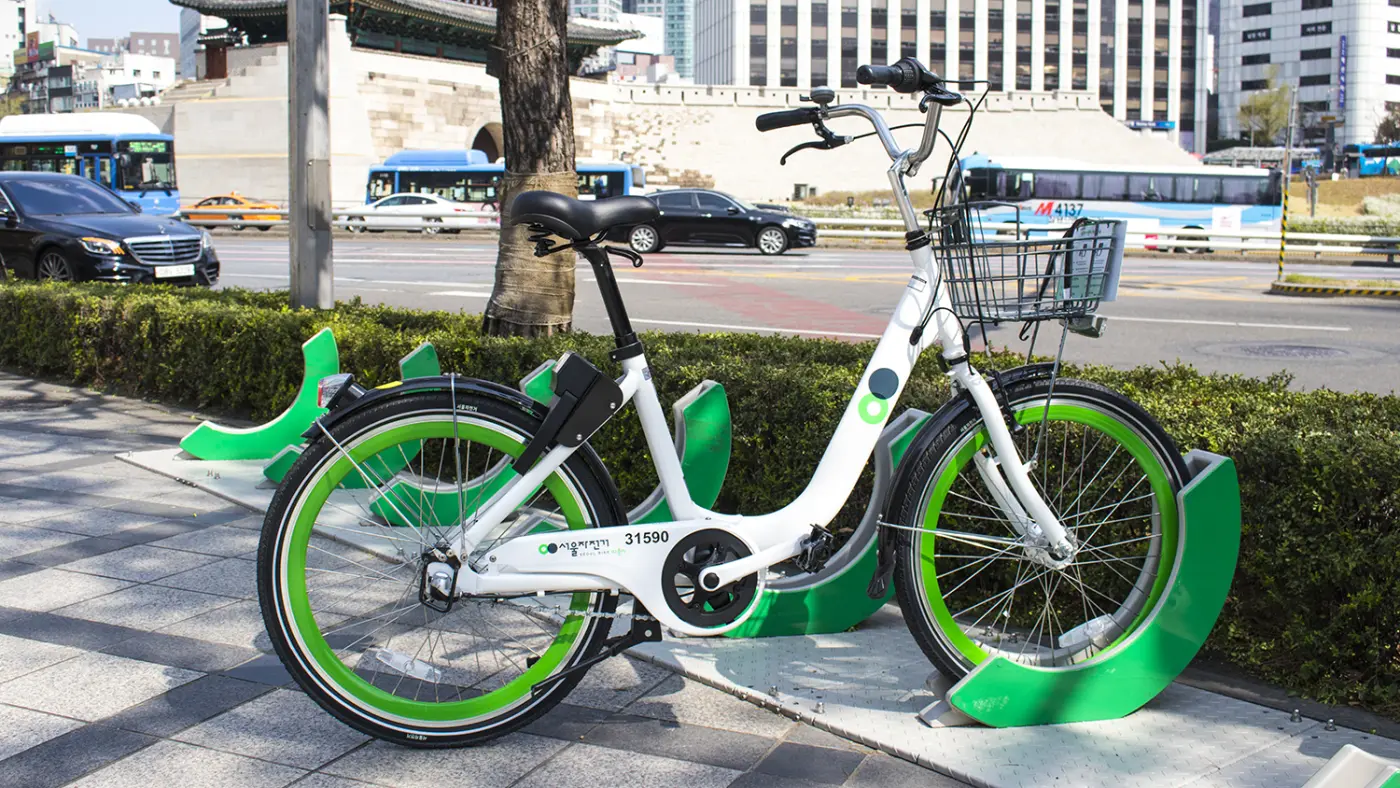
The riverside cycle path is the best way to see several parks in one day, and Seoul's public bike, Ttareungyi (also spelled Ddareungi), is the simplest way to ride it. The official site, bikeseoul.com, has English and Japanese versions, and there is a Ttareungyi app for iPhone and Android. Visitors do not need to create an account: you can buy a one-day pass as a non-member and pay with a credit card issued outside Korea, limited to one pass per person and per card.
As listed on bikeseoul.com in October 2026, the non-member passes cost 1,000 won for one hour, 2,000 won for two hours, 3,000 won for three hours, and 5,000 won for an all-day 24-hour pass. A pass is valid for 24 hours from your first rental; each ride must end within its time limit, but you can rent again straight after returning. Going over the limit costs an extra 200 won for every five minutes, charged to the same card. Holders of the Discover Seoul Pass can use the all-day pass at no extra cost.
- To rent, tap Rent on the app's home screen and scan the QR code under the saddle. The rental starts when the locking lever lifts.
- To return, dock at any Ttareungi station, push the lever all the way down, and wait for the confirmation message in the app. Some stations take only the newer QR bikes.
- For a short stop, use Temporary Lock instead of returning the bike.
- Bikeseoul.com asks riders to wear a helmet, not to ride after drinking, not to use a phone or earphones while riding, and to walk the bike across crosswalks and on pavements.
- The help line is 1599-0120. For interpretation, Seoul's 120 Dasan Call Center (02-120) can join the call.
If you prefer a different kind of bike, rental shops inside the parks hire out single, tandem and child-seat bikes; VisitKorea notes that they usually ask for an ID or passport as a deposit. Our getting-around guide covers the subway and buses for the rest of the city.
Picnics and delivery: how the delivery zones work
Visit Seoul describes fried chicken and beer picnics on the grass as a Yeouido favourite, and having food delivered to the riverside is common enough that the city has organised it around delivery zones. Delivery motorbikes are not allowed to ride into the parks, because of the risk of hitting pedestrians and cyclists. Instead, you set the nearest delivery zone as your address, collect the food there, and carry it to your spot. By autumn 2026 the network had grown from six zones in three parks to 17 zones across all 11 parks: four at Yeouido, three at Ttukseom, two at Banpo, and one each in the other parks. Two of the Yeouido zones are next to Exits 2 and 3 of Yeouinaru Station, and one Banpo zone is in Moonlight Square under Banpo Bridge.
The city also asks people not to linger at the zone itself, and to separate or take away disposable containers and food waste. The practical catch for visitors is the ordering: the main Korean delivery apps are designed for residents, as our travel apps guide explains. If you cannot order yourself, the riverside convenience stores sell drinks, snacks and picnic basics, and many have ramyeon cooking machines; our convenience store guide shows how they work. Or simply bring takeaway from a market or restaurant on the way.
For shade, small tents and sunshades are allowed only in designated areas, which the city has increased to 20. VisitKorea's guide gives the limits as no larger than 2 m by 2 m, and the city asks for at least two sides to be left open. Since September 2026 these shades may stay up until 10 p.m. instead of 7 p.m. A simple mat needs no permission.
The rules that come with fines
The Hangang Parks are relaxed, but they are governed by a city ordinance on their conservation and use, and the park website lists the fines. The ones most likely to matter to a visitor are below; the amounts are for a first offence, as listed by the Hangang Parks site under the ordinance as amended on 29 December 2023.
| What is not allowed | Fine (first offence) |
|---|---|
| Camping or cooking outside designated areas | 1,000,000 won (rising to 2,000,000 and 3,000,000 won for repeat offences) |
| Leaving behind the rubbish from your picnic | 100,000 won |
| Dropping litter such as cigarette butts, gum or tissues outside bins | 30,000 won |
| Loud noise, foul smells, or drunken behaviour that disturbs or threatens others | 70,000 won |
| Walking a dog without a lead | 50,000 won |
| Not cleaning up after your dog | 70,000 won |
| Picking flowers or fruit | 50,000 won |
| Fishing in a no-fishing zone | 500,000 won |
Drinking. The ordinance does not ban drinking in the parks; what it penalises is drunken behaviour that disturbs other people. Some places are stricter: the city's 2026 pool rules ban alcohol on the premises and forbid entering the water after drinking, and VisitKorea notes that no alcohol is allowed on the Tubester boats at Banpo. Do not ride a Ttareungi after drinking. Our drinking rules guide covers the wider picture.
Smoking. The 2026 pool rules forbid smoking on the pool premises, and the ordinance fines anyone who drops a cigarette butt. Elsewhere, follow the no-smoking signs where they are posted and keep away from families and food.
Drones and wheels. The Seoul Metropolitan Government lists a legal drone-flying area of about 27,000 square metres at Gwangnaru Hangang Park, next to its bicycle park. Drone rules in Korea depend on where you are, so if you plan to fly anywhere else, check the rules before you unpack. Under the ordinance, motorised wheeled devices may not leave the roads inside the parks, although e-bikes and personal mobility devices may use the cycle paths.
Events through the year
The parks host something in almost every season. The Seoul International Fireworks Festival is held over the river at Yeouido in the autumn. Admission is free, and the date changes every year, so check Visit Seoul's event listing before you plan around it. Spring brings the flower festival at Yeouido and, in 2026, drone light shows at Yeouido, Ttukseom and Jamsil. The pools and water playgrounds open in summer (19 June to 30 August in 2026), and Ttukseom's pool becomes a sledding slope in winter.
The city also runs a four-season Hangang River Festival. The autumn 2026 edition ran from 17 to 25 October at parks including Jamwon, Ttukseom, Banpo and Yeouido, with yacht and kayak sessions, picnic concerts and an outdoor library, and the city has announced the winter edition for 19 to 27 December 2026. For dates in other years, check the Hangang Parks or Visit Seoul event pages close to your trip.
On the water: Hangang Bus and cruises
Since 2025 the city has run the Hangang Bus, a public ferry service whose hybrid and electric boats link seven piers between Magok and Jamsil: Magok, Mangwon, Yeouido, Apgujeong, Oksu, Ttukseom and Jamsil. The boats have bicycle racks, and Ttareungi docks were added near several piers. Timetables have changed several times since the launch, so check the official Hangang Bus site (hgbus.co.kr) for current departures. Separate sightseeing cruises leave from piers at Yeouido and Jamsil, according to VisitKorea, with sunset and evening sailings.
Practical tips
- The official park pages warn that weekends, public holidays and big events bring heavy crowds and traffic, so use public transport, and go on a weekday or arrive early if you want a spot on the grass.
- Bring a mat, a light layer for the evening, and a bag for your rubbish. The city's park guidelines ask visitors to clean up after themselves, recycle properly and use fewer disposable items.
- Check the air quality on hazy days before planning a long ride; our fine dust guide explains how.
- Shade can be limited on the open lawns, so a hat and sunscreen help in summer.
- Each park's information centre is open 9:00 to 18:00, and the Hangang Parks inquiry line is 02-3780-0777.
A Han River afternoon fits easily into a short trip. Our three-day Seoul plan suggests it as a slower third day, and it pairs naturally with a market lunch at Mangwon or an evening fountain show at Banpo. If you would like a day planned around your own dates and interests, Haeva's planning service can help.
Comments
Sign in to leave a comment.
Sign in ·No account? Create one
Confirm your email address to comment — it takes one click.
No comments yet.