
Jeonju Hanok Village Guide: Day Trip or Overnight from Seoul
How to reach Jeonju from Seoul by KTX or bus, what Gyeonggijeon, Jeondong Cathedral and Omokdae are, official hours, bibimbap and a 1-day or 1-night plan.
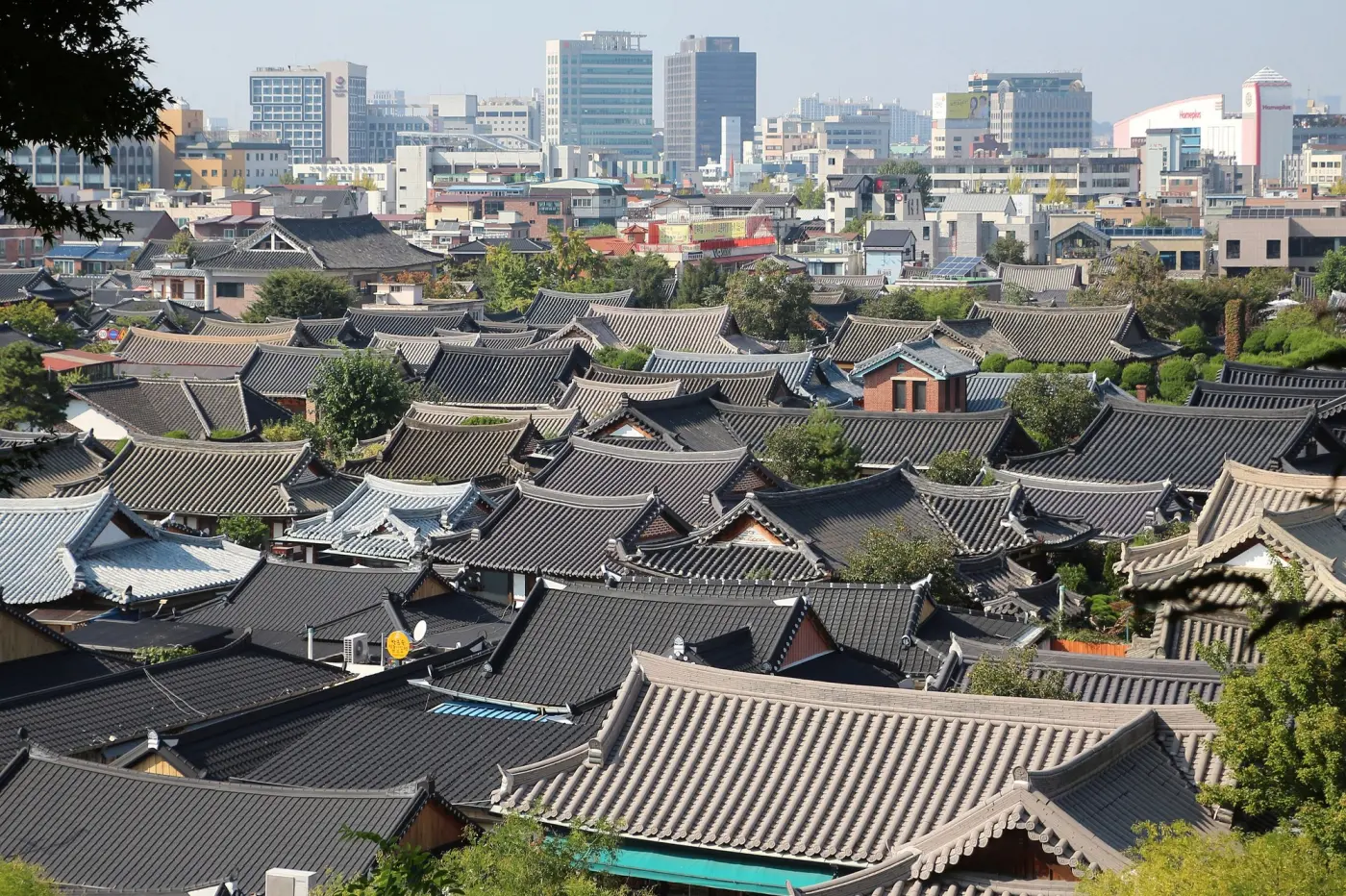
Jeonju is the city most Koreans name when you ask where to see a whole neighbourhood of traditional houses that people still live and work in. Its Hanok Village sits in the middle of an ordinary modern city, a short ride from the train station, and it packs a royal shrine, a red-brick cathedral, a Confucian school, a hilltop pavilion and one of the country's best-known food markets into an area you can cross on foot in well under an hour.
That compactness is what makes Jeonju work as a trip from Seoul. You can do it as a long day trip by high-speed train, or stay one night in a hanok guesthouse and see the lanes after the day visitors leave. This guide covers how to get there, how to get from the station to the village, what each main sight actually is, opening hours where the city publishes them, what to eat, and two sample plans. Hours and details below were checked on Jeonju City's official tourism sites in October 2026; they do change, so confirm before you travel.
What Jeonju Hanok Village is
According to the village's official site, run by Jeonju City, the Hanok Village covers the Pungnam-dong and Gyo-dong neighbourhoods of Wansan-gu, about 298,000 square metres, with more than 700 hanok (traditional Korean houses). The city describes it as the only hanok district in Korea located in the centre of a city, and as home to about 20 cultural facilities including Gyeonggijeon Shrine, Omokdae and the Hyanggyo Confucian school. The area was designated a Hanok Preservation District in 1977 and was named an International Slow City in 2010.
It is not an open-air museum. The same official page counts 575 businesses inside the district, and most of the houses you walk past are guesthouses, restaurants, cafés, craft workshops and rental shops. That is worth knowing in advance: the main streets such as Taejo-ro are busy and commercial, while the side lanes and the edges of the village near the Hyanggyo are noticeably quieter. The city also made the whole district a non-smoking area in 2016.
- Accommodation203shops
- Food and drink183shops
- Other sales and rentals189shops
Getting to Jeonju from Seoul
Visit Jeonju, the city's tourism site, lays out three main options, and each one arrives at a different place in the city. Check which terminal or station your ticket names before you plan the last leg.
- KTX high-speed train to Jeonju Station. The city's guide gives the journey from Seoul as about 1 hour 40 minutes and notes that KTX trains to Jeonju leave Yongsan Station much more often than Seoul Station, so search from Yongsan if the times look thin. Tickets can be bought on KORAIL's official website and app with a passport and an email address, or at the station. Our KTX guide explains booking step by step.
- SRT from Suseo, in southern Seoul. The official guide says only two direct SRT trains a day run to Jeonju; otherwise you can ride to Iksan and change to a regular train (Mugunghwa or ITX), a section the city puts at about 15 to 20 minutes.
- Express bus. From central Seoul, express buses to Jeonju Express Bus Terminal leave from Central City Terminal (the Honam side of the Express Bus Terminal complex) and from Dong Seoul Terminal. Intercity buses to Jeonju Intercity Bus Terminal leave from Seoul Nambu Terminal. The city notes that buses make one rest-area stop of about 15 minutes, and that the two Jeonju bus terminals stand side by side, about a three-minute walk apart.
- Direct from Incheon Airport. Airport buses run straight to Jeonju without going through Seoul; the official guide lists the provincial bus zone at platforms 12–13 outside Terminal 1 arrivals and platform 8 in the Terminal 2 transportation centre.
Two practical warnings from the same official page. Seats to Jeonju sell out on weekends (Friday to Sunday), public holidays and in the festival months of May, September and October, so buy your return ticket early. And the city specifically warns foreign visitors not to confuse Jeonju with Gyeongju, Cheongju or Jinju on ticket machines; the spellings are close and the cities are hours apart.
From the station or terminal to the village
Jeonju Station and the bus terminals are not next to the Hanok Village, so most visitors take a city bus or a taxi for the last leg. The official transport guide says the main sights, including the Hanok Village, are densely connected by city bus routes, but routes and numbers change, so the most reliable approach is to put "Jeonju Hanok Village" into a map app at the station and take whichever city bus it suggests, or join the taxi rank. Jeonju's own guide recommends NAVER Maps for this, and our travel apps article covers the alternatives.
If you ride the bus, the city's guide spells out the local rule: tap your transport card when you board at the front door and again on the reader by the rear door when you get off. Tapping off is what unlocks free transfers to another Jeonju city bus within 30 minutes (up to two), and skipping it can mean an extra charge the next time you board. The card itself works the same way as in Seoul; see our guide to getting around.
If you arrive with luggage, the city runs tourist information centres with lockers at Jeonju Station, in the bus terminal building, at the Hanok Village Tourist Information Center (99 Girin-daero) and at the Gyeonggijeon Travelers' Lounge, where the lockers are listed as free. The centres are listed as open 09:00 to 18:00 with a one-hour lunch break, and several offer interpretation in English and Japanese.
The main sights at a glance
| Place | What it is | Hours / closed days (official) | Time to allow |
|---|---|---|---|
| Gyeonggijeon Shrine | Shrine for the portrait of King Taejo, founder of Joseon; Royal Portrait Museum on site | Mar–May & Sep–Oct 09:00–19:00; Jun–Aug 09:00–20:00; Nov–Feb 09:00–18:00. Last entry 1 hour before closing | 1–1.5 hours |
| Jeondong Cathedral | Red-brick Romanesque church, completed 1914, on Korea's first Catholic martyrdom site | Open 09:00–17:00 (may change for parish reasons); active parish with daily Mass | 20–30 minutes |
| Omokdae | Hilltop pavilion linked to the founding of Joseon, with a view over the hanok roofs | No hours published; an open hillside park | 30–45 minutes |
| Jeonju Hyanggyo | Confucian school dating from late Goryeo, with ginkgo trees | Mar–Oct 09:00–18:00; Nov–Feb 10:00–17:00. Closed Mondays (next day if Monday is a holiday) | 30–45 minutes |
| Nambu Market and night market | Traditional market by Pungnammun Gate; Youth Mall upstairs | Night market Fri & Sat 18:30–23:00 per the official Hanok Village site | 1–2 hours |
Gyeonggijeon Shrine
Gyeonggijeon is the reason Jeonju calls itself the birthplace of the Joseon dynasty. The city's page explains that in 1410 royal portrait halls were set up in Jeonju, Gyeongju and Pyongyang to hold the portrait of King Taejo (Yi Seong-gye), whose family came from Jeonju; the Jeonju hall later took the name Gyeonggijeon. It was destroyed during the Imjin War and rebuilt in 1614, and it is a designated Historic Site. Inside the walls you will find the main hall with the royal portrait, the Jeonju Archive building where copies of the Annals of the Joseon Dynasty were kept, the Jogyeongmyo shrine to the founder of the Jeonju Yi clan, and the Royal Portrait Museum.
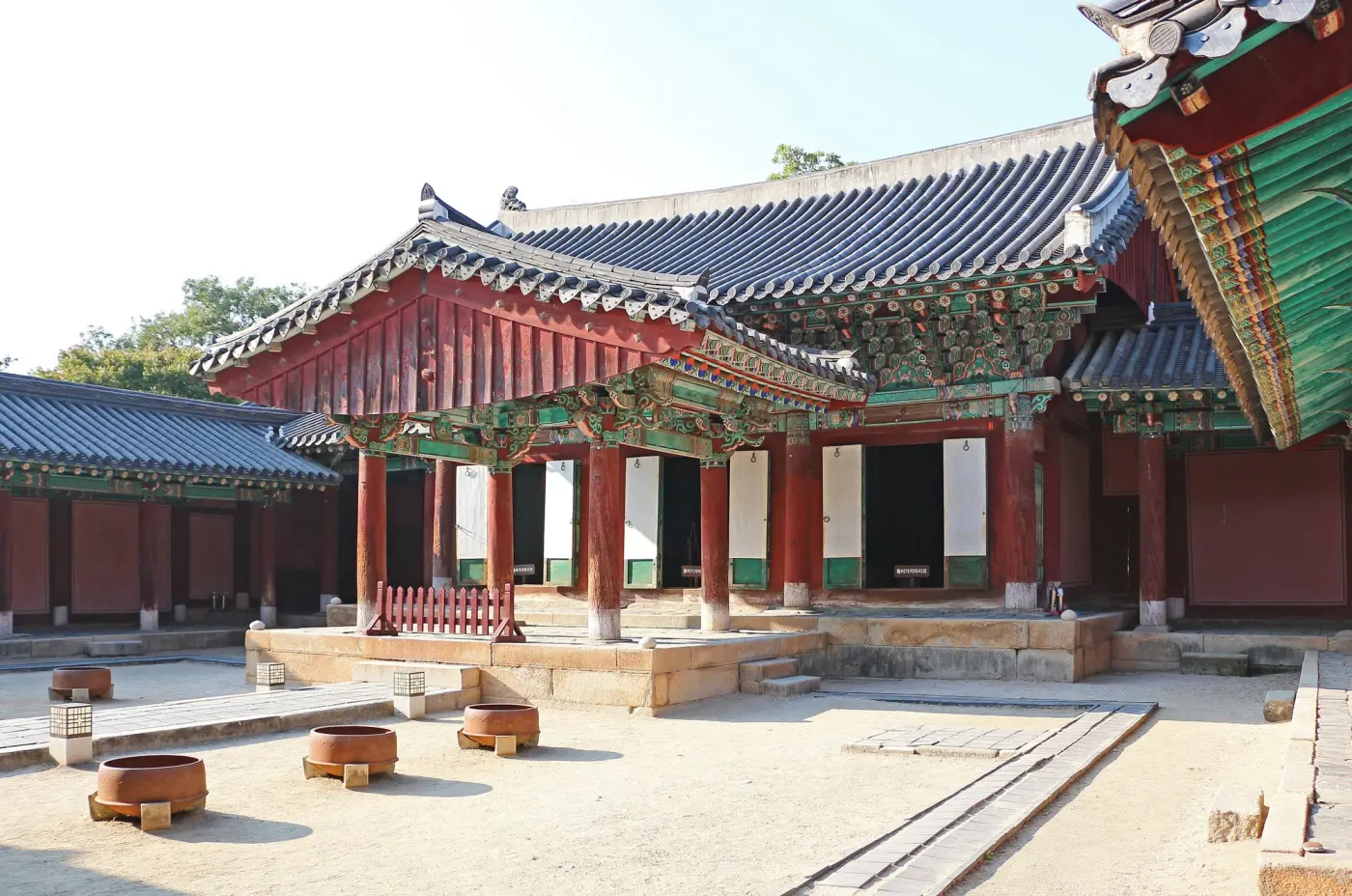
Admission is charged. Visit Jeonju listed the adult fare for non-residents as 3,000 won in October 2026, with free entry on the last Wednesday of each month ("Culture Day") and 50 percent off on the fourth Saturday ("Hanbok Day"). The grounds, with bamboo, old pines and stone walls, take longer than the size suggests; give it at least an hour, and go early if you want the courtyards quiet. The shrine also runs a seasonal evening programme, "Walk with the King", with storytelling performances after dark; dates are announced on Visit Jeonju.
Jeondong Cathedral
Directly across Taejo-ro from Gyeonggijeon stands Jeondong Cathedral, one of the oldest Western-style buildings in the Honam region. The city's page explains that this is the site where Yun Ji-chung (Paul) and Kwon Sang-yeon (James) were executed in 1791, Korea's first Catholic martyrdom. The parish was founded in 1891, construction began in 1908 to a design by Father Poisnel, who also designed Myeongdong Cathedral in Seoul, and the church was completed in 1914. Stones from Jeonju's demolished fortress wall were used in its foundation.
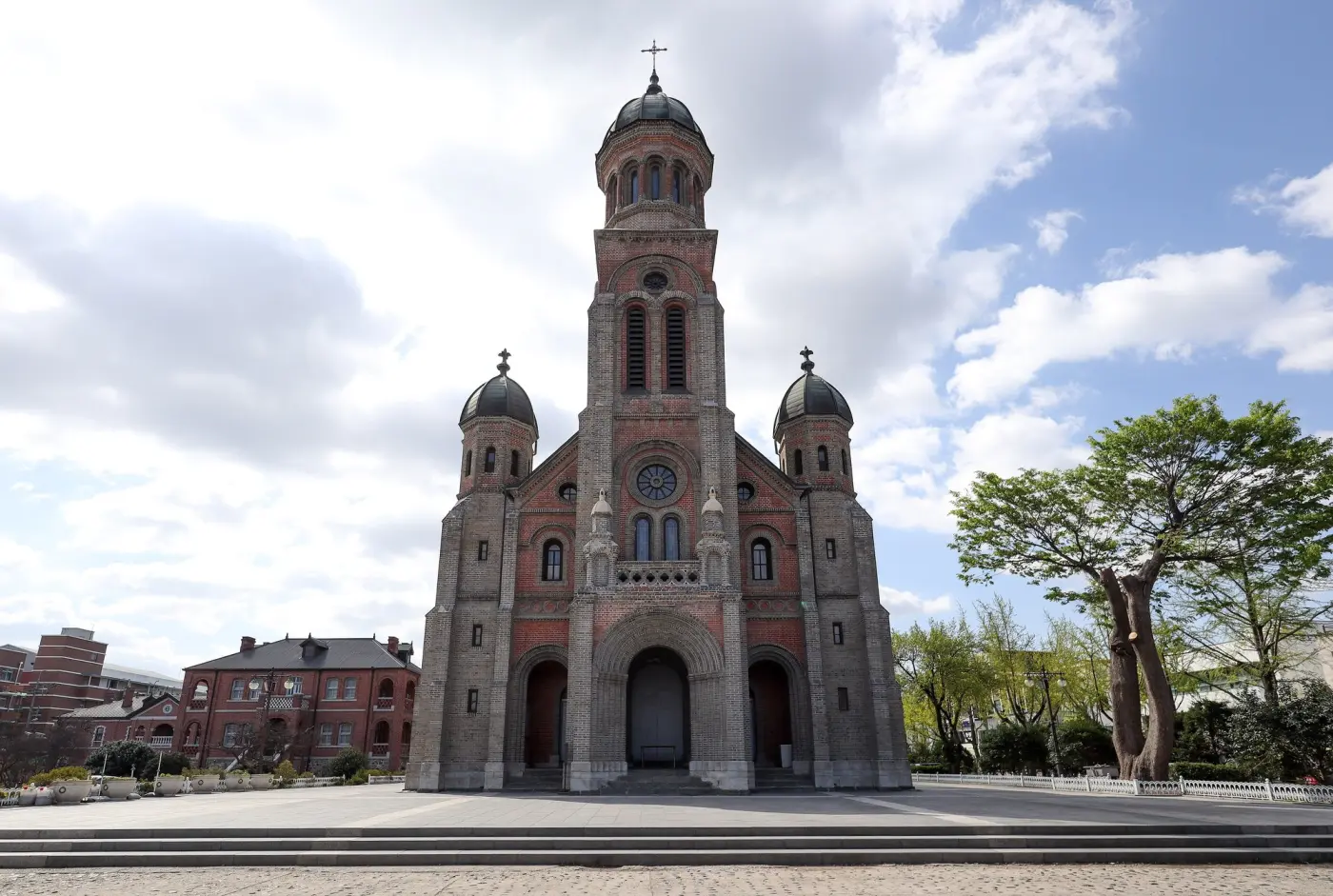
It is an active parish church, not a museum. Visit Jeonju lists opening hours of 09:00 to 17:00, subject to parish circumstances, and publishes the Mass schedule, including a dawn Mass every day from Monday to Saturday and a late-morning Mass from Tuesday to Friday. If you step inside during a service, sit quietly at the back or come back later. Photographs of the façade from the square are the usual approach; inside, follow any posted signs.
Omokdae
Omokdae is a small pavilion on a low hill about 500 metres south-east of Gyeonggijeon. The city's account says that in 1380 the general Yi Seong-gye held a victory banquet here on his way back from defeating pirates, and is said to have revealed his ambition to found a new state; after Joseon was established a pavilion was built on the spot. A monument with Emperor Gojong's calligraphy was added in 1900. A footbridge leads on to Imokdae, linked to Taejo's ancestors.
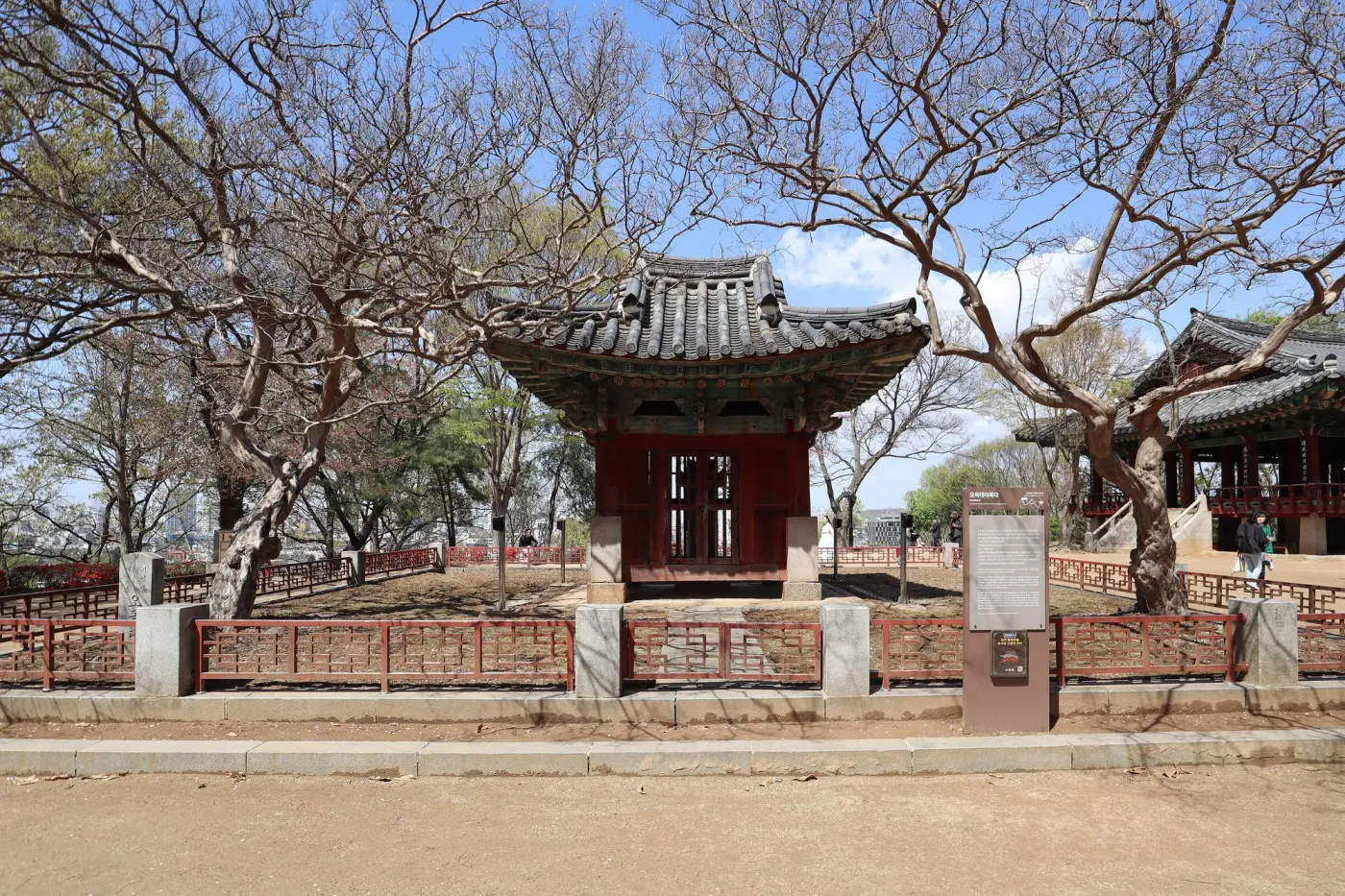
For most visitors the reason to climb is the view. The paths around the pavilion look down over the grey tiled roofs of the whole village, which makes it a useful first stop for getting your bearings or a last stop to see where you have been. The city notes that the paths are lit in the evening and that the hill is known for cherry blossom in spring and crape myrtle in summer.
Jeonju Hyanggyo
On the eastern edge of the village, a few minutes from the busiest streets, the Jeonju Hyanggyo is a local Confucian school that the city dates to the late Goryeo period. Its layout survives: Daeseongjeon, the shrine hall holding the memorial tablet of Confucius, and Myeongnyundang, the lecture hall where students studied. Large ginkgo trees fill the courtyard and turn gold in autumn, which is when the school is busiest, and it has appeared in many Korean period dramas. Remember the Monday closure in the table above.
Nambu Market and the night market
Cross the road at Pungnammun, the southern gate of the old walled town and the only one of its four gates still standing, and you are in Nambu Market, the city's best-known traditional market. During the day it is a working market; on the second floor, the Youth Mall gathers small shops and bars opened by young owners. The official Hanok Village site lists the Nambu Night Market as open on Friday and Saturday evenings from 18:30 to 23:00, with stalls selling a wide mix of snacks. There is also an early-morning street market by the stream, which Visit Jeonju describes as running from about 4:00 to 10:00.
If you only eat one thing here, the city's market page suggests bean sprout soup with rice (kongnamul gukbap) in the Nambu Market style, where hot anchovy-and-kelp broth is poured in and out of the bowl several times over cooled rice and bean sprouts. It is traditionally eaten with roasted laver and a soft poached egg, and paired with moju, a warm drink brewed with medicinal herbs. The market is also known for pisundae, a softer local blood sausage.
Jeonju bibimbap and what else to eat
Bibimbap is the dish Jeonju is most identified with. Visit Jeonju sets out what makes the local version distinct: rice cooked in beef-bone broth, crunchy Jeonju bean sprouts, yellow mung bean jelly (hwangpo-muk), traditionally made gochujang and soy sauce, and more than 30 ingredients arranged by colour, often with raw beef (yukhoe) and a raw egg yolk on top. It usually arrives in a brass bowl with a set of side dishes and a light soup.
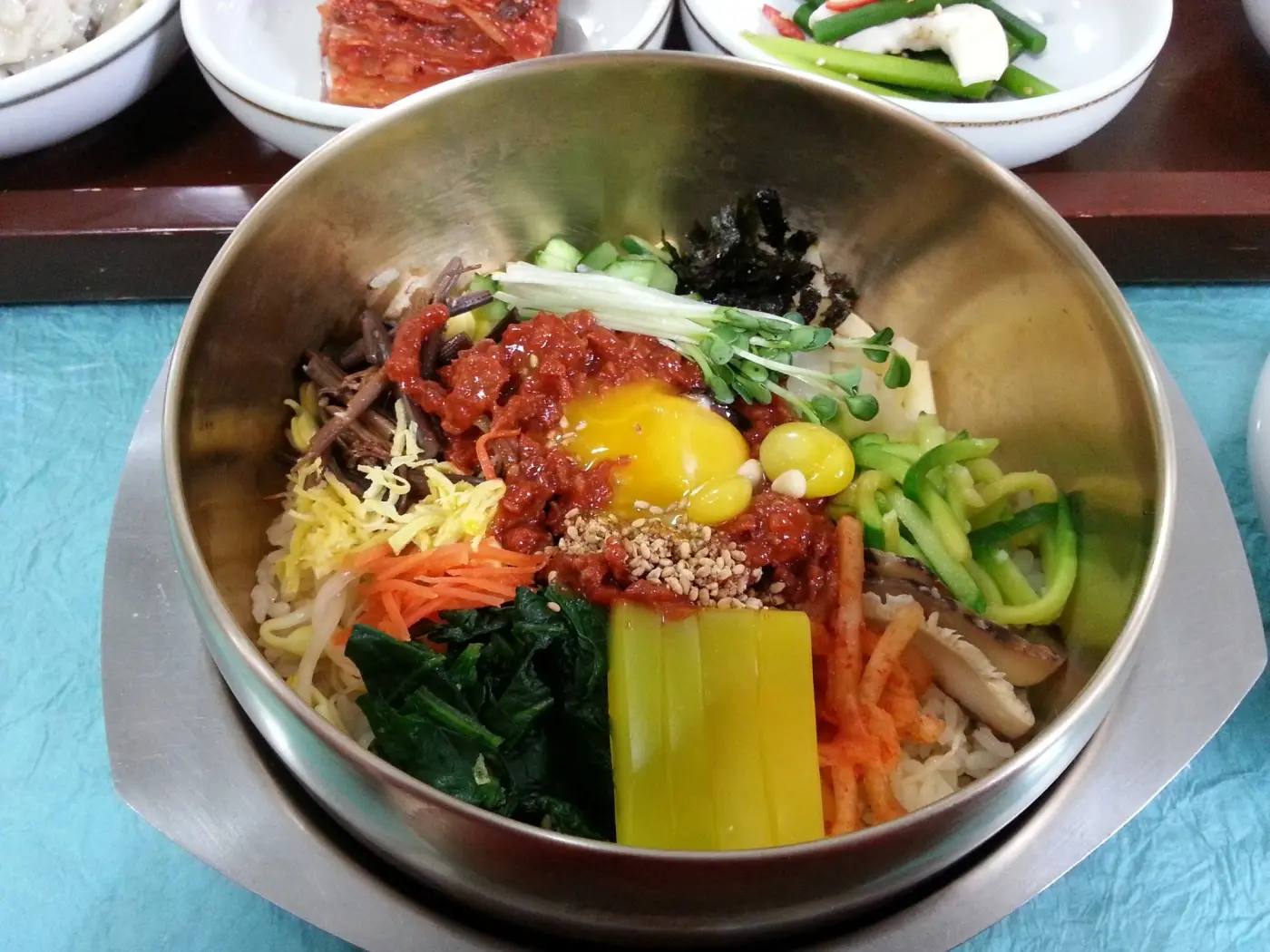
Restaurants serving it cluster around the old town, the Hanok Village, City Hall and the main markets, according to the city's food page, and range from long-established specialists to simple canteens. Rather than one famous address, it is easier to choose by what you want: a full set meal, a quicker lunch, or a version without raw beef if that is not for you. If you eat plant-based, ask for it without meat and egg; our vegetarian and vegan guide has the phrases. Beyond bibimbap, look for kongnamul gukbap at breakfast, pisundae in the market and, in the Hanok Village lanes, plenty of street snacks.
Staying the night in a hanok
Staying over changes the village. The day crowds thin after dinner, the lanes and Omokdae are lit, and you can be at the Hyanggyo or Gyeonggijeon close to opening time the next morning. The official count of 203 accommodation businesses inside the district means choice is wide, from simple rooms to restored traditional houses. Many hanok stays use floor bedding on heated floors, rooms open onto a shared courtyard, and walls are thin, so expect to take your shoes off, keep voices down at night, and check the room description for bed type, private bathroom and heating or cooling. Weekend and autumn nights fill first.
Wearing hanbok in the village
You will see many visitors walking the lanes in rented hanbok, and rental shops are part of the village's businesses. Wearing one is entirely optional. If you do, a few things help: check what is included and when it must be returned, and plan your route before you set off; the skirts are long, so mind steps and the hill paths at Omokdae; and Gyeonggijeon's fourth-Saturday "Hanbok Day" discount is linked to it. At Jeondong Cathedral, remember that people come there to pray, and keep photo shoots to the square outside.
A one-day plan from Seoul
- Morning: an early KTX from Yongsan to Jeonju (about 1 hour 40 minutes). Leave bags in a locker if needed, then take a city bus or taxi to the village.
- Late morning: Gyeonggijeon and the Royal Portrait Museum, then Jeondong Cathedral across the road.
- Lunch: Jeonju bibimbap near Taejo-ro or in the old town.
- Afternoon: walk the side lanes east to the Jeonju Hyanggyo (not on Mondays), then climb Omokdae for the view over the roofs.
- Evening: Nambu Market. On a Friday or Saturday the night market opens at 18:30; on other days have kongnamul gukbap in the market instead. Take an evening train back with a return seat booked in advance.
A one-night plan
- Day 1 afternoon: arrive, check in to a hanok stay, and see Gyeonggijeon and Jeondong Cathedral before they close.
- Day 1 evening: bibimbap for dinner, then Omokdae after dark and, on Fridays and Saturdays, the Nambu night market.
- Day 2 early: the morning street market by Nambu Market, with kongnamul gukbap for breakfast.
- Day 2 morning: the Jeonju Hyanggyo at opening time, the quieter lanes on the east side, and Jaman Mural Village on the hillside, which the official Hanok Village site lists among nearby spots.
- Day 2 afternoon: lunch, a last walk on Taejo-ro, and the train or bus back to Seoul.
Autumn is the most popular season, both for the ginkgo trees and for the city's festivals, which is also why seats sell out; our guide to the best time to visit Korea has the wider picture. If you want more of the region, including where Jeonju fits in the rest of Jeonbuk, see our Jeonbuk page. And if you would like a printable companion for the walk, our Jeonju city guide PDF gathers the neighbourhood, food and routes in one place.
Comments
Sign in to leave a comment.
Sign in ·No account? Create one
Confirm your email address to comment — it takes one click.
No comments yet.