Hangul in an hour: the letters, and how they stack
Hangul was designed to be learned quickly, and it delivers on that. An hour gets you from nothing to sounding out words — which is not the same as understanding them, and is far more useful than it sounds.

An hour, and you can read the sounds
Hangul has twenty-four letters. They get packed into squares, one square per syllable, which is why a page of Korean looks like characters at first glance. It isn’t a set of characters. Learn the letters, learn how they stack, and the squares come apart in your hands.
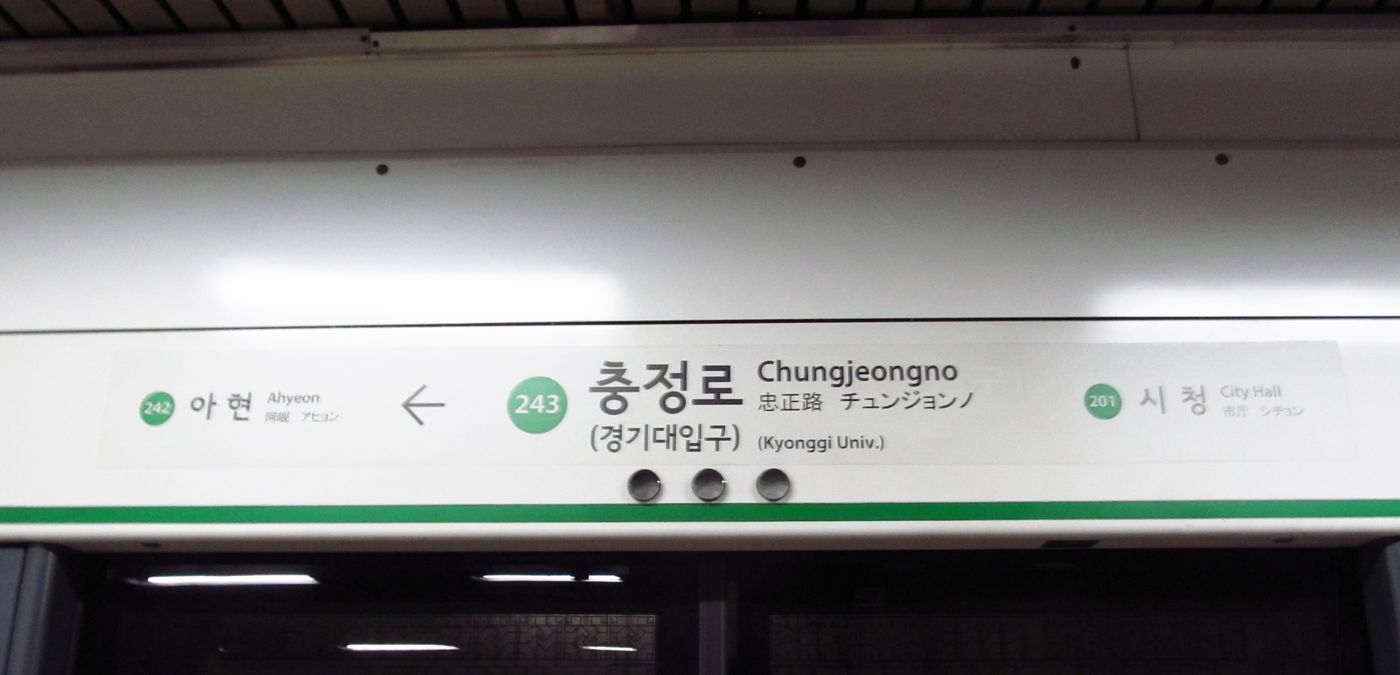
What you’re learning here is sound, not meaning. Reading 부산 as bu-san won’t tell you it’s a city, but it will put you on the right train and it will let a stranger answer your question. Airports and big stations print roman letters underneath the Korean. Walk one street off the main route and they’re gone.
- Bus destination boards, which often carry no roman letters at all.
- A handwritten menu taped to a window, or the day’s special written on a board.
- The address of the place you’re staying, checked against the sign on the building.
- Everything, the moment your phone battery is gone.
Work through this chapter with a pen. Copying a letter once fixes it in a way that looking at it doesn’t. Stroke order doesn’t matter for our purposes — you’re learning to read, not to write neatly.
The fourteen consonants
Here they are, with the sound written underneath. Treat that roman letter as a hint, not as a spelling. Korean has no fixed spelling in roman letters, so the same name can turn up two ways on two signs, and both are right.
- ㄱg / k
- ㄴn
- ㄷd / t
- ㄹr / l
- ㅁm
- ㅂb / p
- ㅅs
- ㅇng / -
- ㅈj
- ㅊch
- ㅋk
- ㅌt
- ㅍp
- ㅎh
- ㅋ, ㅌ, ㅍ and ㅊ are ㄱ, ㄷ, ㅂ and ㅈ with one stroke added, and the stroke means a puff of air. Hold your palm in front of your mouth: ㅋ moves it, ㄱ doesn’t. That’s four letters you don’t have to learn separately.
- ㄱ, ㄷ and ㅂ each show two sounds. They come out soft between vowels and hard at the start or the end of a word. You don’t have to steer this; it happens by itself once you speak at normal speed.
- ㄹ falls between r and l. The closest thing in English is the quick tap in the middle of "butter" — one flick of the tongue against the ridge behind your teeth. Close enough is fine here.
ㅇ is the letter to watch, because it does two jobs. At the top of a square it makes no sound at all; it’s a placeholder that keeps the square from looking half empty when a syllable begins with a vowel. At the bottom of a square it’s ng. So 아 is just a, and 앙 is ang.
The ten vowels
Vowels are strokes rather than shapes. Each one is a long stroke with a short tick on it, and the direction of the tick tells you the sound. Add a second tick and you add a y in front of it.
- ㅏa
- ㅑya
- ㅓeo
- ㅕyeo
- ㅣi
- ㅗo
- ㅛyo
- ㅜu
- ㅠyu
- ㅡeu
Telling ㅏ from ㅓ, and ㅗ from ㅜ
These four are where readers stall, and they’re also the four you’ll meet most often. Read the tick as an arrow and they come apart.
| Where the tick points | The sound |
|---|---|
| ㅏ — to the right | a, as in "father". |
| ㅓ — to the left | eo: the vowel in "cut". Not the a above, and not the o below. |
| ㅗ — upward | o, as in "go", with the lips rounded. |
| ㅜ — downward | u, as in "food", with the lips pushed forward. |
| ㅡ — no tick at all | eu: the same u, but with the lips pulled wide instead of rounded. |
Copy those four ticks onto paper now: right, left, up, down. That’s most of the vowel system. What’s left is the same four with a y added, plus the two bare strokes.
Letters stack into a square
Korean doesn’t run its letters in a line. It packs them into a square, one square per syllable, and you read the square the way you read a page: left to right, top to bottom. The consonant comes first. The vowel goes to its right if the vowel is tall, and underneath if the vowel is flat.
- 가ga
- 나na
- 마ma
- 사sa
- 아a
- 고go
- 노no
- 모mo
- 소so
- 오o
- Find the letter at the top left. That’s the consonant, and it goes first.
- Find the vowel: to the right of the consonant, or underneath it.
- Say the two together. If a third letter sits at the bottom of the square, it closes the sound — that’s the next page.
Look at 아 and 오 in the last column. The ㅇ makes no sound there — it’s holding the consonant’s seat so the square doesn’t sit lopsided. Every syllable that starts with a vowel sound is written with this letter in front of it.
The letter at the bottom
A square can hold a third letter, tucked underneath. It closes the syllable instead of starting a new one. 바 is ba; put ㅂ under it and 밥 is bap, said with your lips shut at the end and no puff of air after.
- 각gak
- 간gan
- 갈gal
- 감gam
- 강gang
- 밥bap
- 물mul
- 문mun
- 산san
- 김gim
Most consonants can go down there, but at the bottom they collapse into seven closing sounds. This is the whole system, and it’s shorter than you’d expect.
| At the bottom of the square | It closes as |
|---|---|
| ㄱ ㅋ ㄲ | k — the back of the tongue shuts it. |
| ㄴ | n |
| ㄷ ㅅ ㅆ ㅈ ㅊ ㅌ ㅎ | t — the tongue stops it dead. Seven letters, one sound. |
| ㄹ | l — here it really is an l. |
| ㅁ | m |
| ㅂ ㅍ | p — lips shut, no air after. |
| ㅇ | ng — the one place ㅇ has a sound. |
One rule explains most of the romanizations that don’t match what you read. When the next square begins with ㅇ, the bottom letter slides across and is said at the front of it. 한국어 is written han-guk-eo and comes out han-gu-geo. Once you notice this, you see it everywhere.
Doubled letters and blended vowels
Two small sets are left, and then you have the whole system. Neither needs studying. You can recognize both on sight, because both are built out of parts you’ve already learned.
- ㄲkk
- ㄸtt
- ㅃpp
- ㅆss
- ㅉjj
Vowels combine as well, and the combination is drawn as the two vowels standing side by side. You can take each one apart on the page.
- ㅐae
- ㅔe
- ㅘwa
- ㅝwo
- ㅟwi
For reading, treat ㅐ and ㅔ as the same sound, the e in "bed". Saying one for the other will not stop anyone from understanding you. There are a few more blends than these five, built the same way, so you can take them apart when you meet them.
Chapter 2 in six lines
- Twenty-four letters, packed into squares, one square per syllable.
- Read the square the way you read a page: left to right, top to bottom.
- A tall vowel stands to the right of the consonant; a flat one lies underneath it.
- ㅇ is silent on top of a square and ng at the bottom of one.
- A letter at the bottom closes the syllable, and slides into the next square if that square starts with ㅇ.
- You’re reading sound, not meaning. That’s enough to get on the right train.
Questions people actually ask
- How long does it really take to learn Hangul?
- An hour to read the sounds, which is the claim this page makes and the one worth making. Reading fluently and understanding what you read are longer projects, and neither is needed to find your platform.
- Is learning Hangul worth it for a short trip?
- It pays for itself the first time you match a sign to a name in your phone. Signs, tickets and menus are written in it and mostly not translated, so reading the sounds turns a wall of shapes into words you can compare.