One phrase, one small bow, and what to call people
One phrase — annyeonghaseyo — carries almost all of it, and the rest is smaller than you think. This is the whole of it: what to say, how far to bend, and what to call the person in front of you.
One phrase does almost all the work
안녕하세요 covers hello, good morning, good afternoon, good evening, and "excuse me, I have arrived" — for a shopkeeper, a taxi driver, a hotel clerk, a stranger holding a door. It’s polite enough for anyone and never too stiff. If you learn one thing in this book, make it saying this one without thinking.
안녕하세요
annyeonghaseyo
The two ways it goes wrong
- Stressing a syllable. English speakers tend to hit "nyeong" or "se" hard. Korean doesn’t stress syllables the way English does — keep all five flat, like counting off.
- Using 안녕 by itself. That’s the same word with the polite ending stripped off, so to a stranger it lands like "hey." Keep the -세요.
You’ll hear locals shorten it with each other all the time. That’s not permission — it marks a relationship that already exists, and you don’t have one yet.
The bow is smaller than you think
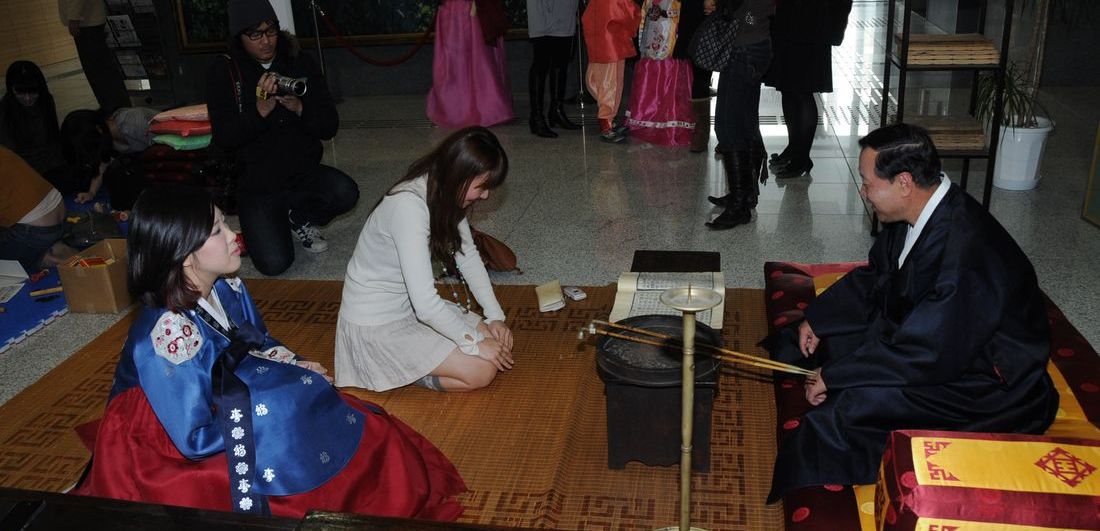
Foreign visitors almost always bow too deeply, which comes off as either theatrical or as an apology for something. Day to day, the greeting is a short nod from the neck and shoulders, held about a second. That’s it.
There are three depths, and you’ll live at the first one. The everyday nod covers ninety-nine times out of a hundred. A fuller bow goes with a formal introduction or a heartfelt thank-you. The deep bow is for ceremony and serious apology. When in doubt, the nod is never wrong.
- Let your eyes drop as you go, instead of locking onto the other person. Holding eye contact through a bow feels uncomfortable here.
- Hands at your sides, or one resting lightly over the other in front. Not in your pockets.
- A bow instead of a handshake is always safe. Bowing while you offer your hand is common in business and perfectly fine too.
Names run family-name first
Kim Min-jun is Mr. Kim, not Mr. Min-jun. The family name comes first and is usually one syllable; the given name is usually two. Most Koreans you meet professionally introduce themselves family-name-first even in English, though some flip it to be helpful — which is exactly how the confusion starts.
If you’re not sure which part is the family name, just ask. "Sorry — which one is your family name?" is a perfectly normal question and takes four seconds. Guessing wrong and running with it for three days is the worse outcome.
성이 어떻게 되세요?
seongi eotteoke doeseyo?
씨 and 님, and why you rarely use a bare name
Korean almost always attaches something to a name. A name with nothing after it is what you use for close friends, children, and subordinates — so using it on someone you’ve just met isn’t neutral. It’s a small demotion.
| Form | When to use it |
|---|---|
| …씨 (-ssi) | Your default for an adult you’ve just met, tacked onto the full name or the given name. Kim Min-jun becomes 김민준 씨. Safe, neutral, and the one you’ll use most. |
| …님 (-nim) | More deferential. It’s everywhere in service settings — 고객님 for a customer — and it’s standard in writing and online. Not wrong in person, just a touch formal. |
| Job title | At work, the title usually replaces the name outright — a manager is addressed by title, not by name. Nobody expects a visitor to navigate this; ‑씨 has you covered. |
Two hands, and the card you’re given
Anything passed between people of different age or rank goes with two hands — or with the right hand while the left touches the forearm. Business card, gift, glass, payment, pen: same rule. It costs you no extra time, and people notice.
- Take the card with both hands and actually read it. Two seconds of looking is the whole courtesy.
- Don’t stuff it in a back pocket, and don’t write on it in front of them.
- In a sit-down meeting, leave the cards on the table in front of you until the end. They double as a seating chart.
If you don’t have cards, say so plainly instead of apologizing at length. "I don’t have a card on me — may I write my details down?" closes it cleanly.
One polite register is all you need
Korean has several levels of speech, and learning the whole system is a real study project. As a visitor, you don’t need it. Stay in the -요 form for everything and you’ll be correct with every person you meet, in every setting, for the entire trip.
- Over-polite is invisible. Under-polite is not. When in doubt, go up a level.
- No one expects you to speak Korean. Three words said politely land better than thirty said casually.
한국어를 조금밖에 못 해요.
hangugeoreul jogeumbakke mot haeyo.
Leaving, and thanking
Korean has two goodbyes, and the difference is who’s leaving. It looks fussy on the page; it’s automatic within a day.
안녕히 계세요
annyeonghi gyeseyo
안녕히 가세요
annyeonghi gaseyo
감사합니다
gamsahamnida
Mix the two goodbyes up and nothing happens. Someone might smile. That’s a far smaller risk than walking out without saying anything, which does register as cold.
Chapter 3 in six lines
- 안녕하세요 — five even syllables, and keep the -세요.
- A one-second nod is the greeting. Deep bows are for ceremony.
- Family name first. Not sure? Ask — it takes four seconds.
- Attach 씨 to a name. A bare name isn’t neutral.
- Two hands for anything handed over. Read the card you’re given.
- Stay in the -요 form all trip. Over-polite is invisible.
Questions people actually ask
- Do I have to bow in Korea?
- A small nod from the waist is plenty, and nobody expects a deep bow from a visitor. The deep, kneeling bow you may have seen belongs to New Year and to funerals, not to a shop door.
- Which comes first in a Korean name?
- The family name. It is usually one syllable and the given name usually two, so a name like Kim Minjun is Mr/Ms Kim. Getting this backwards is the single most common misstep, and the page above shows how to address people once you have it right.