
Hwaseong Fortress, Suwon: A Complete Visitor's Guide
Walk the Hwaseong Fortress wall gate by gate, then the palace, trolley, archery, night views, festival and Suwon galbi, with half-day and full-day routes.
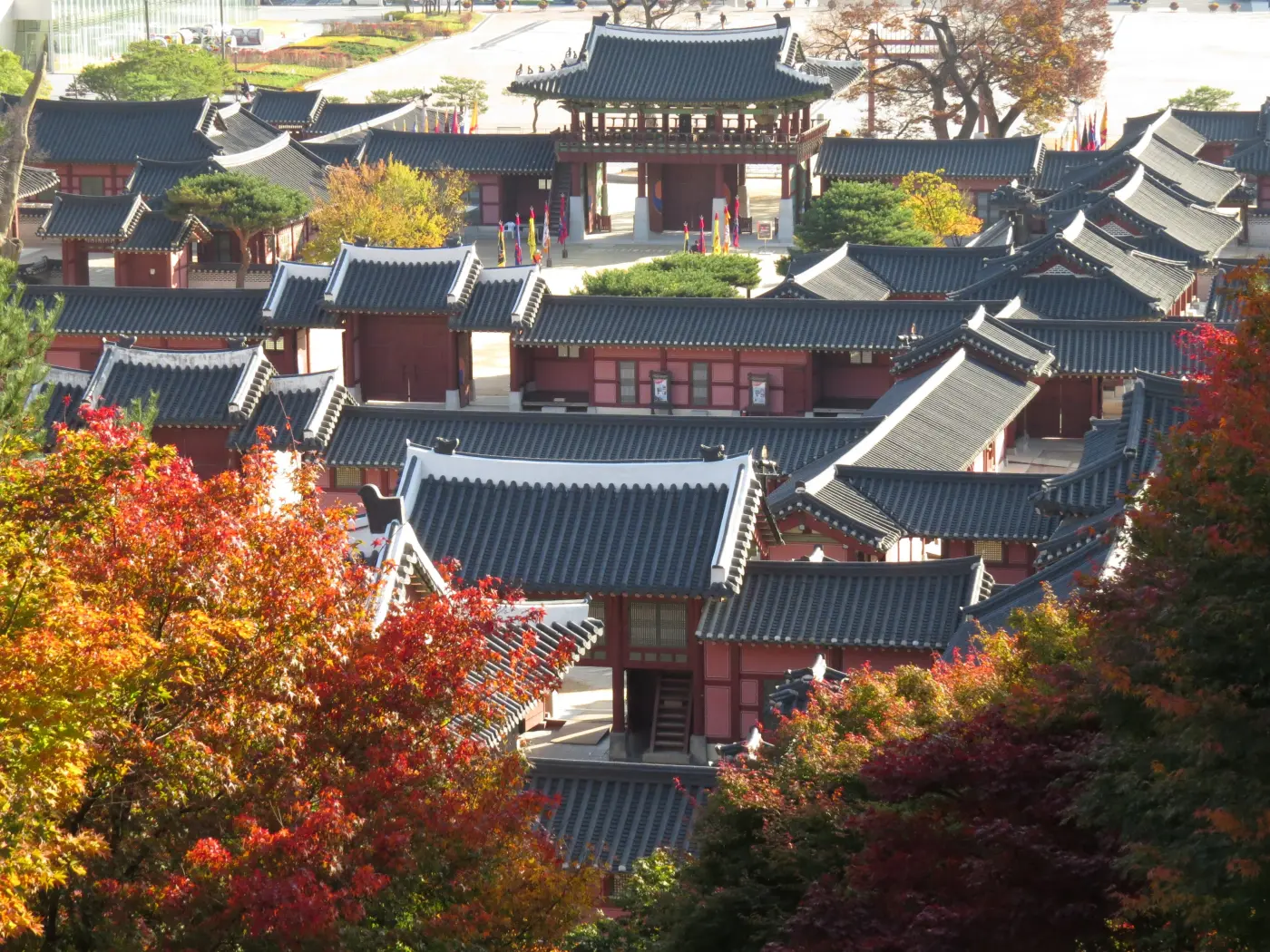
Most visitors meet Hwaseong Fortress as one stop on a list of day trips from Seoul: an hour on the subway, a stretch of wall, a palace, then back to the capital. That works, and our day-trips guide covers the basics of getting there. But Suwon rewards a slower look. The fortress is not a single monument but a ring of gates, watchtowers, command posts and water gates wrapped around a living city, and each piece was designed to do a specific job. Once you know what you are looking at, the walk turns from a pleasant stroll into a lesson in late-18th-century engineering.
This guide goes deeper than a day-trip summary. It walks you round the wall gate by gate, explains what happens inside Hwaseong Haenggung, the palace at the centre of the old town, and sorts out the trolley, the archery range, the night-time programmes and the autumn festival. Hours and fees come from the Suwon Cultural Foundation, which runs the site, and from Suwon City; they are listed at the end. Where two official pages did not agree, we have left the detail out and pointed you to the source instead.
Why Hwaseong looks the way it does
King Jeongjo, the 22nd ruler of the Joseon dynasty, moved the tomb of his father, Crown Prince Sado, to a hill near Suwon in 1789, relocated the local town to the foot of Paldalsan, and then enclosed the new town with a fortress. According to the Suwon Cultural Foundation, construction began in January 1794 and was finished in September 1796. The foundation lists three motives: filial devotion to his father, a political plan to strengthen royal authority against court factions, and a defensive stronghold south of the capital.
Two things make it unusual. First, it is what Koreans call a pyeongsanseong, a fortress that is half on flat ground and half on a hill: the eastern side runs across level land, while the western side climbs over Paldalsan. Second, it was built with new methods for the time, including a mix of stone and brick and lifting devices such as the geojunggi crane. Parts were damaged during the Japanese colonial period and the Korean War, and most of the lost sections were rebuilt between 1975 and 1979 using Hwaseong Seongyeok Uigwe, the detailed construction report published in 1801. That report is the reason the restoration could be so exact.
Suwon City and the foundation both describe the fortress wall as open at all times, all year, with no admission charge, and note that you can walk it after dark. Only Hwaseong Haenggung and a few attractions inside the walls charge for entry.
The wall walk: an official full-circuit route
Suwon City publishes several walking courses along the wall, from about 60 minutes up to a 180-minute full circuit. The 180-minute course starts and ends at Paldalmun and runs in this order: Paldalmun, Seojangdae, Hwaseomun, Janganmun, Banghwasuryujeong, Changnyongmun, Bongdon, Namsumun, and back to Paldalmun. Going this way round gets the only real climb, up Paldalsan to Seojangdae, out of the way while your legs are fresh. After that, the route is mostly downhill or level.
Here is what you pass, in walking order.
Paldalmun (South Gate). Work began on 28 February 1794 and ended on 15 September the same year. The name comes from a Korean phrase meaning "open in all directions", and it was the gate King Jeongjo and later kings used on the way to his father's tomb. Like the north gate, it is protected by an ongseong, a curved outer wall that forces attackers into a confined space before the gate itself. Today the wall is cut on both sides of it, and roads and traditional markets have grown into the gap.
Seojangdae (West Command Post). The command post sits on the summit of Paldalsan and was built in August and September 1794. The name board reading Hwaseongjangdae was written by King Jeongjo himself. The foundation notes that in February 1795, after visiting his father's tomb, the king came here to direct defensive drills that went on late into the night. Suwon City recommends it as a viewpoint over the whole city, including at sunrise.
Hwaseomun (West Gate) and Seobuk Gongsimdon. Coming down from Paldalsan you reach the west gate, built between July 1795 and January 1796 on the road towards the west coast. It survives in its original form. Beside it stands Seobuk Gongsimdon, a three-storey watchtower with a stone base and brick upper levels, with stairs and fighting positions inside so that soldiers could watch for and fire on an approaching enemy. The foundation records that when King Jeongjo saw it in 1797, he praised it as the first defence structure of its kind in the country. Look on the stone wall inside the gate's curved enclosure: the names of the workers and the foreman are carved there.
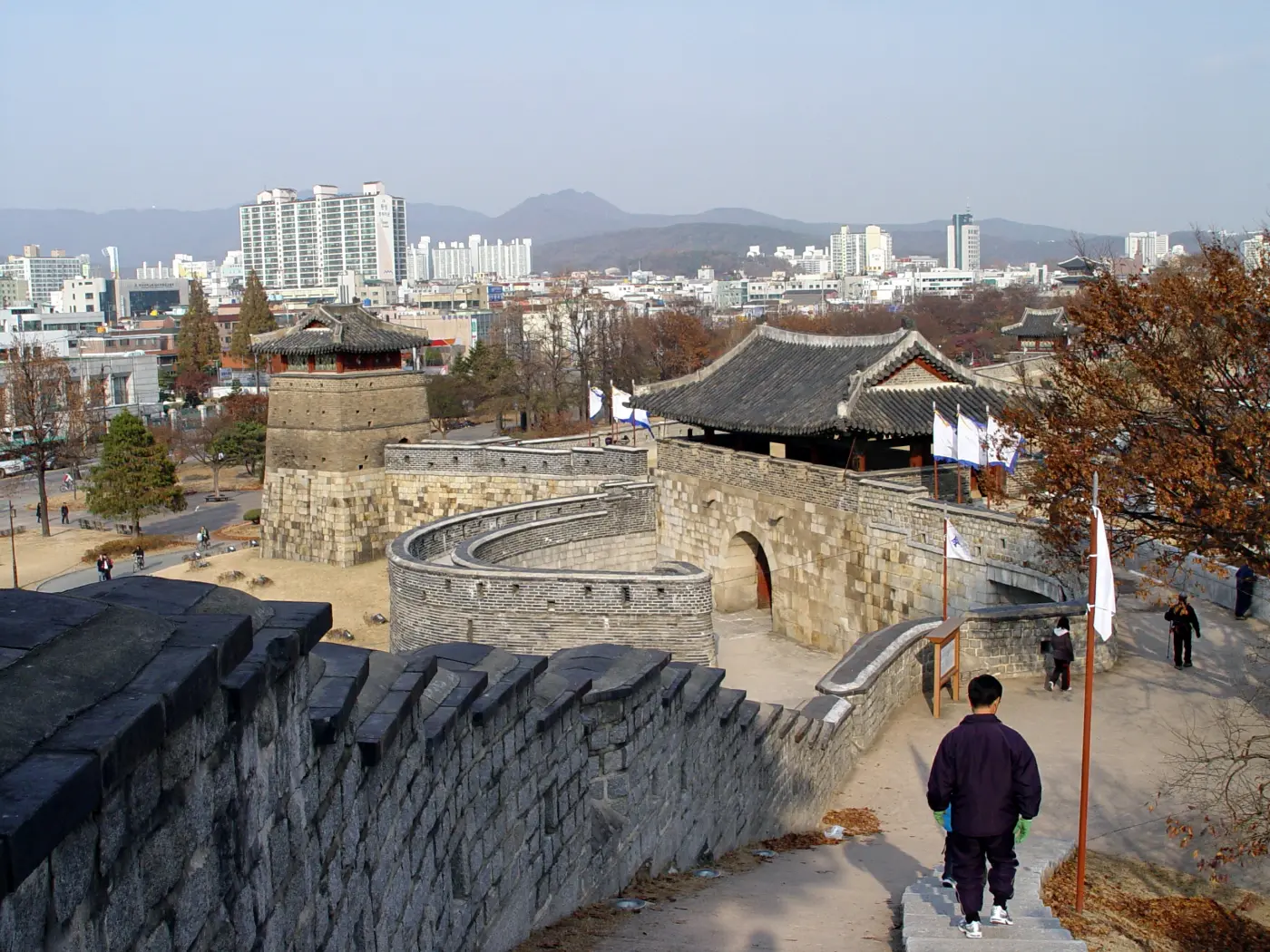
Janganmun (North Gate). Built between February and September 1794, this is the gate King Jeongjo used to enter the city, which is why Suwon City calls it the fortress's main gate. Its name combines the ideas of the capital and the welfare of the people. From here the wall drops towards the Suwoncheon stream.
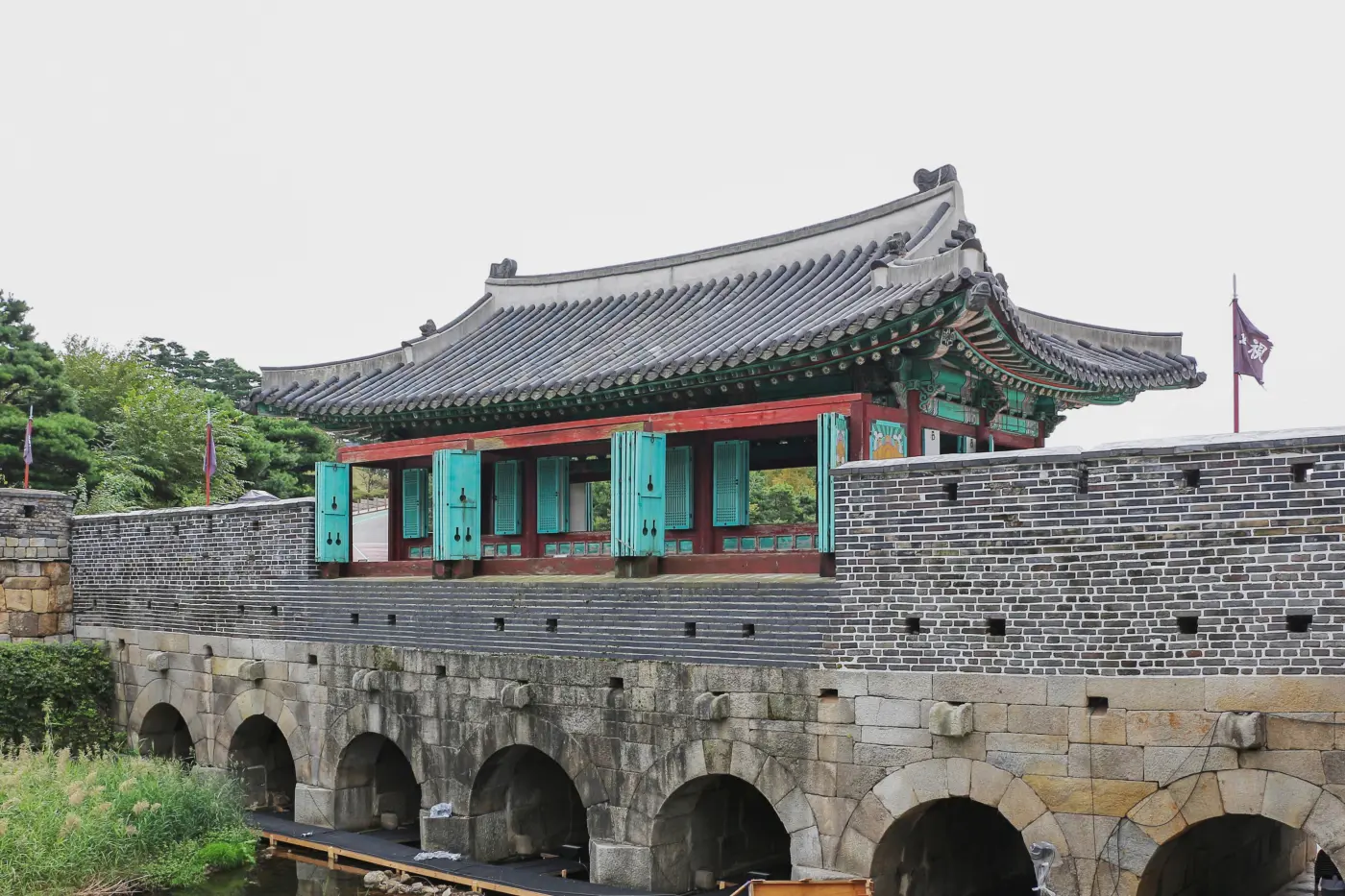
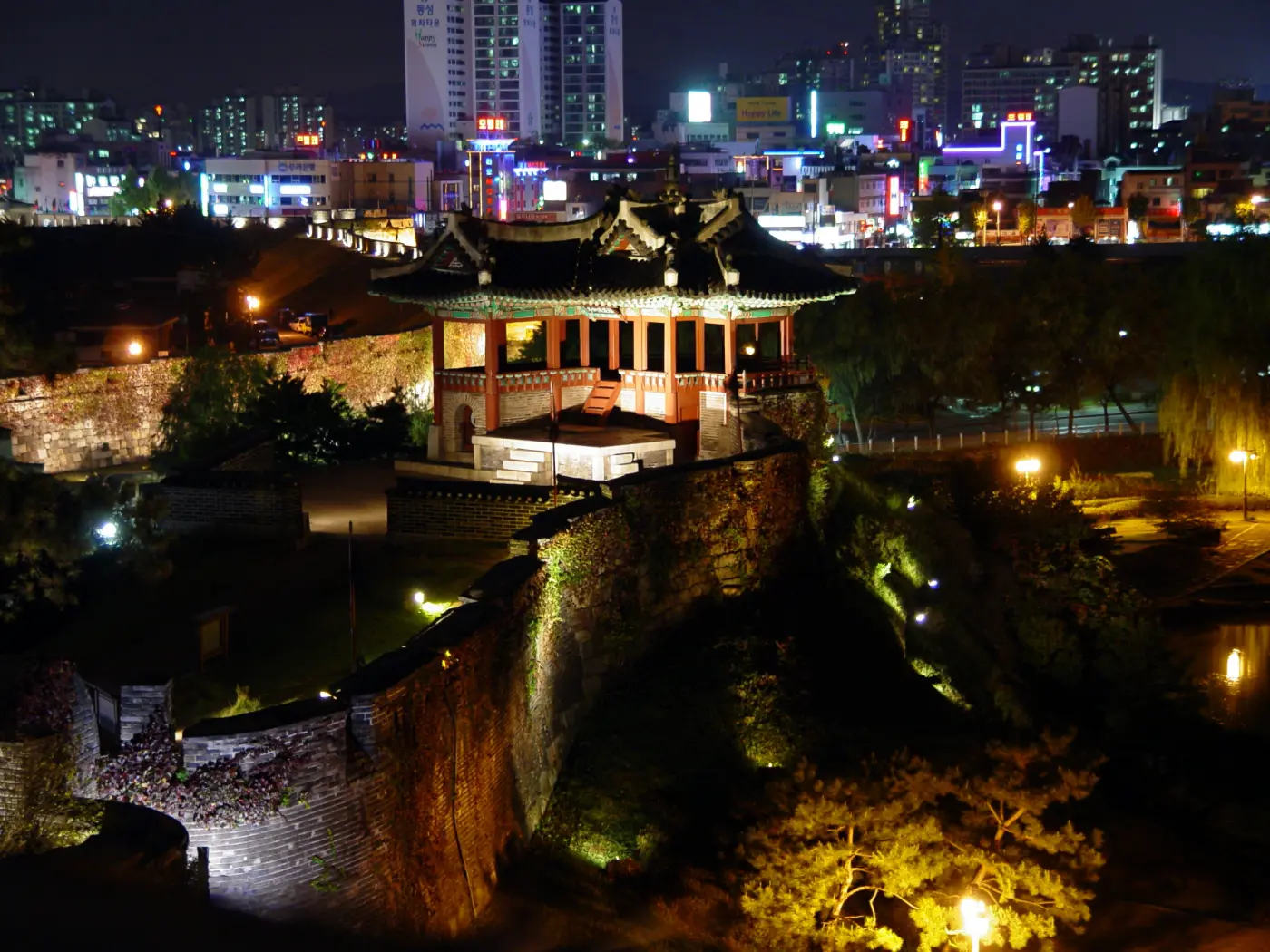
Hwahongmun and Banghwasuryujeong. Hwahongmun, officially Buksumun (North Water Gate), carries the wall over the Suwoncheon stream on seven stone arches; its name combines Hwaseong with the word for rainbow. It was completed in January 1795. Just above it, on a rise overlooking the pond called Yongyeon, is Banghwasuryujeong, finished in October 1794. It served as a watchtower, a command post and a pavilion at once, and its name means roughly "a pavilion that seeks flowers and follows the willows". The foundation calls it the most beautiful structure in the fortress, and the grassy banks of the pond below are a popular place to sit.
Changnyongmun, Dongjangdae and Bongdon. The east side of the circuit is flat and open. Dongbuk Gongsimdon, the round watchtower with a spiral brick staircase inside, is on this stretch. Dongjangdae, the east command post, was also called Yeonmudae, a martial arts training ground, and it is still where the trolley starts and where you can try archery. Changnyongmun, the east gate, has an outer enclosure left open on one side, unlike the north and south gates. Further south, Bongdon is the beacon tower; Suwon City notes it was placed on open ground in the east so that signals could be seen directly from the palace.
Namsumun (South Water Gate). The last structure before you close the loop at Paldalmun is the second water gate over the Suwoncheon. It has nine arches rather than Hwahongmun's seven, to cope with the larger volume of water downstream. It is also the newest-looking part of the wall: according to Suwon City, the site was excavated from 2004 and the restoration was completed in June 2012.
Two free extras make the walk more rewarding. A stamp tour runs all year at ten points including the gates, Seojangdae and the palace; VisitKorea says you can pick up a booklet at a tourist information centre and claim a small souvenir after collecting at least seven stamps. The foundation also runs guided tours by trained cultural tourism interpreters, with English and Japanese among the listed languages; ask at the information centres by the gates, which are staffed from 10:00 to 17:00.
Hwaseong Haenggung: the palace inside the walls
A haenggung is a temporary palace where the king stayed when he travelled outside the capital. Hwaseong Haenggung was the largest of them, and the foundation records that King Jeongjo stayed here on each of his 13 visits to his father's tomb. When the king was not in residence it served as the office of the governor of Hwaseong. In 1795 the king held a banquet in the main hall, Bongsudang, to celebrate the 60th birthday of his mother, Lady Hyegyeong; the hall's name expresses a wish for her long life. Most of the palace was destroyed during the colonial period, with Nangnamheon among the few buildings to survive. Restoration began in 1996, and Suwon City says the palace opened to the public in 2003.
If you have visited the Seoul palaces, Haenggung feels different: smaller, more domestic, and arranged as a working government office as much as a royal residence. Next door is Hwaryeongjeon, a shrine built in 1801 to hold King Jeongjo's portrait, which is included in the same ticket.
Practical details, as of October 2026: the palace is open every day from 09:00 to 18:00. The foundation's English and Korean pages give different last-entry times, so arrive well before 17:00 to be safe. Adult admission for the palace and Hwaryeongjeon is 2,000 won, and an integrated ticket covering the palace, the Suwon Hwaseong Museum and Suwon Museum is 4,000 won. Admission is free on the last Wednesday of each month, except for night openings.
Performances at the palace gate
Two regular performances take place outside Sinpungnu, the palace's main gate. The foundation's English pages list both as free to watch.
- Muye 24gi martial arts demonstration: a display of the 24 combat techniques recorded in Muye Dobo Tongji, the illustrated martial arts manual King Jeongjo commissioned in 1790. The soldiers of his royal guard, the Jangyongyeong, trained in these techniques. The foundation's Korean listing for 2026 gives Tuesday to Sunday at 11:00, with a second show at 14:00 on Saturdays and Sundays, and no show on Mondays.
- Jangyongyeong Royal Guard Ceremony: a ceremony recreating the king's royal guard, the Jangyongyeong, which King Jeongjo expanded into a full military unit in 1793. It runs on Sundays in spring and autumn, with a break for the summer heat; in 2026 the season ran from 19 April to the end of October. The foundation's English and Korean pages list different start times, so check the Korean page before you go.
The Hwaseong trolley (Hwaseong Eocha)
You will see this called the Hwaseong Fortress Tourist Trolley in English and Hwaseong Eocha in Korean; eocha means royal carriage. It is the same thing. Its design is modelled on a Joseon king's palanquin and the car of Sunjong, Korea's last emperor. The trolley leaves from Yeonmudae and loops past Hwahongmun, Janganmun, Hwaseomun and Maehyanggyo Bridge before returning to Yeonmudae; VisitKorea gives the loop as about 20 minutes, with departures every 20 minutes from 09:40 to 17:00, Tuesday to Sunday. VisitKorea lists audio commentary in English and Japanese among its languages.
Each trolley has 36 seats. The foundation sells all of them online up to the end of the following month, and any seats left over are sold at the Yeonmudae ticket office on the day, so on weekends and in autumn it is worth booking ahead. As of October 2026 an adult fare is 6,000 won. The older English page also warns that the trolley does not run in rain or snow. The trolley is a good way to see the flat eastern and northern sides if you want to save your energy for Paldalsan, but it does not climb to Seojangdae.
Traditional archery at Yeonmudae
Yeonmudae was where the king's guard practised martial arts, so it is a fitting place to pick up a Korean bow. The archery experience runs at the range there from 09:30 to 17:30 between March and October and from 09:30 to 17:00 between November and February, with a lunch break from 12:00 to 13:00. As of October 2026, one round of 10 arrows costs 3,000 won, and you aim at a bear target, a design the foundation says only the king was allowed to use in the Joseon period. Instructors start with a short explanation of the bow and of how to stand. Like the trolley, it stops in rain or snow. Tickets are sold at the same Yeonmudae office as the trolley, so the two pair neatly.
Hwaseong after dark
Because the wall is open at all hours, you can walk sections of it after sunset, and the lit-up gates and pavilions are one of the best reasons to stay into the evening. The most rewarding stretch is around Banghwasuryujeong, Hwahongmun and Janganmun, where the lights reflect in the pond and the stream. The hill section around Seojangdae is steep, so at night the flat northern and eastern sides are the easier choice.
Hwaseong Haenggung also opens at night in the warmer months. In 2026 the night opening ran from 1 May to 1 November on Fridays, Saturdays, Sundays and public holidays, from 18:00 to 21:30 with last entry at 21:00, according to both the foundation and Suwon City. The dates are set each spring and can change, so check before you plan around it.
Several seasonal events also use the fortress as a stage at night. The Suwon National Heritage Night (also listed as Suwon Cultural Heritage Night) ran from 14 to 16 August 2026 between Banghwasuryujeong, Hwahongmun, the Suwoncheon, Haenggung Square and Paldalmun. The Suwon Hwaseong Media Art festival projected light shows onto Hwaseomun and filled Jangan Park with installations from 19 September to 6 October 2026, from 18:00 to 22:00. Both are annual; the 2027 dates had not been announced at the time of writing.
The Suwon Hwaseong Festival
The city's biggest event takes place every autumn and is built around a historical journey: King Jeongjo's eight-day procession to Suwon in 1795. VisitKorea says the festival has been running for more than 60 years, and its centrepiece is a re-enactment of that royal procession, which VisitKorea describes as Korea's largest royal parade. Other programmes include night-time military drills and water performances around Banghwasuryujeong. The festival's own site lists the 63rd edition as 4 to 11 October 2026, with the royal procession on 4 October. Expect the old town to be crowded and some roads to close on procession day; if you prefer a quiet wall walk, go on a weekday outside the festival week.
Haenggung-dong streets and the markets
The neighbourhood around the palace, Haenggung-dong, is where most visitors end up eating and resting. The foundation describes Haenggung Street, running for roughly 420 metres from the palace towards Paldalmun, as a mix of craft workshops and small eateries decorated with murals and art pieces. North-west of the palace, the lanes between Hwaseo Park and Hwahongmun, often called Haengnidan-gil, are full of small cafes, restaurants and studios, and VisitKorea notes that several K-dramas have filmed there. Around Paldalmun, the gap in the wall is filled by traditional markets; VisitKorea describes Suwon Nammun Market, a group of nine markets, as the largest market complex in Gyeonggi Province. Shops open and close on their own schedules, and many cafes close one day a week, so do not plan your day around a single address.
Suwon galbi
Ask Koreans what Suwon is known for and the answer is usually two things: the fortress and galbi, grilled beef short ribs. A feature in the Korean government's culture webzine traces the link back to King Jeongjo, who gave farmers cattle to develop the area; Suwon grew a large cattle market, and with it a steady supply of beef. The local style of marinated galbi took shape in the 1940s around Yeongdong Market, and the city designated galbi as its specialty in April 1985. The same article notes two features that set Suwon galbi apart: the ribs are cut in larger pieces than elsewhere, and the marinade is seasoned with salt rather than soy sauce. You will find both saeng galbi (unmarinated, salted ribs) and yangnyeom galbi (marinated) on menus. It makes a natural dinner after a day on the wall; our galbi page and Korean barbecue guide explain how ordering and grilling work.
Getting there and getting around
Suwon Station is served by both Seoul Subway Line 1 and the Suin-Bundang Line. Our day-trips guide gives the simplest route from there: city buses 11, 13 or 13-4 from near Exit 4 to the Hwaseong Haenggung stop. Suwon City's directions page adds alternatives depending on where you want to start. For Paldalmun and the 180-minute circuit, buses 2-2, 36, 39 and several others run from the Maesan Market stop outside Exit 9 to the Paldalmun stop. On the Suin-Bundang Line you can also get off at Maegyo Station and take a bus such as 20-1, 25 or 112 from Exit 7 to Paldalmun. For Yeonmudae, where the trolley and archery start, buses 7-2, 60, 660 and 700-2 run from the Suwon Station stop to the Changnyongmun / Yeonmudae stop. Bus routes change, so confirm on the day; the tourist information centre near Exit 4 of Suwon Station is open from 09:00 to 18:00 and can help in English and Japanese.
Spots at a glance
| Spot | What it is | How long to allow | Notes |
|---|---|---|---|
| Paldalmun | South gate, start of the official full circuit | 15 min | Surrounded by traffic and markets; wall cut on both sides |
| Seojangdae | West command post on top of Paldalsan | 30 min incl. climb | Steepest part of the walk; city-wide views |
| Hwaseomun and Seobuk Gongsimdon | West gate and three-storey watchtower | 20 min | Look for workers' names carved inside the gate enclosure |
| Janganmun | North gate, treated as the main gate | 15 min | The gate King Jeongjo used to enter Suwon |
| Hwahongmun and Banghwasuryujeong | Water gate over the stream and a pavilion above a pond | 30–45 min | Best spot for sitting by the water; lit at night |
| Yeonmudae (Dongjangdae) | East command post and training ground | 30–60 min | Trolley and archery start here; closed in rain or snow |
| Hwaseong Haenggung | Temporary royal palace and Hwaryeongjeon shrine | 1–1.5 hours | Paid entry; martial arts show outside Sinpungnu, Tue–Sun |
| Haenggung-dong and markets | Cafes, workshops and traditional markets | 1 hour or more | Good for lunch or dinner; shop hours vary |
A half-day route
- Late morning: bus from Suwon Station to Hwaseong Haenggung. Visit the palace and, from Tuesday to Sunday, catch the 11:00 martial arts demonstration outside Sinpungnu.
- Midday: lunch in Haenggung-dong.
- Afternoon: walk north through the lanes to Hwaseomun, then follow the wall east past Janganmun to Hwahongmun and Banghwasuryujeong. This flat section takes about an hour at an easy pace.
- Finish at Yeonmudae with a round of archery or a trolley loop, then take a bus back towards Suwon Station.
A full-day route
- Morning: start at Paldalmun and climb to Seojangdae while it is cool. Continue down to Hwaseomun and Janganmun.
- Late morning: Hwahongmun and Banghwasuryujeong, then on to Yeonmudae for archery. Book the trolley in advance if you want a rest.
- Lunch: back down to Haenggung-dong, or galbi if you prefer a big meal early.
- Afternoon: Hwaseong Haenggung and Hwaryeongjeon. On weekends there is a second martial arts show at 14:00.
- Evening: complete the eastern side via Changnyongmun, Bongdon and Namsumun to Paldalmun and the markets, or return to Banghwasuryujeong to see it lit up. On Friday to Sunday evenings in the warmer months, the palace night opening is another option.
Before you go
- Wear shoes with grip. The Paldalsan section has steep steps and slopes, and the stone can be slippery after rain.
- On Mondays the palace is open, but the trolley and the martial arts demonstration do not run.
- Carry water in summer. Much of the wall has little shade, and the guard ceremony takes a summer break for the heat.
- If you plan to see Seoul's royal palaces too, see Haenggung after them; the contrast in scale makes both easier to understand.
Suwon is easy to reach and easy to underestimate. Give it a full day, start on Paldalsan, and end with the lights on Banghwasuryujeong, and the fortress makes sense as a whole rather than as a set of photo stops. If you want more background on the old town, the museums and places to eat, our Suwon, a City Guide PDF covers the city in more detail.
Comments
Sign in to leave a comment.
Sign in ·No account? Create one
Confirm your email address to comment — it takes one click.
No comments yet.