
Suncheon Bay Guide: Wetland, Cranes, Temples, Folk Village
Plan a trip to Suncheon: the reed wetland and Yongsan Observatory, winter cranes, the National Garden, Naganeupseong and two mountain temples, by train.
Suncheon is a mid-sized city on Korea's south coast, in the Jeonnam region, and most visitors come for one reason: Suncheon Bay. Where two rivers meet the sea, a wide estuary of mudflats and reed beds opens out, crossed by wooden boardwalks and watched over by a small hill with an observatory. In winter, cranes arrive from the north. Around that wetland the city has built a national garden, and within an hour or so by bus there is a walled Joseon-era village where people still live and two of the most important Buddhist temples in the country.
This guide is for travellers who want to fit Suncheon into a trip along the south coast, often together with Yeosu. It covers what each place actually is, how to reach it from Suncheon Station by train and city bus, how much time to allow, and which season suits which sight. Opening hours and closing days below come from the official wetland, garden and city tourism pages; they change by season, so check those pages again shortly before you go.
Suncheon at a glance
| Place | What it is | How to get there | Time to allow | Good season |
|---|---|---|---|---|
| Suncheon Bay Wetland | Reed beds, mudflats, boardwalks and Yongsan Observatory | City bus 66 from Suncheon Station (about 35 min) | About 3 hours | Autumn for reeds, winter for cranes |
| Suncheon Bay National Garden | Korea's first national garden, with themed and world gardens | City bus 66 from Suncheon Station to the East Gate (about 21 min) | About 4 hours | Spring to autumn |
| SkyCube + reed train | Small automated cars linking the garden and the wetland | Board inside the garden or at the wetland side after entry | About 10 min each way, plus a 7-min train | Any season (closed Mondays) |
| Naganeupseong Folk Village | Walled town with thatched houses, about 22 km west of the city centre | City buses 16, 61, 63 or 68 | About 2 hours | Spring to autumn; folk festival in October |
| Seonamsa | Mountain temple, part of the UNESCO 'Sansa' listing | City bus 1 | 1 hour or more | Spring plum blossom, autumn leaves |
| Songgwangsa | Large Seon temple known for its monks; offers templestay | City buses 63 or 111 | No official estimate | Spring and autumn |
Suncheon Bay Wetland: reeds, mud and the S-shaped channel
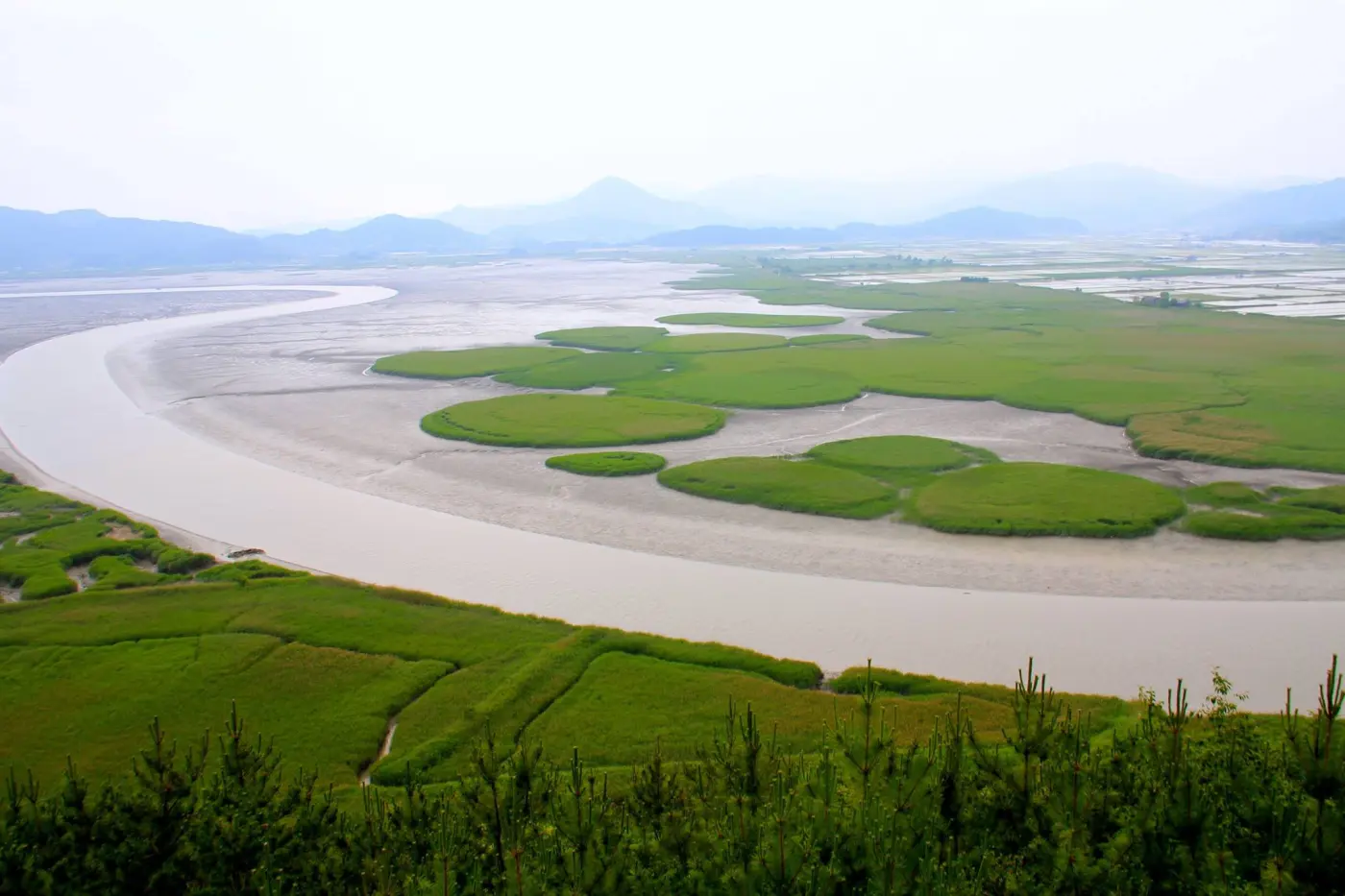
Suncheon Bay is a muddy, sheltered bay fed by the Dongcheon and Isacheon rivers. According to the official wetland site, the protected wetland covers about 28 square kilometres, of which roughly 22.6 are tidal flat and 5.4 are salt marsh and reeds. The reeds grow in circular colonies that spread outward from their centre, which is why the bay looks dotted with green or golden discs when seen from above. The site says the reed beds have spread more than tenfold since 1997; until the late 1970s villagers cut the reeds to sell as shade screens and brooms.
A visit usually starts near the ticket office and crosses Mujingyo bridge onto the boardwalk through the reeds. The decking is kept low and plain on purpose: the official site explains that the structures were designed to look as natural as possible at a bird's eye level, and that the streetlights near the buildings were lowered to human height so that they do not disturb birds resting in nearby fields at night. The same thinking explains a practical point for visitors: the trails have no lighting at all.
At the far end of the boardwalk a path climbs Yongsan, a low hill of 77 metres on the east side of the wetland. The old observatory was removed after a safety inspection, and a new two-storey timber observatory opened in July 2025. The official site says it takes about 30 minutes on foot from the Yongsan entrance to reach it. From the top you see the view that appears on most Suncheon posters: the S-shaped tidal channel curving through the reed colonies, with the mudflats beyond. The official site lists the sunset among the bay's classic views, but remember the walk back is unlit.
If you would rather see the channel from the water, an eco-tour boat runs from the wetland's pier along the S-shaped channel. The standard route is a 30-minute round trip. Tickets are sold on site only, passengers fill in a boarding form and need ID, the boat sails only with at least four passengers, and it does not run on Mondays (or the following day when Monday is a public holiday). Weather and fog can cancel sailings without notice.
Migratory birds, cranes and the UNESCO tidal flats
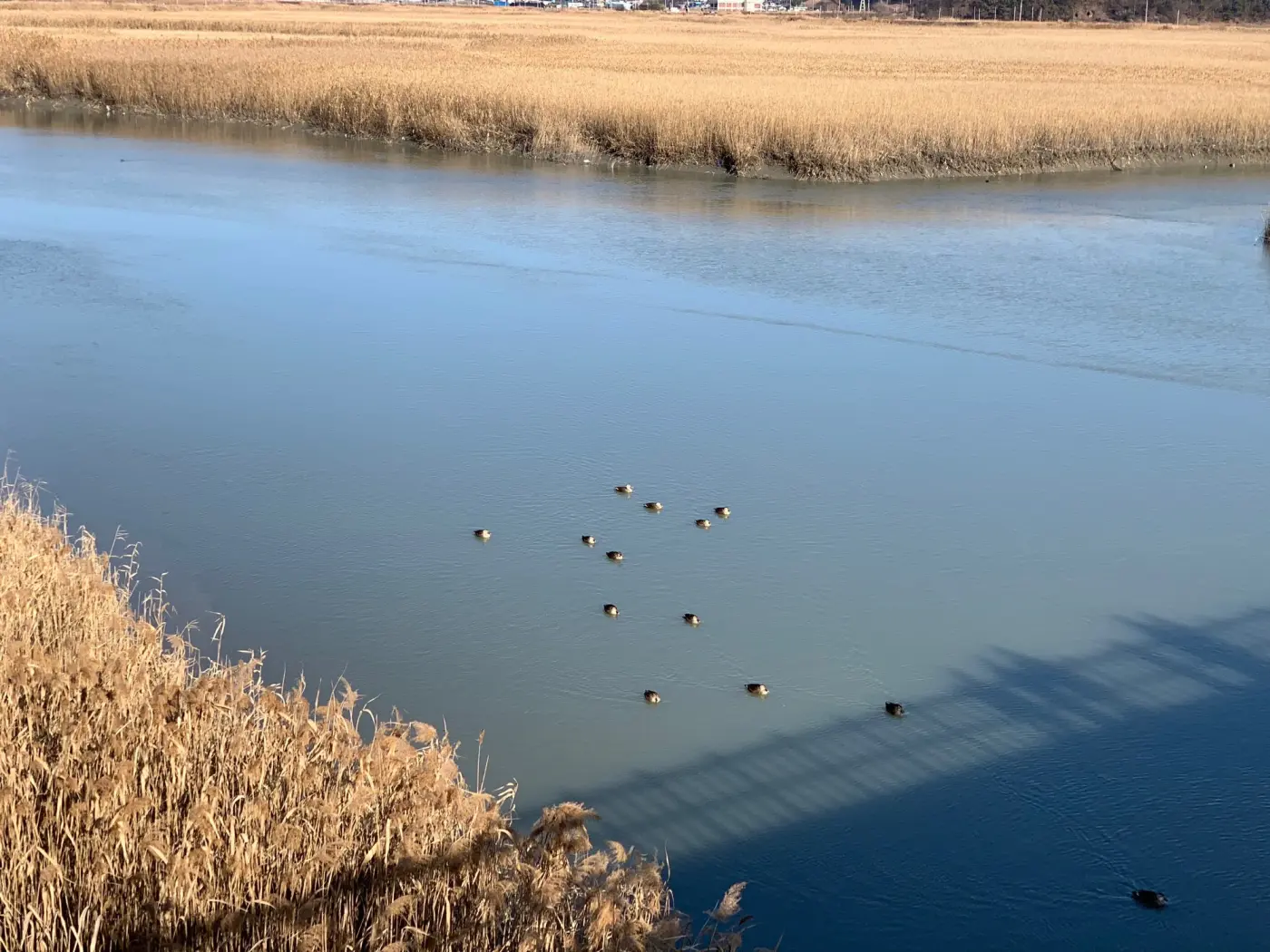
The reasons Suncheon Bay is protected are mostly feathered. The official wetland site describes the bay as the largest wintering ground for hooded cranes in Korea and lists other endangered species seen here, such as black-faced spoonbills, whooper swans and Saunders's gulls. It also states that hooded cranes and Saunders's gulls found here make up around one per cent or more of their world populations. The city's tourism page puts the number of bird species recorded around the bay at about 230. Winter is when the cranes are present; the wetland site publishes regular winter counts on its hooded crane monitoring page.
Several layers of protection have built up over two decades. The coastal area became a wetland protected area in 2003, and in 2006 the Suncheon and Boseong-Beolgyo tidal flats were listed together under the Ramsar Convention, the first coastal wetland in Korea to be listed. Then in July 2021 UNESCO inscribed 'Getbol, Korean Tidal Flats' as a natural World Heritage Site. The Korea Heritage Service lists four component parts in that inscription, and one of them is the Boseong-Suncheon Getbol, which includes Suncheon Bay. The heritage description stresses the flats' role for migratory waterbirds, including 27 globally threatened or near-threatened species.
To protect the birds, the wetland asks visitors not to bring drones, food, alcohol, pets, bicycles or other ride-on devices, and to stay on the marked paths. Wheelchairs and pushchairs for small children can be borrowed in front of the ticket office. Ticket sales run from 08:00 to 17:00 between November and February, to 18:00 in March, April, September and October, and to 19:00 from May to August; visitors can remain for a while after ticket sales end, but the paths are dark after sunset.
Suncheon Bay National Garden and the SkyCube
The National Garden grew out of the international garden expo held in 2013, and in 2015 it was designated Korea's first national garden. The city describes traditional Korean gardens, themed gardens including a lake garden designed by the landscape architect Charles Jencks, and a world garden section with gardens from 11 countries. It is large, and the city suggests around four hours for a visit. Last admission is 19:00.
The garden and the wetland are several kilometres apart, and the link between them is the SkyCube, small driverless cars on an elevated track. It runs 4.6 km from Garden Station to Suncheonman Station in about 10 minutes one way. From Suncheonman Station a free reed train for SkyCube passengers covers the last 1.2 km to Mujingyo bridge at the wetland in about seven minutes; the city notes it is also about a 15-minute walk. You need to have entered the garden or the wetland before boarding. The first car leaves Garden Station at 10:00, and the last leaves at 17:00 from November to February and 18:00 from March to October. The SkyCube and reed train do not run on Mondays (or the next weekday when Monday is a holiday), and the garden and wetland themselves close on the last Monday of every month, so avoid Mondays if you want the full combination.
Naganeupseong: a walled town that is still lived in
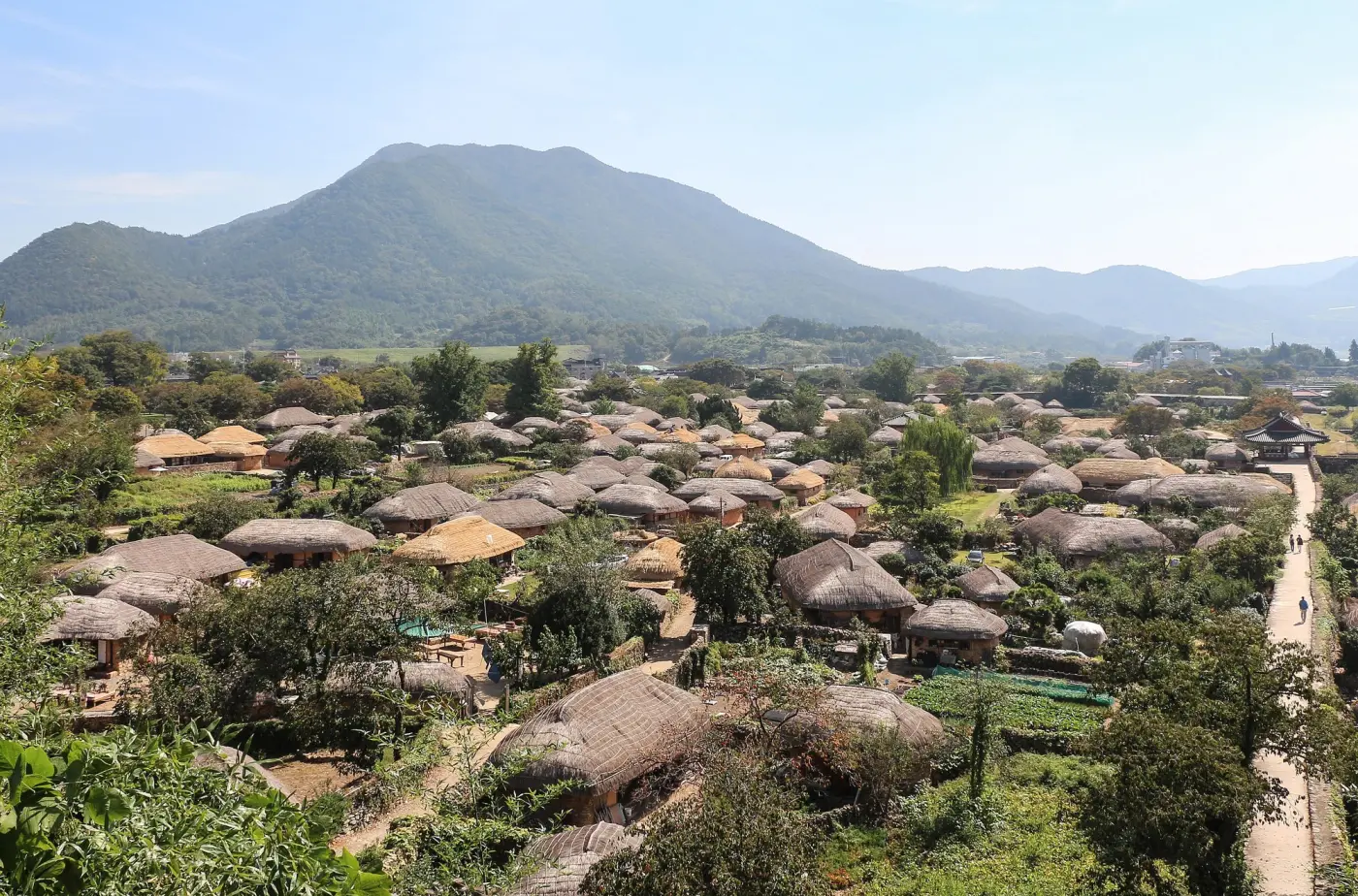
About 22 km west of central Suncheon, Naganeupseong is a Joseon-era county town enclosed by stone walls. According to the city, the walls were rebuilt in stone in 1626 by General Im Gyeong-eop, then the local magistrate, and the town remained the seat of Nagan county until 1895. Inside are lanes of thatched houses, the old magistrate's office and guesthouse, a large communal well and vegetable plots. What makes it different from an open-air museum is that residents still live and farm here, and Naganeupseong is on Korea's tentative list for UNESCO World Heritage.
Walking the top of the walls gives the best view over the roofs, as in the photo below. Because many of the houses are homes, follow the marked route and treat closed gates as private. The city lists no closing day; ticket sales start at 08:30 or 09:00 depending on the month and end between 17:30 and 18:30. A folk culture festival is held in October, with other traditional events around the first full moon of the lunar year and in May. The city suggests about two hours here.
Seonamsa and Songgwangsa: two temples of Jogyesan
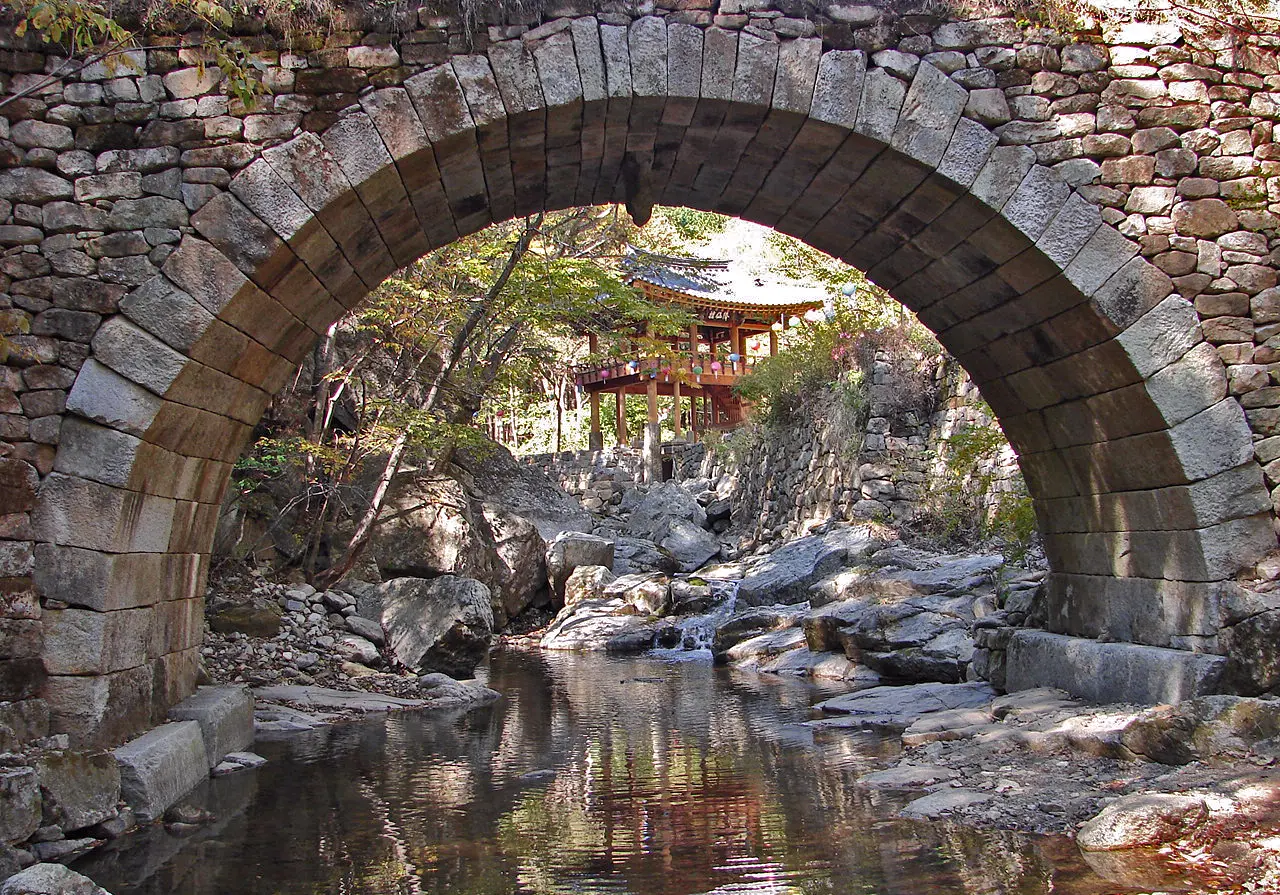
Seonamsa is one of seven temples inscribed by UNESCO in 2018 as 'Sansa, Buddhist Mountain Monasteries in Korea'. The Korea Heritage Service describes the group as monasteries founded between the 7th and 9th centuries that have stayed living centres of faith and monastic life. For visitors, Seonamsa is about the approach as much as the halls: a path follows a stream to Seungseongyo, an arched stone bridge designated a Treasure, with Gangseollu pavilion beyond. The city also points out the old plum trees by the halls, designated a natural monument and in bloom in early spring, and the temple's traditional wooden toilet building, which has become a sight of its own. The city's page notes about an hour for the walk from the ticket booth and back, plus time in the precinct.
Songgwangsa, on the other side of the same mountain area, is one of Korea's three 'jewel' temples, the one associated with the Sangha, the community of monks. The city notes that it has produced sixteen national preceptors, beginning with the Goryeo monk Jinul, and that monks from abroad come to study here. It offers templestay, so it is one of the easier places in the region to stay overnight in a working monastery; our templestay guide explains what a programme involves. The city's tourism pages list admission to both temples as free (as of October 2026). Remember these are active places of practice: keep voices low in the halls and ask before photographing monks.
Getting to Suncheon
Suncheon Station is on the Jeolla Line, which runs south from the Seoul area through Jeonju to Suncheon and on to Yeosu. KTX trains use this line, and since 1 September 2023 SRT trains from Suseo in southeast Seoul also run to Yeosu EXPO with a stop at Suncheon, according to the operator SR. Departure stations, timings and the number of trains vary, so compare both operators' timetables when you book; our KTX guide covers how booking works. The Gyeongjeon Line also serves Suncheon Station, and the official directions also list routes from Yeosu Airport.
From Suncheon Station, city bus 66 is the workhorse: the official sites give about 21 minutes to the National Garden's East Gate and about 35 minutes to the wetland. Naganeupseong and the two temples are further out and served by less frequent buses, which is where a planned route or the city tour bus helps.
The Suncheon city tour bus
Suncheon runs themed city tour buses for individual travellers, departing Suncheon Station at 10:30 and returning around 17:00 to 17:30. The city's pages list, for example, an eco tour on Saturdays (Songgwangsa, the wetland and the National Garden), a World Heritage tour on Sundays (Naganeupseong, Seonamsa and a drama filming set) and a temple tour on Fridays (Songgwangsa and Seonamsa). Advance booking is requested, but you can also turn up at the departure time and board if seats remain. Admission and meals are not included, and courses can change by season or for festivals, so check the current page before relying on it. The pages do not say which languages the guiding is in.
A day in Suncheon
- Morning: train to Suncheon, then bus 66 to the National Garden's East Gate. Spend two to three hours in the gardens.
- Midday: take the SkyCube from Garden Station to Suncheonman Station and the reed train to Mujingyo bridge (not on Mondays).
- Afternoon: walk the boardwalk through the reeds and climb to Yongsan Observatory. Start back while there is still light, then take bus 66 to the station.
- On a Saturday, the eco-themed city tour bus covers a similar route and adds Songgwangsa.
One night: wetland, village and temples
- Day 1: National Garden in the morning, SkyCube to the wetland, then Yongsan Observatory in the late afternoon. Stay in the city, or arrange a templestay at Songgwangsa instead.
- Day 2 morning: Naganeupseong when it opens, while the lanes are quiet.
- Day 2 afternoon: Seonamsa and the walk to Seungseongyo, then back to Suncheon Station or on to Yeosu.
- Alternative: on a Sunday, the World Heritage city tour bus links Naganeupseong and Seonamsa in one trip.
Which season?
Each season changes the bay. The reeds are green in summer and turn gold from autumn, when the city also holds its reed festival; winter brings the cranes and other waterbirds; spring is the time for the garden's flowers and Seonamsa's plum blossoms, and autumn colours the temple valleys. Our guide to the best time to visit Korea and our winter guide cover weather and clothing. In winter, remember that wetland ticket sales end at 17:00 and that wind across the open flats feels colder than in the city.
Combining Suncheon with Yeosu and Boseong
Yeosu is the next city down the Jeolla Line, so the two pair naturally: Suncheon for nature and temples, Yeosu for the harbour, Odongdo and evenings by the sea. Our Yeosu travel guide covers that side, and our Yeosu city guide PDF collects the main areas in one place. To the west, Boseong County shares Suncheon Bay's Ramsar listing and its part of the UNESCO tidal flats, and it is also known for hillside green tea plantations; VisitKorea lists the Daehan Dawon tea plantation there. Our Jeonnam regional page brings these places together.
Comments
Sign in to leave a comment.
Sign in ·No account? Create one
Confirm your email address to comment — it takes one click.
No comments yet.