K-Beauty Shopping in Seoul: A First-Timer's Guide
Where Seoul's cosmetics shops cluster, how testers work, what Korean labels mean, tax refunds, and packing skincare liquids for your flight home.
Korean skincare and make-up are near the top of many first-timers' shopping lists, and Seoul makes it easy to start. Whole streets are lined with cosmetics shops, staff are used to visitors, and you can walk out with a bag of products in half an hour. The harder part is shopping well: knowing which neighbourhood suits you, how to read a box written mostly in Korean, how the tourist tax refund works, and how to get your toner and sunscreen home without losing them at airport security.
This guide is not a list of brands or shops to buy from, and it does not rank anything. It explains how cosmetics shopping in Seoul works, written by people who live here, with the rules taken from Korean law and from official tourism, government and airport pages. Opening hours, promotions and tax refund conditions change, so treat the details as a starting point and check on the day.
Where the cosmetics shops are
You will find cosmetics in almost every Seoul neighbourhood, from subway station arcades to department stores. Four areas come up again and again on the city's official tourism pages, and each has a different feel. You do not need to visit all of them. Pick the one that fits your trip, and combine it with sightseeing nearby.
| Area | What it's like | Tip |
|---|---|---|
| Myeongdong (Jung-gu) | Visit Seoul calls it the city's shopping mecca: street stalls and shops side by side, many Korean cosmetics stores, and very popular with international visitors | Most convenient for a first look and for comparing many products in one walk; hours vary by store, so do not plan on early mornings |
| Hongdae R3 area (Mapo-gu) | A dense cluster of clothing and cosmetics stores near Hongik University, popular with young people and tourists | About 350 m from Exit 9 of Hongik Univ. Station, which is on the airport railway; easy to fit in on arrival or departure day |
| Garosu-gil, Sinsa-dong (Gangnam-gu) | Gangnam's official tourism site calls it a street packed with K-beauty stores, including flagship and experience stores, alongside designer shops and cafés | A five-minute walk from Exit 8 of Sinsa Station (Line 3); better for browsing and experiences than for bulk buying |
| Seongsu-dong (Seongdong-gu) | A former district of factories and small workshops, now full of cafés, flagship stores and short-lived pop-up stores | What is open changes quickly; check current pop-ups shortly before you go, and expect queues at weekends |
Myeongdong: the classic first stop
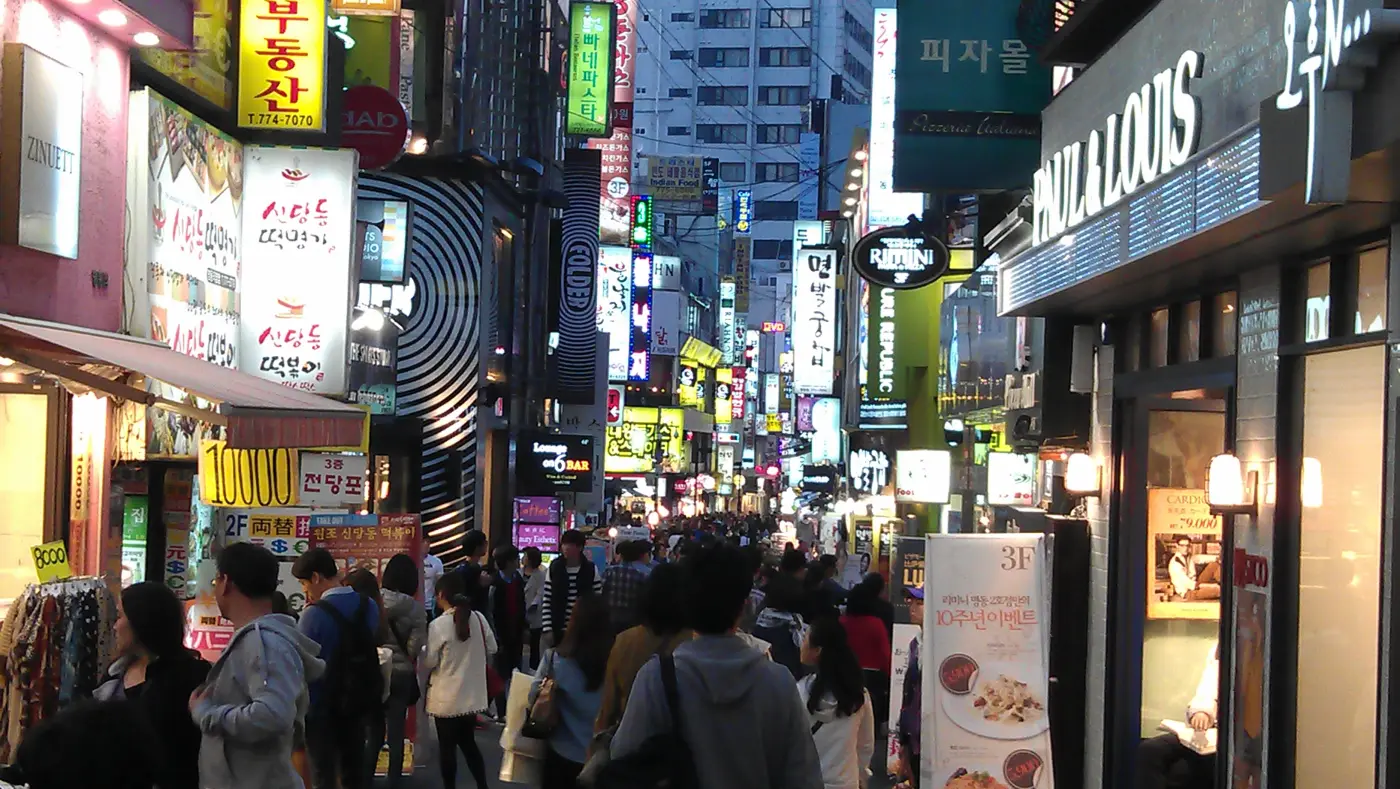
Myeongdong is where most visitors start, and for good reason. Visit Seoul, the city's official tourism site, describes it as Seoul's shopping mecca, with a mix of street stalls and retail shops and many Korean cosmetics stores, and notes that it is very popular with international visitors. Another Visit Seoul feature goes further and calls Myeongdong the heart of K-beauty. The practical upside is density: within a few blocks you can compare skincare from many brands, so it is a good place to work out what you actually like before committing.
VisitKorea's own Myeongdong shopping page points to two different experiences. Large multi-brand beauty stores let you try a wide range of products before you buy, and the cosmetics floor of a department store is where you will find high-end lines. Visit Seoul's feature also describes a brand space where you can look around without buying anything, and services such as skin consultations that need booking in advance. Myeongdong is open every day, but hours vary by store, so it is a late-morning, afternoon and evening area rather than an early one. If you are following our three-day Seoul plan, Myeongdong already sits on day two.
Hongdae: young, busy and close to the airport line
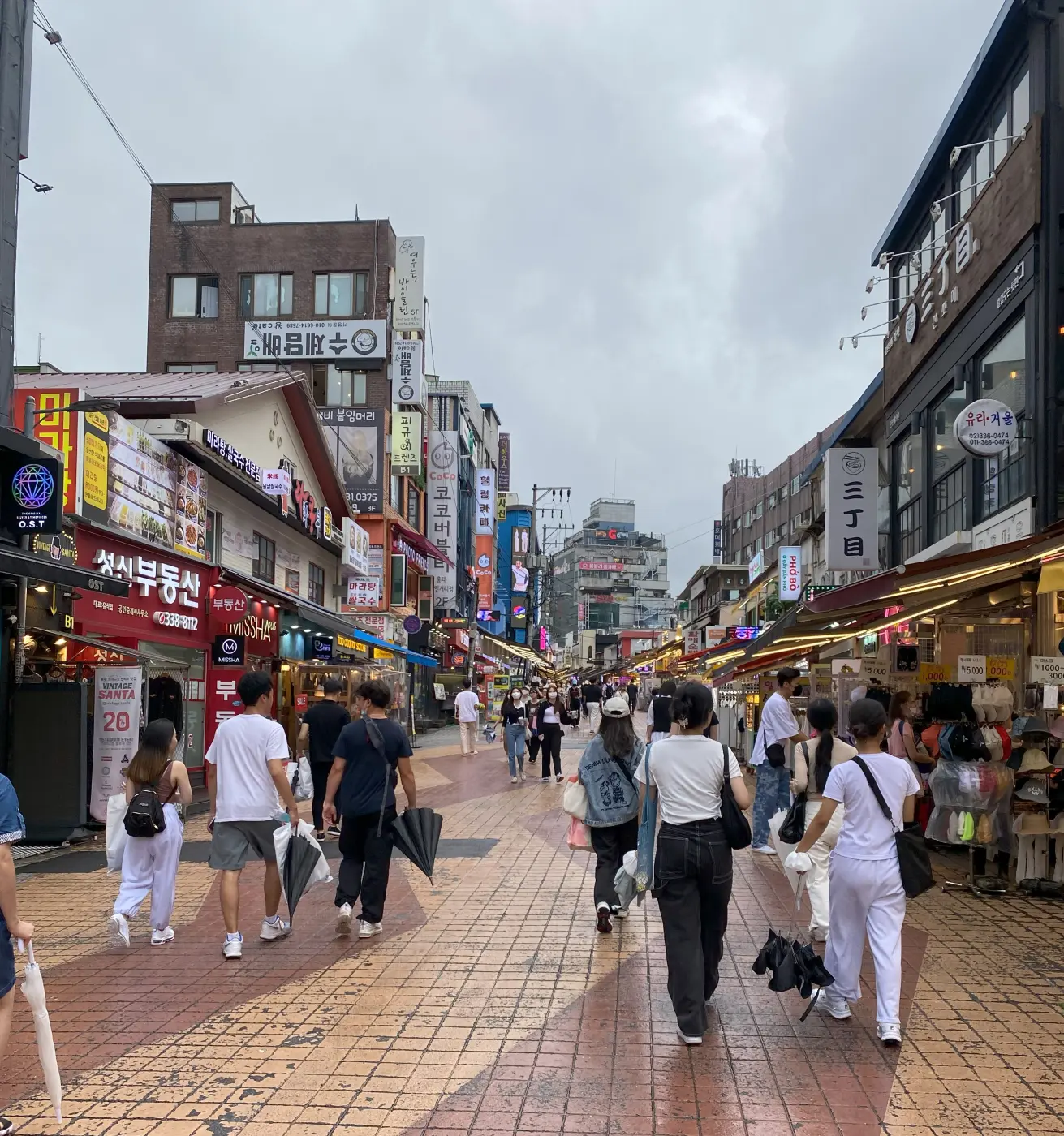
Hongdae, the area around Hongik University in Mapo-gu, is better known for street fashion, live music and nightlife, but it is also a busy place to shop for cosmetics. Visit Seoul describes the R3 area as a central spot for fashion and shopping, densely packed with clothing and cosmetics stores, and popular with young people and tourists. VisitKorea's guide to K-fashion and K-beauty sums up the street as buzzing with youthful energy.
The big practical advantage is transport. Hongik Univ. Station is served by Line 2, the Gyeongui–Jungang Line and the Airport Railroad, and the R3 area is about 350 metres from Exit 9. That makes Hongdae a realistic last stop before the airport, as long as you leave time to repack, and a reasonable first stop if you are staying nearby.
Garosu-gil: flagship stores and experiences
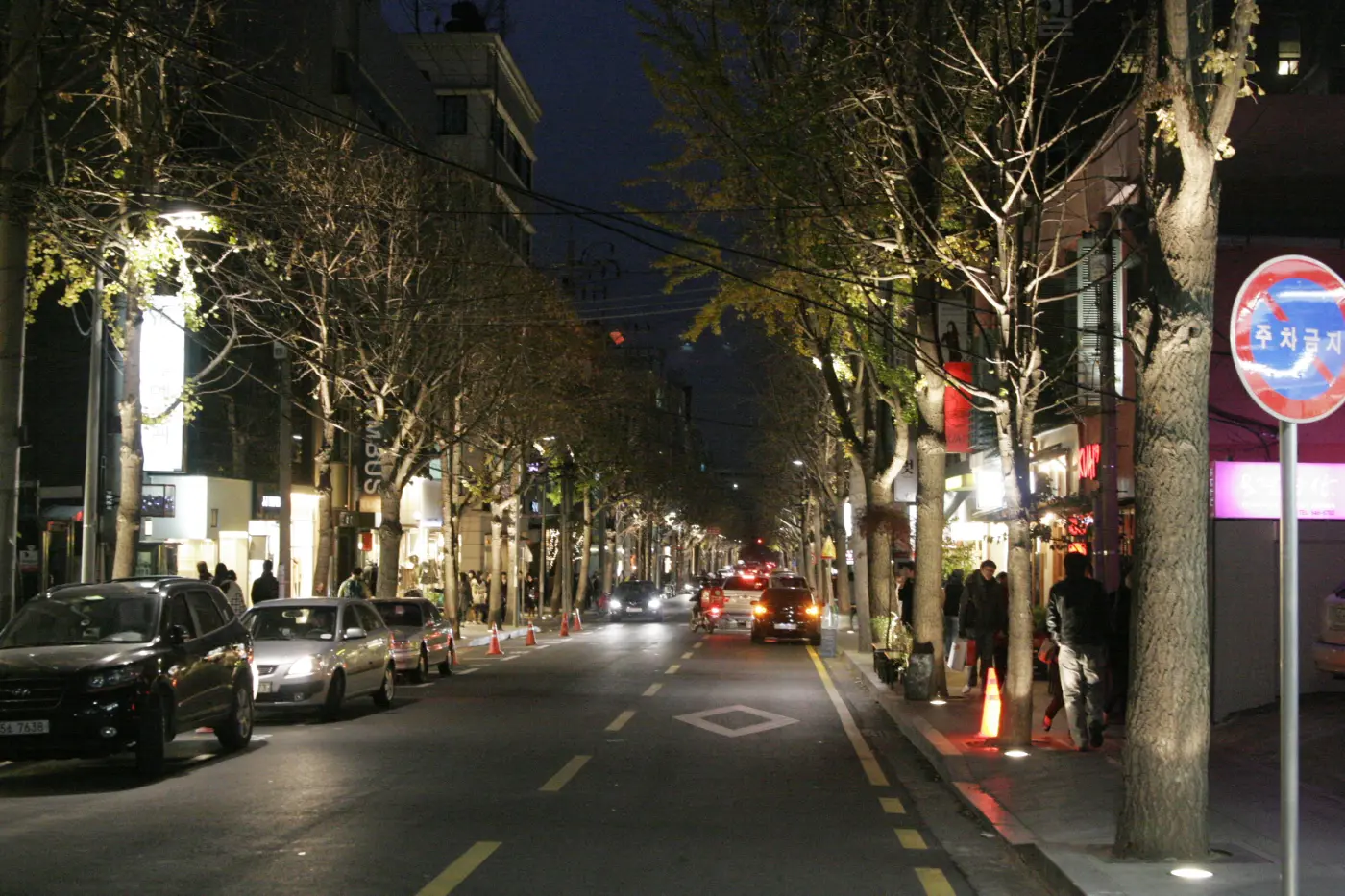
South of the river, Garosu-gil in Sinsa-dong is Gangnam's showcase for beauty. The Gangnam-gu Office's tourism site calls it the signature street packed with K-beauty stores, hosting flagship and experience stores from many Korean beauty brands, and says it is a five-minute walk from Exit 8 of Sinsa Station on Line 3. Nearby Cheongdam-dong has flagship stores of global beauty brands.
Garosu-gil suits a slower afternoon: browsing, trying things on your skin, a coffee, then one or two purchases. Flagship stores often put their effort into the space itself, so it is more about discovering a product than filling a basket. The same tourism site notes that shops displaying a "Tax Free" sign on Garosu-gil offer VAT refunds, and reminds visitors to bring a passport.
Seongsu-dong: pop-ups and custom-made products
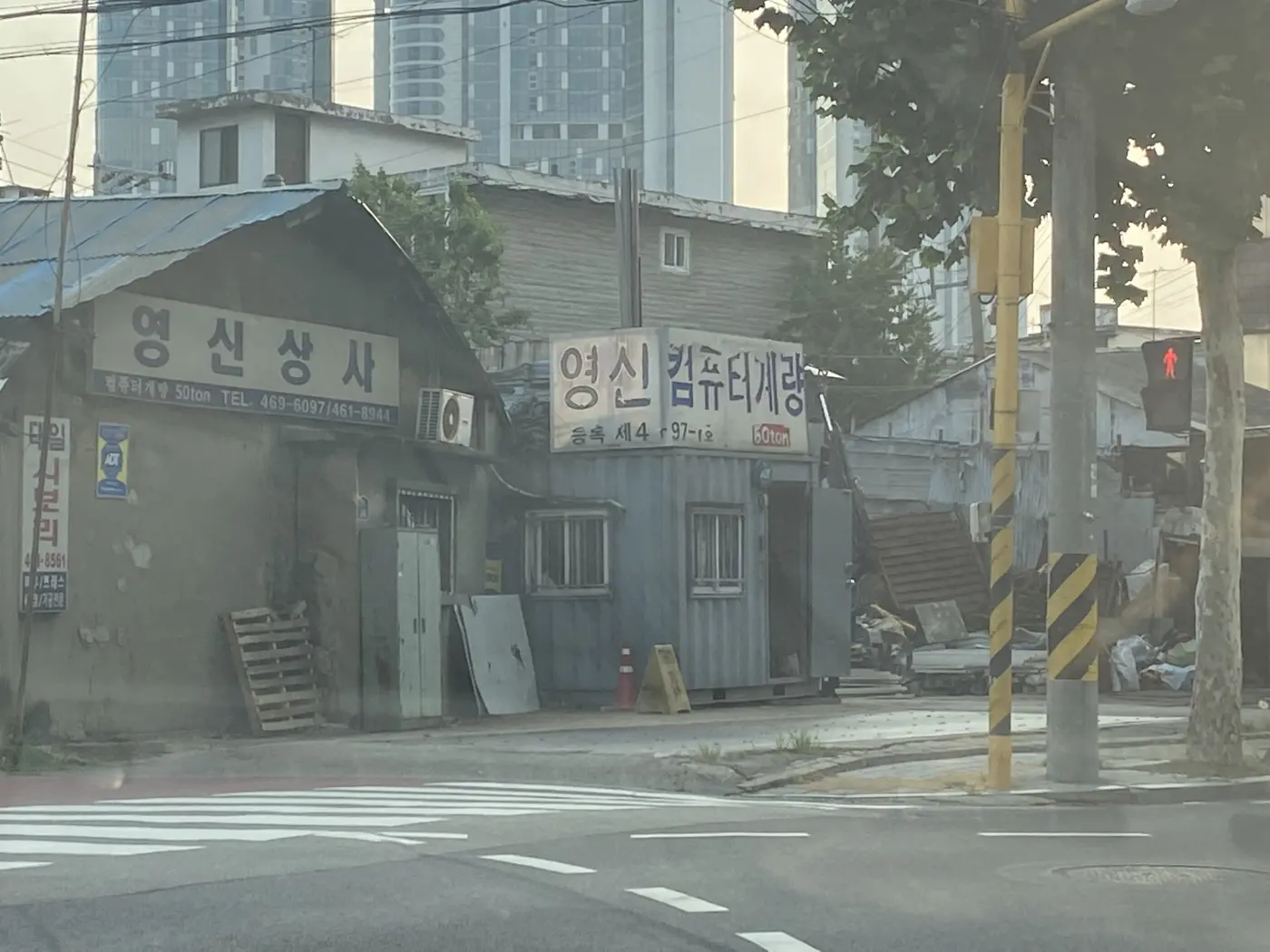
Seongsu-dong, east of the city centre, has changed the most. Visit Seoul's 2026 guide to the area describes a district once known for factories and small workshops that has embraced its industrial past rather than erasing it. People now come for the cafés, flagship stores and pop-up stores, and the guide notes that a newly opened concept store regularly replaces yesterday's pop-up.
Beauty in Seongsu leans towards experiences. Visit Seoul describes one venue that is not run like a traditional cosmetics store at all, where visitors explore Korean beauty through experiments and can create personalised products such as custom-matched foundation and lipstick. Because pop-ups come and go every few weeks, look up what is on just before you go, and treat the area as half shopping, half sightseeing.
How the shops work: testers, samples and staff
Trying before you buy is normal. VisitKorea's K-beauty guide says plainly that in-store you are encouraged to try out the products, and testers are set out on most shelves. A few habits make it easier for everyone:
- Use the cotton pads, spatulas and disposable applicators provided, and test lipsticks or foundations on the back of your hand rather than directly on your lips.
- Ask before opening a sealed box. Testers are the open products on display; the boxes on the shelf are for sale.
- Staff may follow you around the store. It is usually to help, not to hurry you, and a simple "I'm just looking" is fine.
- Free samples are common but not guaranteed. VisitKorea mentions that some stores give instant samples for small actions such as following them on social media.
- If you want to try something on your skin, "balla bwado dwaeyo?" (발라 봐도 돼요?) means "May I put this on?". For clothes, the phrase changes; see our page on "Can I try this on?".
Custom-blended products deserve a word, because they are popular with visitors. In Korean law, a shop that mixes cosmetics to order, or divides them into smaller containers, sells what the Cosmetics Act calls customised cosmetics. That business must be registered with the Ministry of Food and Drug Safety (MFDS) and must employ a qualified preparation manager who handles the mixing. The enforcement rules also require the seller to explain the ingredients used and the cautions for use. It is a good sign when someone explains what is going into your bottle; you are entitled to ask.
Reading a Korean cosmetics label
You do not need to read Korean fluently to get the important information off a box. The Cosmetics Act sets out what the outer packaging must show, and Article 12 says it must be written clearly in Korean, with Chinese characters or foreign languages allowed alongside. Many products sold in tourist areas add English, but the Korean is the legally required part, so a few words take you a long way.
Under Article 10, the outer packaging must show the product name, the company's name and address, all ingredients used (with minor exceptions set by regulation), the volume or weight, the batch number, the expiry date or the period after opening, the price, precautions for use, and, for functional cosmetics, the words "기능성화장품" or a symbol set by the MFDS. If a label gives a period after opening, the manufacturing date has to be shown too. Very small items can show less, but they still need the name, the company, the batch number and an expiry date or period after opening.
| Korean | Sounds like | What it tells you |
|---|---|---|
| 기능성화장품 | gineungseong hwajangpum | Functional cosmetic: the claim has been reviewed or reported to the MFDS |
| 미백 | mibaek | Brightening: helps with skin tone and dark spots |
| 주름 개선 | jureum gaeseon | Wrinkle improvement |
| 자외선 차단 | jaoeseon chadan | UV protection; look for SPF and PA next to it |
| 전성분 | jeonseongbun | Full ingredient list |
| 사용기한 | sayong gihan | Use-by date |
| 개봉 후 사용기간 | gaebong hu sayong gigan | How long it lasts once opened |
| 사용 시의 주의사항 | sayong si-ui juuisahang | Precautions for use |
What "functional cosmetics" means in Korea
"Functional cosmetic" (기능성화장품) is a legal category, not a marketing word. The Cosmetics Act defines it as a product that helps with skin brightening, wrinkle improvement, tanning or protection from UV rays, changing or removing hair colour or nourishing hair, or preventing and improving dryness, cracking, loss or flaking caused by weakened skin or hair function. The enforcement rule then lists the specific categories, which include:
- Brightening, either by preventing melanin from settling in the skin or by lightening pigment already there.
- Wrinkle improvement, by giving the skin elasticity.
- Helping the skin tan evenly, and protecting the skin from UV rays.
- Changing hair colour (temporary colour is excluded) and removing body hair by chemical means.
- Easing the symptoms of hair loss (products that only coat hair to make it look thicker are excluded).
- Easing acne-prone skin, limited to cleansing products.
- Restoring the skin barrier to help with itching, and fading the red lines of stretch marks.
The point for a shopper is simple. Article 13 of the Act forbids labelling or advertising that could make an ordinary cosmetic look like a functional one, or that differs from what the MFDS review found. So if you are buying for a specific purpose, especially sun protection, look for 기능성화장품 on the box rather than relying on the front-of-pack slogan.
Sunscreen is the product visitors buy most often for a reason, so it is worth knowing the two numbers. In a June 2026 consumer notice, the MFDS explained that SPF shows protection against UVB, and that PA is a grade of protection against UVA, written PA+, PA++, PA+++ or PA++++, with more plus signs meaning stronger UVA protection. The ministry advises checking for the functional cosmetic label, choosing a product that fits what you will be doing, applying it about 15 minutes before going out, and reapplying when you sweat a lot or spend a long time in the sun. Even water-resistant products should be reapplied every two hours during long periods in the water.
Shopping for your skin type
Staff in Seoul's cosmetics shops will often ask about your skin before recommending anything. It helps to know the words: 건성 (geonseong) for dry skin, 지성 (jiseong) for oily, 복합성 (bokhapseong) for combination and 민감성 (mingamseong) for sensitive. Many products print the intended skin type on the box using the same words. Beyond that, some general habits help:
- Start with what you already use at home and look for the Korean equivalent, rather than replacing your whole routine in one trip.
- If your skin reacts easily, test a product on a small patch of skin, such as the jawline or inner arm, and wait before buying several.
- Buy fewer active products at once. Several new brightening or exfoliating products started on the same day make it hard to tell which one caused a problem.
- Think about where you live. A texture that feels right in Seoul's humid summer may feel too light in a dry winter at home, and the reverse.
- Ask for a sample when you are unsure, and buy the full size later.
- If you have a skin condition or are using prescription treatment, check with your own doctor or pharmacist; shop staff are not medical advisers.
Tax refunds on cosmetics
Cosmetics are one of the most common tax refund purchases, and the rules are the same as for anything else. According to VisitKorea's tax refund page, non-Korean visitors staying in Korea for less than six months can claim a refund at shops displaying a "Tax Free" or "Tax Refund" sign. The page lists a minimum purchase of 15,000 won, and says goods must be new, unopened and unused, and that you must leave Korea within three months of the purchase date.
Many shops can deduct the tax at the till if you show your passport. Korea's regulation on tax refunds for foreign tourists sets the limits for this immediate refund: each transaction, including tax, must be under 1,000,000 won, and the total of immediate-refund purchases since you entered Korea must not exceed 5,000,000 won. Above those limits, you claim at the airport instead. Not every shop offers the immediate refund, and conditions can differ, so ask at the counter.
The unopened rule matters more for cosmetics than for most things. If you plan to claim a refund on a box of skincare, do not open it until you have left Korea. At the airport, VisitKorea describes the order: check in and get your boarding pass but do not check your bags yet, show the goods and receipts to customs, then check your bags and go to a refund counter or kiosk. Even with an immediate refund, the regulation lets customs inspect goods selectively, so keep your purchases easy to reach. Our tax refund guide walks through the three steps.
Getting liquids home: the airport rules
Toner, lotion, serum and perfume count as liquids at security, and sunscreen and lip gloss count as gels. Incheon Airport's restricted items pages set out the rule for international flights: in carry-on baggage, each container must be 100 ml or less, judged by the size of the container and not by how much is left inside, and all of them must fit in a single 1-litre transparent resealable bag, one bag per person. A 150 ml bottle that is half empty still does not pass.
- Pack full-size bottles in checked baggage, wrapped in a plastic bag in case they leak.
- Personal care sprays can go in carry-on under the same 100 ml rule. In checked baggage, Incheon allows up to 500 ml per item and 2 kg (2 litres) in total.
- Liquids bought in the duty-free area after security are allowed regardless of volume only if they stay sealed in the special duty-free liquids bag until you board your final flight. If you change planes, check the rules at your transfer airport too.
- If you are claiming a tax refund on liquids you plan to check in, show them to customs before you drop your bag.
- Incheon's page notes that these limits do not apply to domestic flights, but your onward international flight will follow them.
Avoiding fakes and unauthorised sellers
Seoul's established cosmetics districts are not risky places to shop, but popular products attract imitations everywhere in the world, and Korea is no exception. Korean law gives you some useful signals. Under Article 16 of the Cosmetics Act, nobody may sell, or store or display for sale, cosmetics made by an unregistered manufacturer, products whose packaging or label has been damaged, forged or altered, or products made in advance for consumers to try for promotional purposes, the testers and samples that are usually marked as not for sale. Article 15 also bans selling products whose expiry date has been forged or altered.
- Buy from established shops, department stores and brand stores, especially for expensive products.
- Be cautious about prices that are far below what you see in nearby shops, particularly from street sellers or sellers who approach you.
- Check that the box carries Korean label information: company name, batch number and an expiry date or period after opening.
- Look at the seal and the printing. Blurred text, misspellings and damaged or re-glued packaging are warning signs.
- Do not buy samples or testers that are being sold. Under Korean law, they are not meant to be sold at all.
- Keep your receipt. You need it for a tax refund, and it is your proof of where you bought the product if something goes wrong.
- If you have a problem in Korea, the 1330 Korea Travel Hotline offers tourist information, interpretation and a channel for complaints in several languages, including English and Japanese.
Paying and a few useful phrases
Cosmetics shops in the main districts take cards, and our guide to money in Korea explains when to keep some cash. Prices are printed on the product or the shelf, as the Cosmetics Act requires the seller to show the selling price, so there is no haggling in regular shops. Three phrases cover most of what you need: "eolmayeyo?" (얼마예요?) for "How much is it?", "saempeul isseoyo?" (샘플 있어요?) for "Do you have samples?" and "balla bwado dwaeyo?" (발라 봐도 돼요?) for "May I put this on?".
The best K-beauty haul is rarely the biggest one. Try things on your skin, buy a few products you are confident about, keep the boxes sealed for the refund, and pack the liquids with the airport rules in mind. You will enjoy using them far more at home than a suitcase full of guesses. If you want help building shopping into a wider Seoul trip, our PDF guide Korea, The Basics covers the everyday practicalities in one place.
Comments
Sign in to leave a comment.
Sign in ·No account? Create one
Confirm your email address to comment — it takes one click.
No comments yet.