
Incheon Airport Layover: What to Do by Hours
A layover at Incheon? What fits into 3, 8, 12 or 24 hours: transit-area facilities, the free Transit Tour, AREX to Seoul and how much time to keep spare.
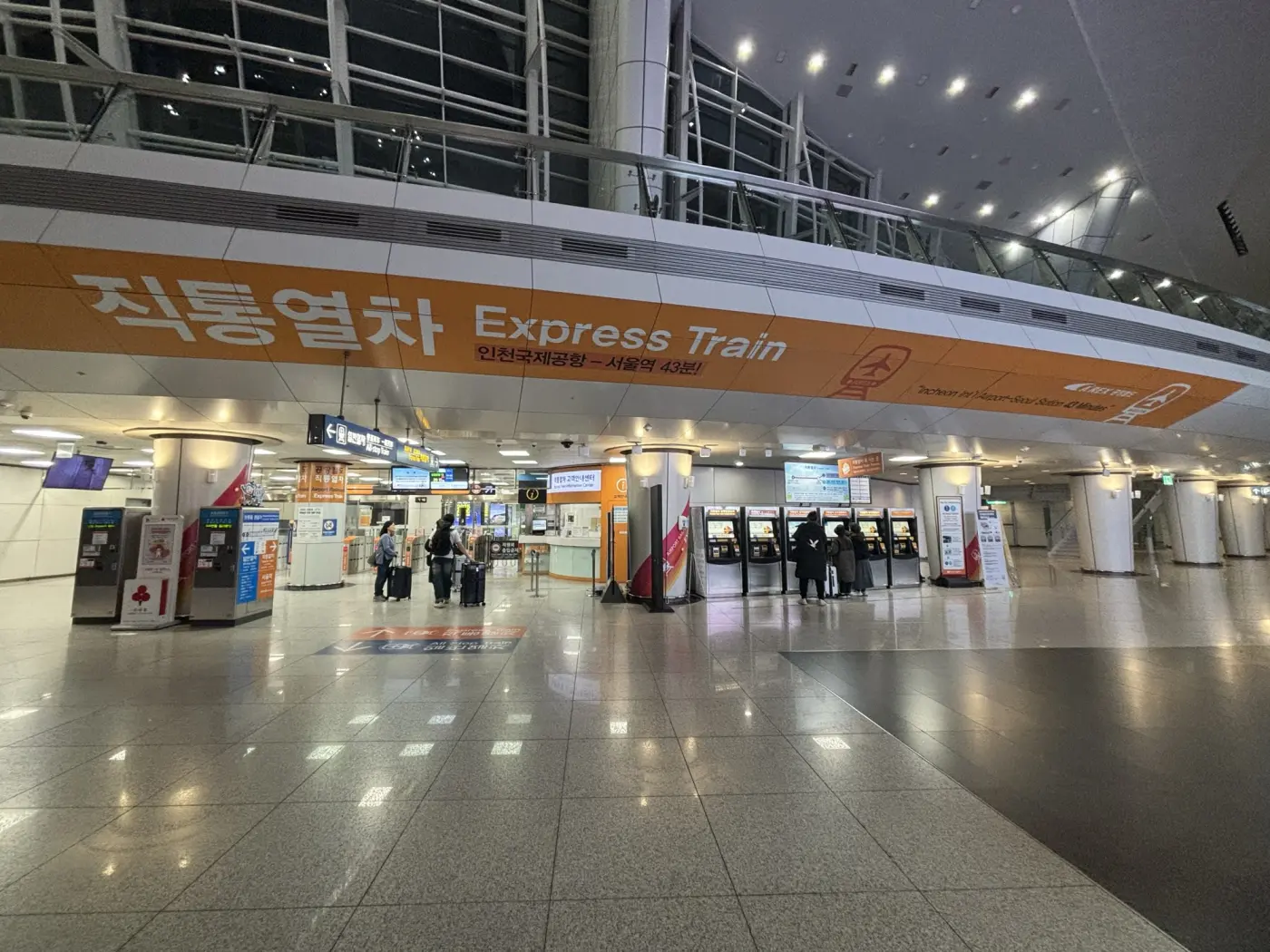
Incheon International Airport is a major transfer hub, and plenty of travellers pass through it without ever planning to visit Korea. Your connection might be a tight two hours, a long afternoon, or a night you did not ask for. The question is always the same: is it worth leaving the airport, and if not, how do you make the waiting easier?
The honest answer depends less on the number of hours than on three things: whether you are allowed to enter Korea at all, which terminal you arrive at and leave from, and how much time you need to get back through check-in, security and departure immigration. This guide walks through each of those, using only the airport's own pages, the Airport Railroad (AREX) and Korean government notices, all checked on 27 October 2026. Programmes and hours change, so treat every time below as something to re-check on the official page before you fly.
First question: can you leave the airport?
If you stay in the transfer area, you never pass Korean immigration. You follow the transfer signs, go through a security check and walk to your next gate. The moment you want to step outside, though, you are entering Korea, and the normal entry rules apply to you just as they would to any other visitor.
For travellers from visa-free countries, that usually means checking whether you need a K-ETA, Korea's electronic travel authorization. The airport's own Transit Tour page states that even visa-exempt passengers need a K-ETA unless their nationality is on the temporary exemption list. We cover who needs one, how long it takes and where to apply in our separate K-ETA and entry guide, linked at the end, so we will not repeat it here. Apply only on the official k-eta.go.kr site.
Travellers who would normally need a visa have one more route. A Korean consulate notice on visa-free entry for third-country transit passengers describes a scheme for people holding a visa or permanent residency for the United States, Canada, Australia, New Zealand or one of 32 European countries, who are flying via Korea to or from one of those countries. Conditions include a confirmed onward flight leaving within 30 days, and some nationalities are excluded. The consulate says plainly that it does not confirm in advance whether you qualify, and points to the Korea Immigration contact centre for questions. If this is your situation, read the notice in full rather than relying on a summary.
One more rule matters for layovers: the airport notes that the Ministry of Justice does not allow two entries into Korea during a single visit. Plan one outing, not a quick trip out, a return airside and a second trip out.
The one-minute version
| Layover length | Realistic options | Notes |
|---|---|---|
| Under about 5 hours | Stay airside: rest zones, nap zones, paid showers, a transit hotel room, traditional culture centres near the gates | No immigration needed. Transit Tour courses outside the airport are listed at 3 to 5 hours, plus registration 30 minutes before the start |
| About 5 to 8 hours | A free Transit Tour if you are eligible, or a long rest airside | Tours run only at set times on set days; seats are first come, first served |
| About 8 to 12 hours | A Transit Tour, or Seoul on your own by AREX for one area near a station | Express train to Seoul Station: 43 min from T1, 51 min from T2, each way |
| 12 to 24 hours (often overnight) | Transit hotel airside, or a night landside and a morning in Seoul | Transit Tours are open only to layovers of 24 hours or less |
| 24 to 72 hours | A short stopover: K-Stopover packages, or plan it like a mini trip | Normal entry rules apply; the Transit Tour is not available |
A short layover: making the most of the transfer area
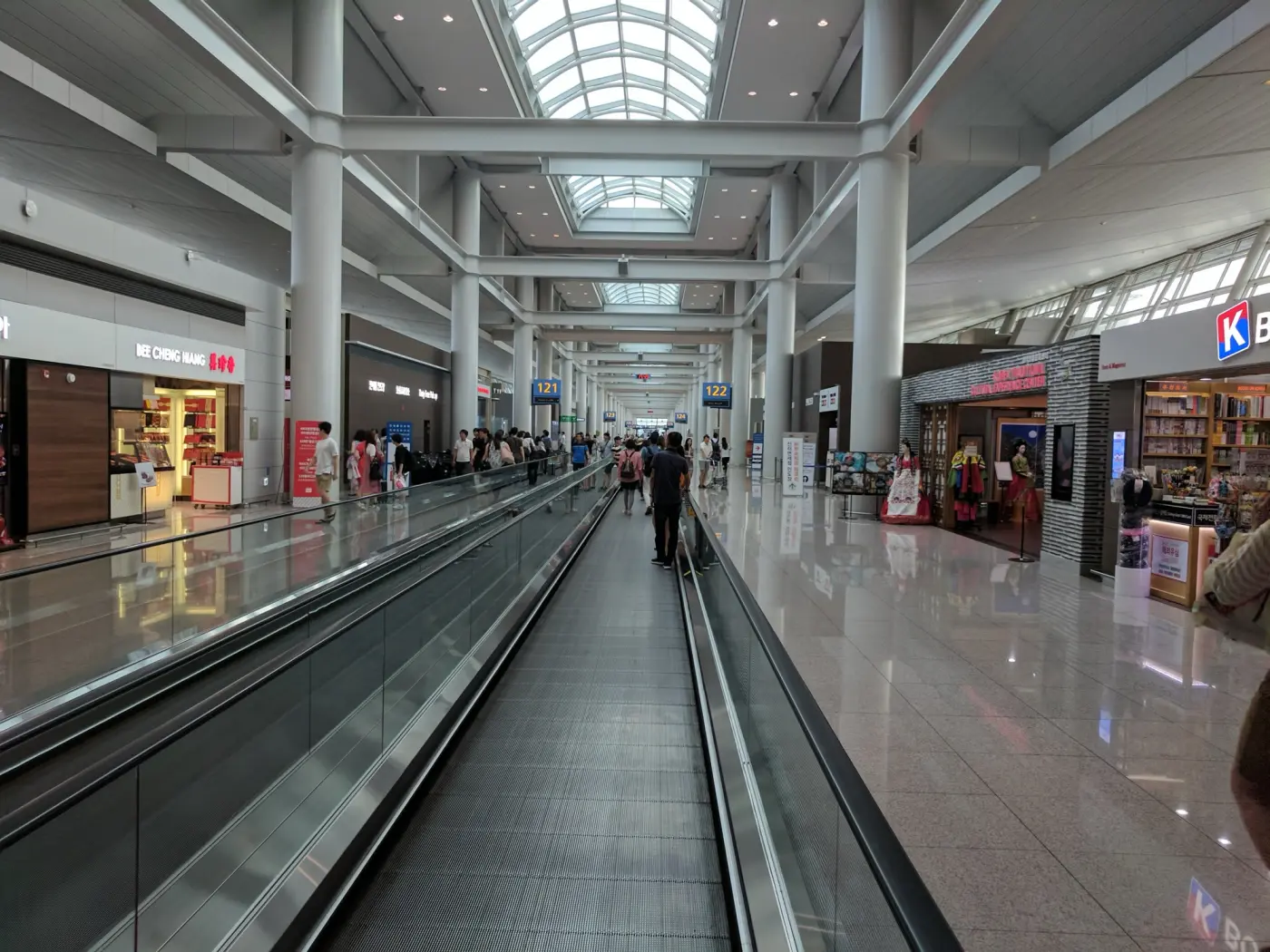
When you land and are connecting, follow the green "Transfer" signs rather than the arrivals signs. The airport's transfer guide sends you to a transfer security screening area on the second floor, then up one floor to the departure level and your gate. Liquids rules apply again here: liquids in your cabin bag must be in containers of 100 ml or less, inside a sealed, transparent one-litre bag, and duty-free liquids must stay in their tamper-evident duty-free bag. If you do not have your next boarding pass yet, the airport points you to transfer desks on the second floor before security and on the fourth floor after it, though the exact procedure depends on your airline.
Check your gate number early. The airport lists gates 1 to 50 at Terminal 1, 101 to 132 at the Concourse, and 208 to 290 at Terminal 2. The Concourse is reached by an underground shuttle train from Terminal 1, and the airport warns that once you board the shuttle you cannot go back. If you arrive at one terminal and leave from the other, the transfer guide routes you through the Concourse by shuttle train, so allow extra time for that.
Most of the facilities that make a long wait bearable are on the fourth floor of the duty-free (airside) area in both main terminals. The airport's facility list shows:
- Rest zones with rest chairs and phone chargers, open 24 hours (Relax and Refresh Zones in Terminal 1, Public Lounges near Gates 231 and 268 in Terminal 2).
- Nap zones with sleeping beds, open 24 hours, in the Terminal 1 east transfer lounge and near Gates 231 and 268 in Terminal 2.
- Paid shower rooms, priced per 30 minutes with towel and amenities provided, open 05:00 to 23:00, near Gates 25 and 29 in Terminal 1 and Gates 231 and 268 in Terminal 2.
- A transit hotel open 24 hours in each terminal: near Gate 11 in Terminal 1 and across from Gate 252 in Terminal 2. The Terminal 2 listing says rooms are charged in six-hour blocks.
- Airline lounges and paid lounges, several of them open around the clock.
If you would rather see something Korean without leaving, the airport runs Korea Traditional Culture Experience Centers on the third floor of the duty-free area: near Gates 25 and 29 in Terminal 1, near Gates 225 and 274 in Terminal 2, and near Gate 122 at the Concourse. The terminal centres are listed as open 07:00 to 21:00 every day (the Concourse one 08:00 to 17:00), and the airport says their cultural experience programmes are free. A royal procession, performers in Joseon-era court dress walking through the departure area, is scheduled in both terminals; the airport notes that times can change with airport conditions. There is also a K-Culture Zone by the fourth-floor transfer lounges with hanbok try-on and Hangul crafts. Two airport pages give different opening hours for it, so check the facility page on the day.
Practical extras: the airport says free Wi-Fi (network name AIRPORTWIFI) covers the whole airport, and you will find 24-hour information desks airside. If you need cash or a SIM before deciding to go out, our guides to money and travel apps in Korea are linked below.
The free Transit Tour
Incheon Airport's Transit Tour is the simplest way to see something of Korea on a layover. The airport runs group tours that take transit passengers from the airport to a few sights and bring them back. On 27 October 2026 the online reservation page was taking bookings for that day's departures from both terminals, so the programme was running; the airport also says courses can change without notice.
The official conditions are clear. Your layover must be 24 hours or less. You need your passport and the boarding passes for both your arriving and departing flights. You register in person at the Transit Tour desk on the first floor of the terminal, after immigration, at least 30 minutes before your tour starts, even if you booked online, because an online booking is only held until 30 minutes before departure. In Terminal 1 the desk is near Exits 1 and 2 (desks 19 and 20); in Terminal 2 it is also on the first-floor arrivals level. If you land at the Concourse, take the shuttle train to Terminal 1 or 2 first. The airport's tip for saving time: after immigration on the second floor, go straight down to the first floor rather than up to the departures level.
Seats go first come, first served, and the reservation page says fewer than half of them are offered online, so there can still be space on arrival even when online booking shows as full. And one line in the airport's FAQ deserves to be taken seriously: if you miss the group's last meeting point, getting back to the airport in time is entirely your responsibility.
| Course | Listed duration | Days and times |
|---|---|---|
| Gyeongbokgung Palace and Insadong (Changdeokgung on Tuesdays) | 5 hours | Tue to Sun, 09:00 to 14:00 |
| Odusan Unification Observatory and Imjingak | 5 hours | Wed and Fri, 09:00 to 14:00 |
| DMZ: Third Tunnel and Dora Observatory | 5 hours | Thu, 09:00 to 14:00 |
| Aegibong Peace Ecopark | 4 hours | Mon, 09:00 to 13:00 |
| Gu-eup ferry (seagull feeding) and Wolmi Park, Incheon | 4 hours | Tue, Sat and Sun, 09:00 to 13:00 |
| Moraenae and Guwol markets, Sorae Port | 5 hours | Mon and Tue, 10:00 to 15:00 |
| Hongdae | 4 hours | Mon, Tue, Sat and Sun, 14:00 to 18:00 |
| Seoul Botanic Park | 3 hours | Offered as a bad-weather alternative |
| K-Culture Zone (inside the airport) | 30 minutes | Hanbok try-on and Hangul crafts |
Most courses are listed as free. Two list a small admission fee for a site along the way, which you pay yourself. Notice that the courses are built around fixed start times: a 5-hour palace tour that leaves at 09:00 only helps if your arrival and your next flight both fit around it. On 27 October 2026 the reservation page also showed a course that was not on the course list, which is a good reminder that the published list is a snapshot.
Going into Seoul on your own by AREX
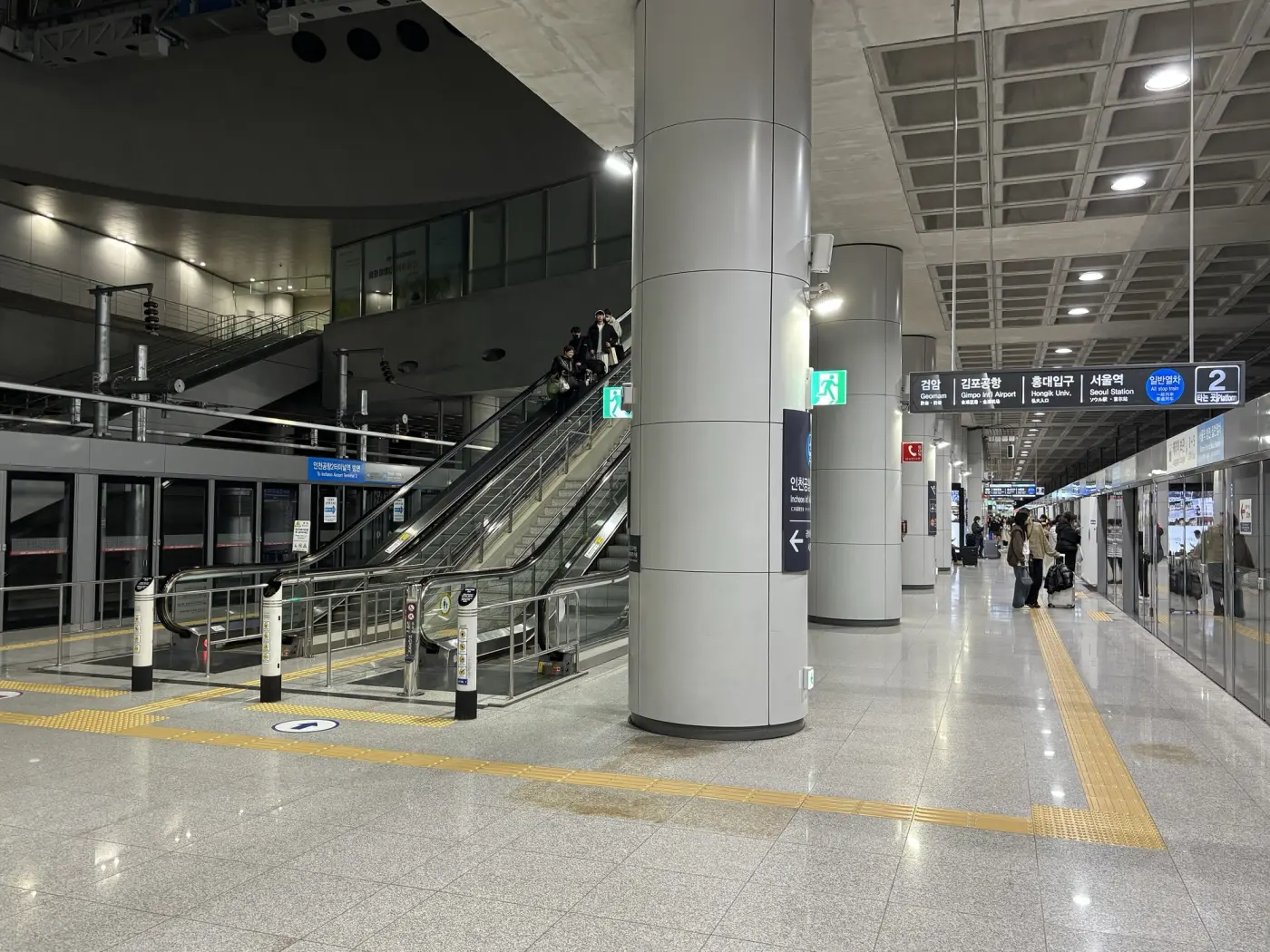
If you can enter Korea and would rather choose your own route, the Airport Railroad, AREX, links both terminals to central Seoul. It runs two kinds of train, and the difference matters on a layover.
The express train runs non-stop between the airport and Seoul Station. AREX gives the journey as 43 minutes from Terminal 1 and 51 minutes from Terminal 2. Seats are reserved, and you need a separate express ticket before boarding, sold at the express customer centres in the basement transportation centres of both terminals and at Seoul Station.
The all-stop train is the ordinary commuter line. AREX lists 59 minutes from Terminal 1 to Seoul Station and 66 minutes from Terminal 2, with some trains taking a few minutes longer. Its advantage is the stops along the way: the airport's route map puts Hongik University Station (for Hongdae) at 58 minutes from Terminal 2, with connections to the Seoul subway at Gimpo Airport, Digital Media City, Gongdeok and Seoul Station. We have left out fares because they change; check the AREX site on the day.
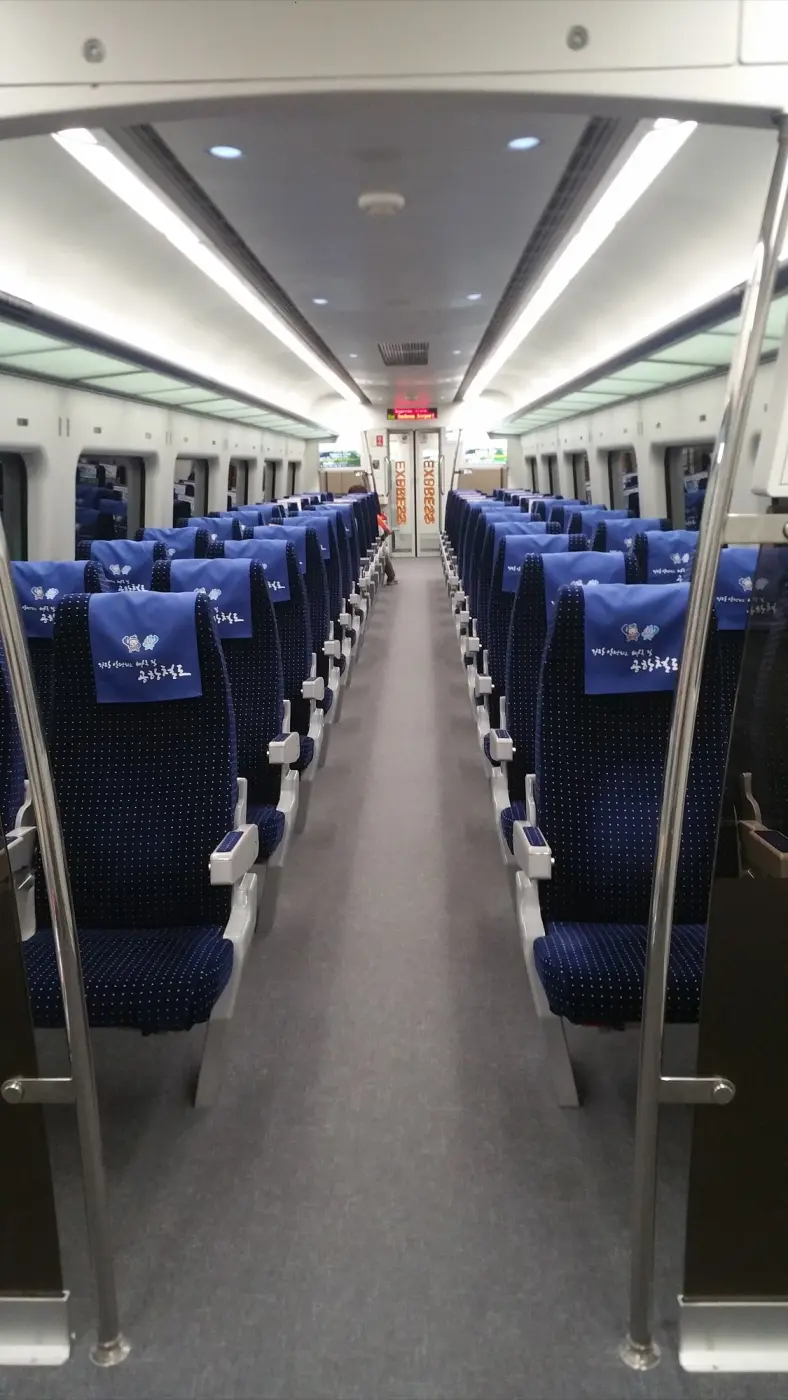
Here is the arithmetic to do before you commit. Add together the time to clear immigration and collect any bags, the train each way (roughly an hour door to platform, more if you head beyond Seoul Station), and the time you need back at the airport before your next flight (see the next section). Whatever is left is your time in the city. With a long daytime layover, one neighbourhood near a station, such as the area around Seoul Station or Hongdae, is realistic. Our three-day Seoul itinerary has ideas if you are staying longer.
How much time to keep spare
The airport does not publish a single "be back by" number for everyone, because it depends on your airline and the day. What it does say is useful. Its FAQ explains that check-in generally opens around three hours before departure, with counter hours varying by airline. Its departure guide asks passengers to be at the boarding gate at least 30 to 40 minutes before boarding time, not departure time. Between those two points you still need security screening and departure immigration, and once you pass immigration into the duty-free area you cannot go back.
Before heading back, look at the airport's real-time wait times page for the departure halls and its congestion forecast. If you are carrying on to the Concourse, add the shuttle train. The safest habit on a layover is to plan your return around your airline's check-in opening, not around your boarding time.
A small money note: the airport's departure checklist lists, among the exemptions from the departure charges collected through your ticket, transit passengers on a single ticket who leave the bonded area for sightseeing and depart again within 24 hours. Refunds are handled at bank counters in the duty-free zone after eligibility is confirmed.
Terminal 1 or Terminal 2?
Incheon has two passenger terminals plus the Concourse. The airport lists Korean Air, Asiana Airlines, Jin Air, Air Seoul, Air Busan and Delta Air Lines among the carriers at Terminal 2, while Terminal 1 handles several other Korean airlines and most other foreign airlines. Codeshares can change this, so the airport asks you to confirm the terminal on your e-ticket or flight search.
Landside, a free shuttle bus links the two terminals about every 10 minutes between 05:00 and 23:00, taking about 15 minutes from Terminal 1 to Terminal 2 and about 18 minutes the other way. The AREX also connects them in 6 minutes as a paid ride. Both terminals have their own AREX station, and the express train serves both.
Overnight, and layovers of 24 to 72 hours
For an overnight connection where you do not want to enter Korea, the transit hotels airside are the obvious choice. If you do enter, the airport also lists 24-hour capsule-style hotels landside, in the Terminal 1 transportation centre and near the Terminal 2 bus ticket counters, and 24-hour spa facilities in the basement of both terminals. Arriving landside in Terminal 1 also gives you the K-Culture Museum in the transportation centre basement, which the airport lists as free and open 10:00 to 19:00, closed on the last Wednesday of each month.
Once your stay passes 24 hours, the Transit Tour is no longer available. The airport instead promotes K-Stopover, paid packages for stays of 24 to 72 hours that combine accommodation, transport and tours, booked on its website with a registration desk on the first floor after immigration. At that point it is simply a short trip, so treat it like one: sort out entry, money and apps first, and pick one or two areas rather than trying to see all of Seoul. If your stopover leans towards Incheon itself, our PDF guide to Incheon covers the city beyond the airport.
Before you land: a short checklist
- Decide whether you will stay airside or enter Korea, and if entering, check K-ETA or visa rules on the official sites.
- Check which terminal your next flight leaves from, and whether it departs from the Concourse.
- Keep your passport and both boarding passes together; the Transit Tour desk asks for all three.
- Ask your airline whether your checked bag goes through to your final destination.
- Look up the Transit Tour course list and the reservation page the day before.
- Work backwards from check-in opening, not from boarding time.
At Incheon you can sleep, shower and try on a hanbok without ever passing immigration. If you do have the time and the right paperwork, a few hours in Seoul or Incheon is a very manageable first taste of Korea, as long as the return trip is the part you plan first.
Comments
Sign in to leave a comment.
Sign in ·No account? Create one
Confirm your email address to comment — it takes one click.
No comments yet.