
Korea Entry Guide: K-ETA, Arrival Card and Customs
Before you fly to Korea: who needs K-ETA, the 2026 exemption, the free e-Arrival card, immigration and customs basics, checked on official sites.
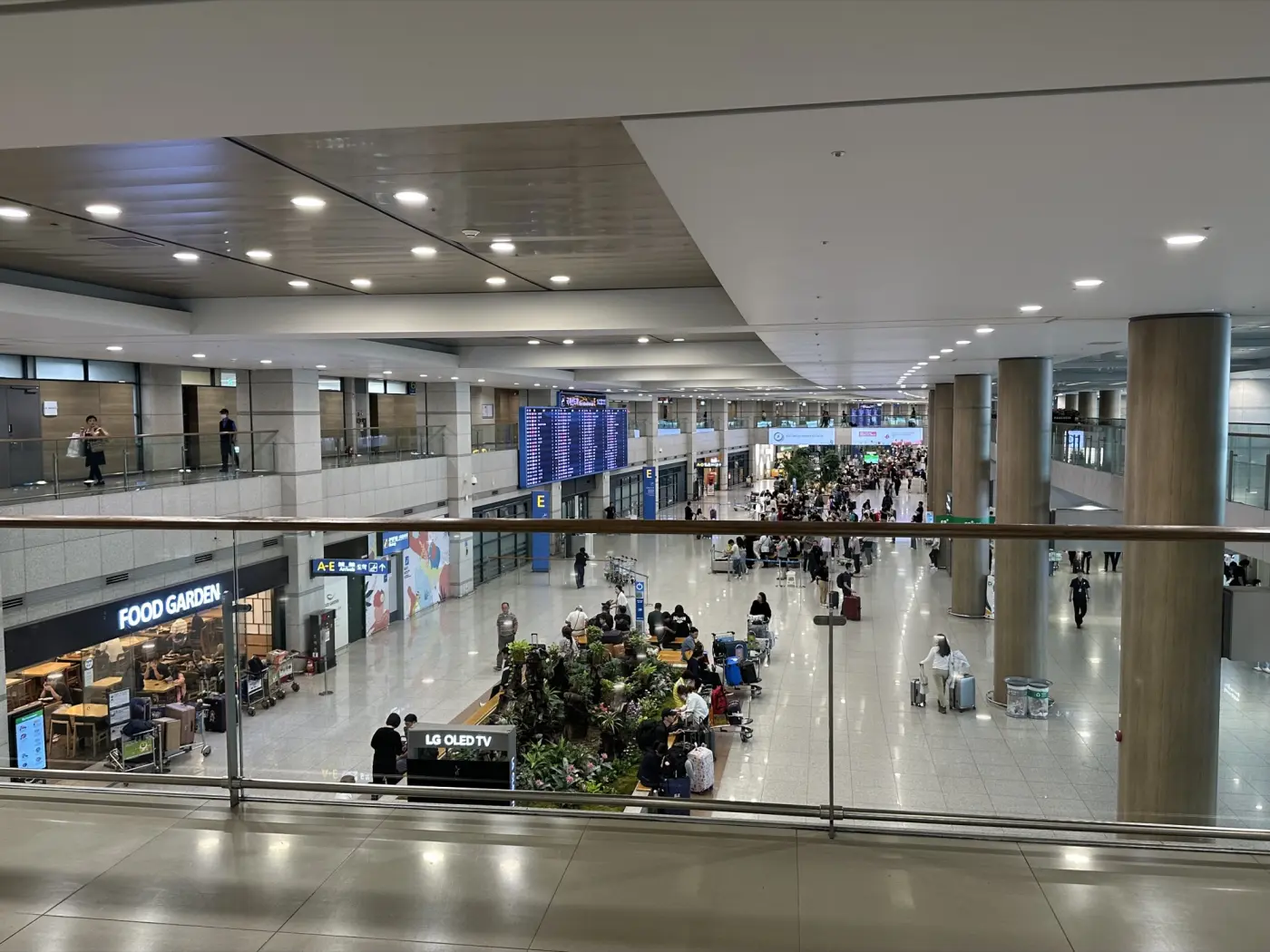
Most first-time visitors to Korea spend weeks on the fun part of planning: which neighbourhoods to stay in, what to eat, which palaces to see. The entry paperwork tends to get a quick search the night before the flight, and that is exactly when people end up on a lookalike website paying several times the real fee, or discover at check-in that they needed something they never applied for.
This guide walks through what a short-stay visitor needs before landing in Korea: the Korea Electronic Travel Authorization (K-ETA), the arrival card and its online version, what happens at the immigration desk, and the basics of the customs declaration. Every rule, date and number below comes from an official Korean government or airport page, and we read each one on 19 October 2026.
Entry rules change, sometimes with only a few weeks' notice. Treat this article as a map, not the final word: check k-eta.go.kr and e-arrivalcard.go.kr yourself before you fly.
First, the one-minute summary
| Item | Who it applies to | Where to check (official URL) |
|---|---|---|
| K-ETA (electronic travel authorization) | Nationals of visa-free countries entering without a visa, unless exempt (age, temporary exemption and other categories listed on the official site) | www.k-eta.go.kr |
| K-ETA temporary exemption | Countries/regions already on the temporary exemption, extended 1 Jan to 31 Dec 2026 (KST) | www.k-eta.go.kr (Notice: Extension of K-ETA Temporary Exemption) |
| Arrival card (paper or e-Arrival card) | Foreign visitors who do not hold a K-ETA, including visa holders and K-ETA-exempt travellers | www.e-arrivalcard.go.kr |
| Fingerprints and face photo | Foreign visitors aged 17 or older, at the immigration desk | english.visitkorea.or.kr (Immigration) |
| Customs declaration | Travellers with items to declare, for example goods above the duty-free allowance | www.customs.go.kr/english and www.airport.kr |
| Cash declaration | Anyone bringing in more than USD 10,000 (or the equivalent) in cash, cheques or other means of payment | www.customs.go.kr/english |
| Visa | Anyone not eligible to enter visa-free, or staying for a purpose or length a visa-free entry does not cover | www.hikorea.go.kr or the nearest Korean embassy |
What K-ETA is, and who needs it
K-ETA is an online pre-screening that nationals of visa-free countries complete before they travel. According to the official K-ETA Application Guide, eligible travellers who want to enter Korea without a visa must obtain K-ETA approval before boarding the flight or ship, and applying after boarding or once already in Korea may lead to refusal or entry restrictions. The same page is clear that K-ETA is not a visa: it covers only part of the requirements for visa-free entry, and the final decision is made by an immigration officer at the port of entry.
The practical facts from that guide are worth knowing before you start the form. The fee is 10,000 won, which the site describes as roughly USD 7 to 8, with the online payment fee charged separately, and it is not refunded even if the application is refused. Assessment typically takes 72 hours or less, but the site warns that it can take longer and that there is no expedited service. An approval can be used for multiple trips for three years, or until your passport expires if that comes first. That validity is separate from how long you may stay on each visit, which depends on your nationality and is listed on the official Eligible Countries page.
To apply you need a valid passport, a working email address, an ID-style photo and a card that can pay the fee. If your passport is reissued, you need a new K-ETA even if the old approval has not expired, and if your travel details change after approval, such as your address in Korea or your dates, the site asks you to update them on its Update Travel Information page.
Who does not need to apply
The K-ETA site publishes a list of people who are not required to apply. For most leisure travellers, the lines that matter are these:
- Travellers aged 17 or younger, or 65 or older, on the date of entry (in force since 3 July 2023).
- People who already hold a Korean visa, and registered foreign residents.
- Transfer passengers who stay airside. If you need to enter Korea, for example because your itinerary changes or you must reclaim checked baggage, the site says you need K-ETA approval.
- Diplomatic and official passport holders, UN passport holders, ABTC (APEC) card holders, flight crew and seafarers, and cruise passengers.
Being exempt is not the same as having no paperwork at all. As the arrival card section below explains, exempt travellers generally fill in an arrival card instead.
The temporary exemption, and exactly what the official page says
On top of those categories, Korea has run a temporary K-ETA exemption for a group of countries and regions since 2023. The K-ETA site's notice, posted on 23 December 2025, says the Ministry of Justice extended it by one more year to support tourism, so the extended exemption runs from 1 January 2026 to 31 December 2026 (Korea Standard Time). It applies to "the countries/regions that are currently exempt", and the notice says people who qualify will see a pop-up message when they scan their passport photo page during the application. That notice does not itself list the countries, and when we checked it did not say what happens after 31 December 2026.
The list was published by Korean embassies when the exemption began on 1 April 2023. It covers 22 countries and regions, among them Japan, the United States (including Guam), the United Kingdom, Canada, Australia, New Zealand, Singapore and much of Western and Northern Europe. Because the exact list is set by the Korean government and can change, check the K-ETA site or your nearest Korean embassy for the full, current wording. If your passport is not covered, assume K-ETA applies to you unless one of the categories above covers you.
Exempt travellers may still apply voluntarily. The notice explains that some people choose to, because a K-ETA holder does not have to submit an arrival card; in that case the normal fee is charged. Whether that is worth it is your call. For a single short trip, filling in the free online arrival card is usually just as easy.
Apply only on the official site
This is the warning the K-ETA site itself repeats most often. The government's notice says Korea has not delegated K-ETA applications to any agency, and that applications should be made only through www.k-eta.go.kr or the official K-ETA mobile app. It also warns about non-official websites that demand much higher fees. Search results and adverts often put these agency sites above the real one, with names and designs that look official. Before you type a passport number, check that the address in your browser is exactly k-eta.go.kr. The e-Arrival card site carries a similar warning: its official address is www.e-arrivalcard.go.kr, and a site that asks for payment details for an arrival card is not the official service.
The arrival card: paper or online
Korea's arrival card is a separate system from K-ETA, and the official e-Arrival card site makes a point of saying so. VisitKorea's immigration page states that visitors entering Korea must submit an arrival card, except for those holding a valid residence card, a K-ETA or an e-Group visa. The e-Arrival card site's list of people who must declare includes Korean visa holders and K-ETA-exempt individuals, and its explanation of that category names citizens of countries temporarily exempt from K-ETA and travellers in the K-ETA age exemption. In other words, if you are skipping K-ETA because of the temporary exemption or your age, you should expect to fill in an arrival card.
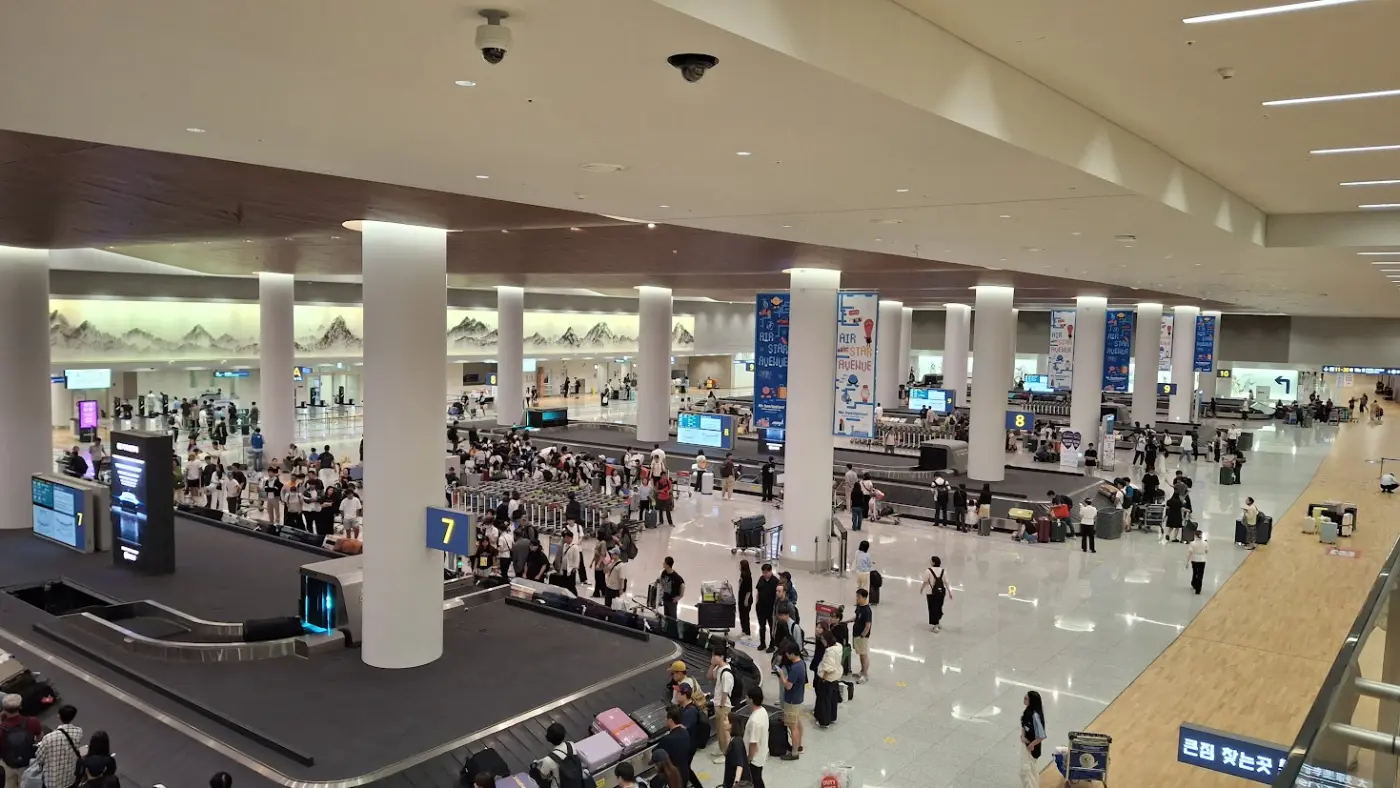
You can still fill in the paper card on the plane or in the arrival hall, or you can do it online in advance. The official e-Arrival card guide sets out how the online version works:
- It is free, and it has the same validity as the paper card, so you do not need both.
- You can submit it from 3 days before your arrival in Korea, based on Korea Standard Time.
- An issue number is emailed to you. You do not need to show the card at immigration, but the site says knowing the number may help.
- On a phone you can submit up to 9 people at once; on a computer, up to 1,000.
- It expires 72 hours after submission, and also once you have passed immigration, so a new one is needed for each entry.
- Have ready your passport, an email address, your arrival date and flight number, and the address where you will stay. The departure date and flight are optional.
One detail catches families out: on the e-Arrival card site, someone aged 14 or younger cannot be the representative declarant, so an adult should fill in the form for the group.
At the immigration desk
At Incheon, the airport's own arrival guide runs in a simple order: information and declaration (quarantine and customs forms), immigration, baggage claim, then the arrival hall. VisitKorea's immigration page describes the manned procedure: queue in the foreign passport line, hand over your passport and arrival card if you have one, and give biometric information. Foreign visitors aged 17 or older provide fingerprints and a face photo on entry, with a few exceptions for officials and invited guests.
There is no published script of questions, and the K-ETA guide reminds travellers that an approval does not guarantee entry. In practice, officers check that what you say matches what you filed. Both the K-ETA application and the arrival card ask for your purpose of entry, where you will stay, and when you plan to leave, so be ready to answer those three things clearly and consistently. Keep your hotel address and your return or onward booking easy to reach on your phone or on paper, and if anything changed after you applied, update it on the official site before you fly.
Customs: what to declare and the duty-free allowance
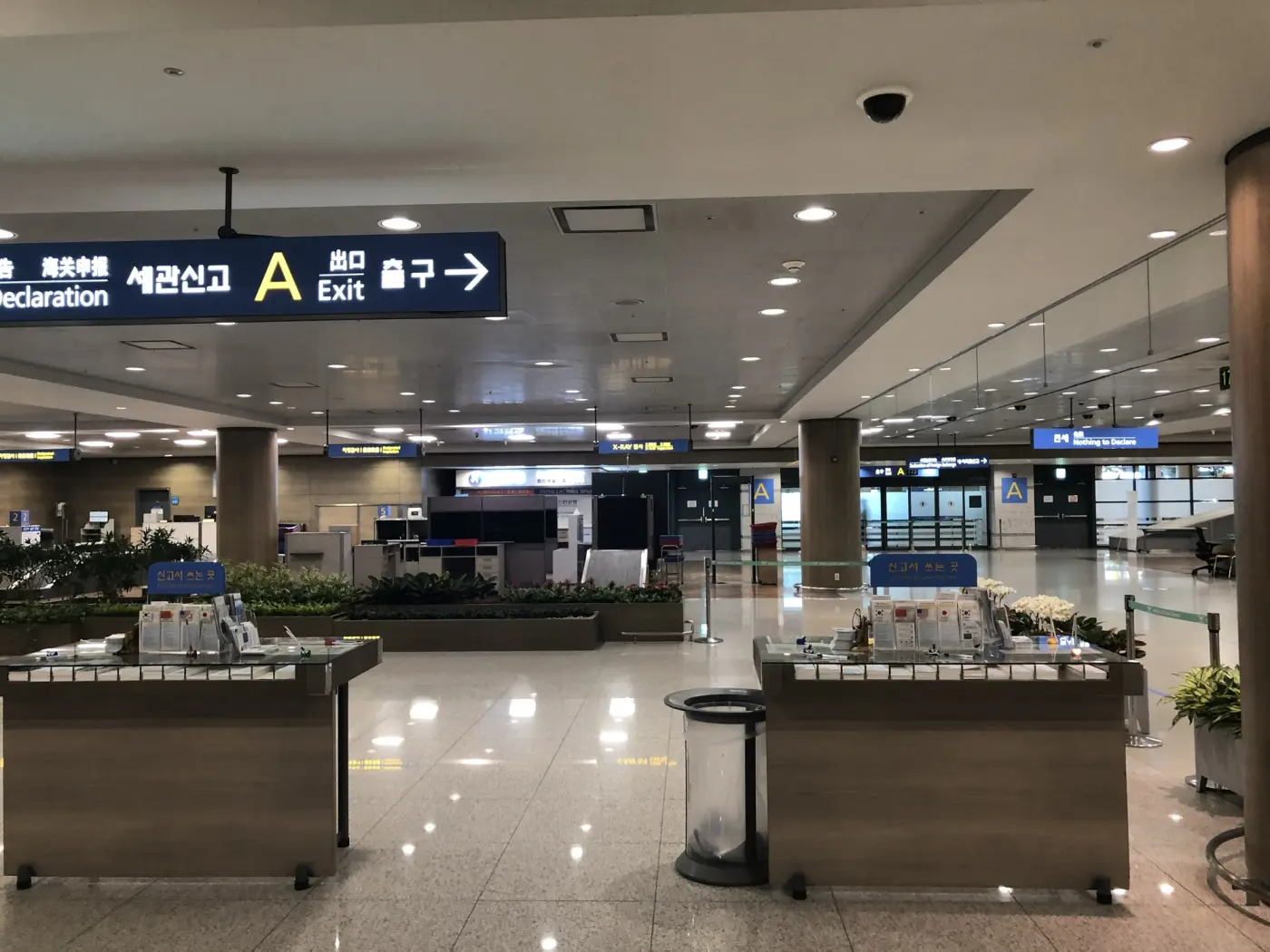
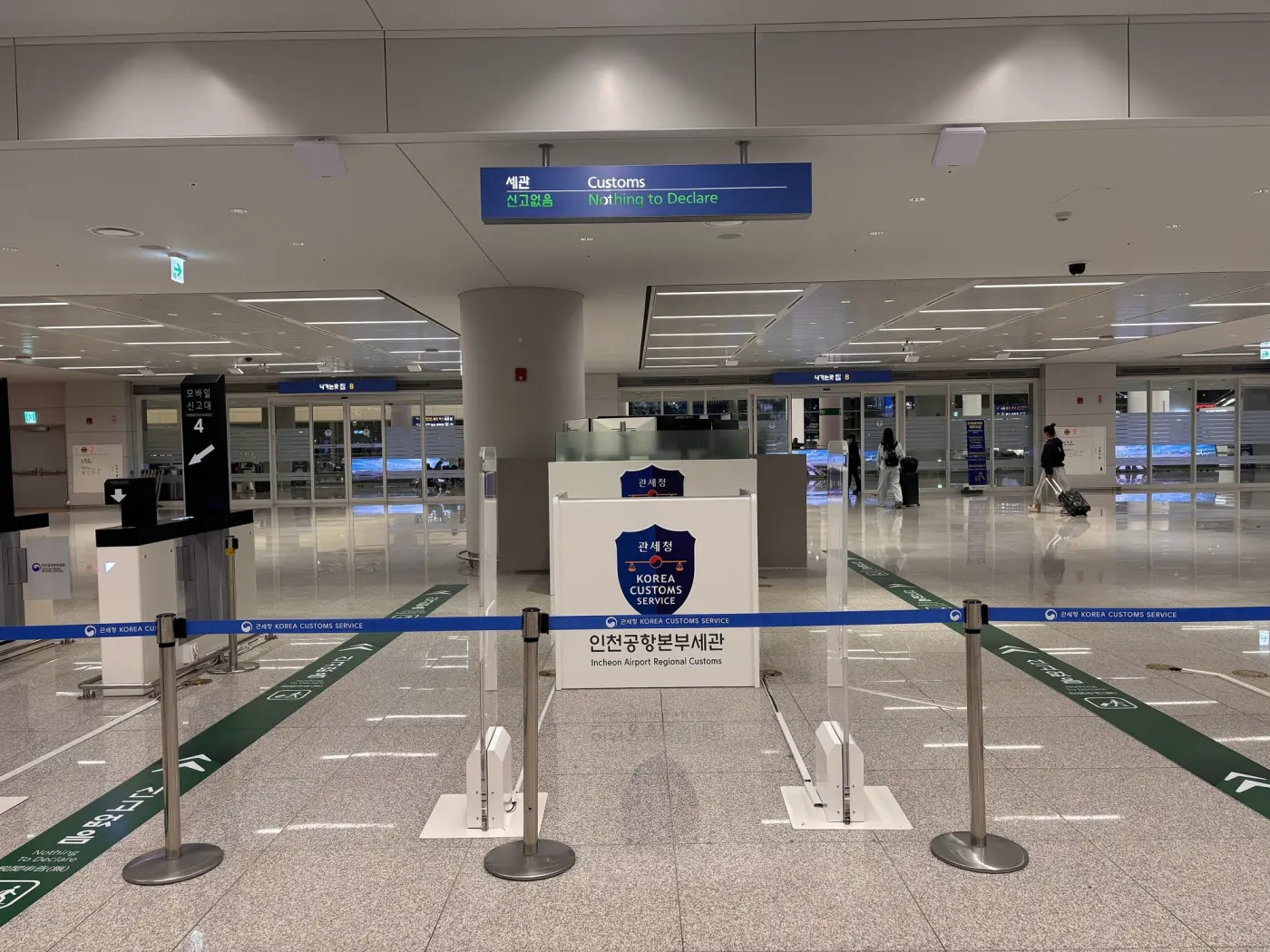
Incheon Airport's customs page says travellers with items to declare should complete a customs declaration form and use the Goods to Declare lane, with one form per family. The form is handed out on board, and the airport also mentions a mobile option through the official Traveler Customs Declaration app or website. If you have nothing to declare, you follow the signs for the Nothing to Declare lane.
The Korea Customs Service sets the traveller's duty-free allowance at US$800 in total taxable value. Separately from that, it allows alcohol up to 2 litres in total and US$400, 200 cigarettes and 100 ml of perfume; travellers under 19 do not get the alcohol and tobacco exemption. If you bring more than the allowance, declaring it voluntarily earns a 30 percent reduction on the standard duty, while goods found undeclared attract an extra 40 percent, rising to 60 percent for repeat cases within two years.
Two more rules are worth a sentence each. Meat, fruit, vegetables, plants and other agricultural products are on the Customs Service's list of goods to declare, so do not bring snacks from home without checking. And if you arrive with more than USD 10,000 or the equivalent in cash, cheques or other means of payment, you must declare it to customs; the Customs Service notes that the certificate cannot be issued once you have left the immigration area.
Your pre-flight checklist
- Check whether you need K-ETA on www.k-eta.go.kr, using the Eligible Countries page and the exemption notices.
- If you need it, apply on the official site or app only, and leave at least 72 hours before your flight.
- If you are exempt or travelling without K-ETA, submit the free e-Arrival card within 3 days before arrival, or plan to fill in the paper card.
- Make sure the passport you used for K-ETA is the same one on your booking and the one you will show at immigration.
- Save your hotel address in Korea and your return or onward flight details where you can reach them offline.
- Pack with the duty-free allowance in mind, and leave fresh food and plant products at home.
- Check the official sites again a few days before departure, especially if you travel near the end of 2026.
Once you are through the doors, the next questions are practical ones: getting into the city, a working SIM or eSIM, and some cash. Our guides to your first hours in Korea and to getting from the airport to Seoul pick up exactly where this one stops.
Comments
Sign in to leave a comment.
Sign in ·No account? Create one
Confirm your email address to comment — it takes one click.
No comments yet.