
Daegu Travel Guide: Markets, Monorail and Day Plans
Reach Daegu by KTX or SRT, ride the Line 3 monorail, and fit Seomun Market, the modern alleys, Apsan and Donghwasa into one day or one night.
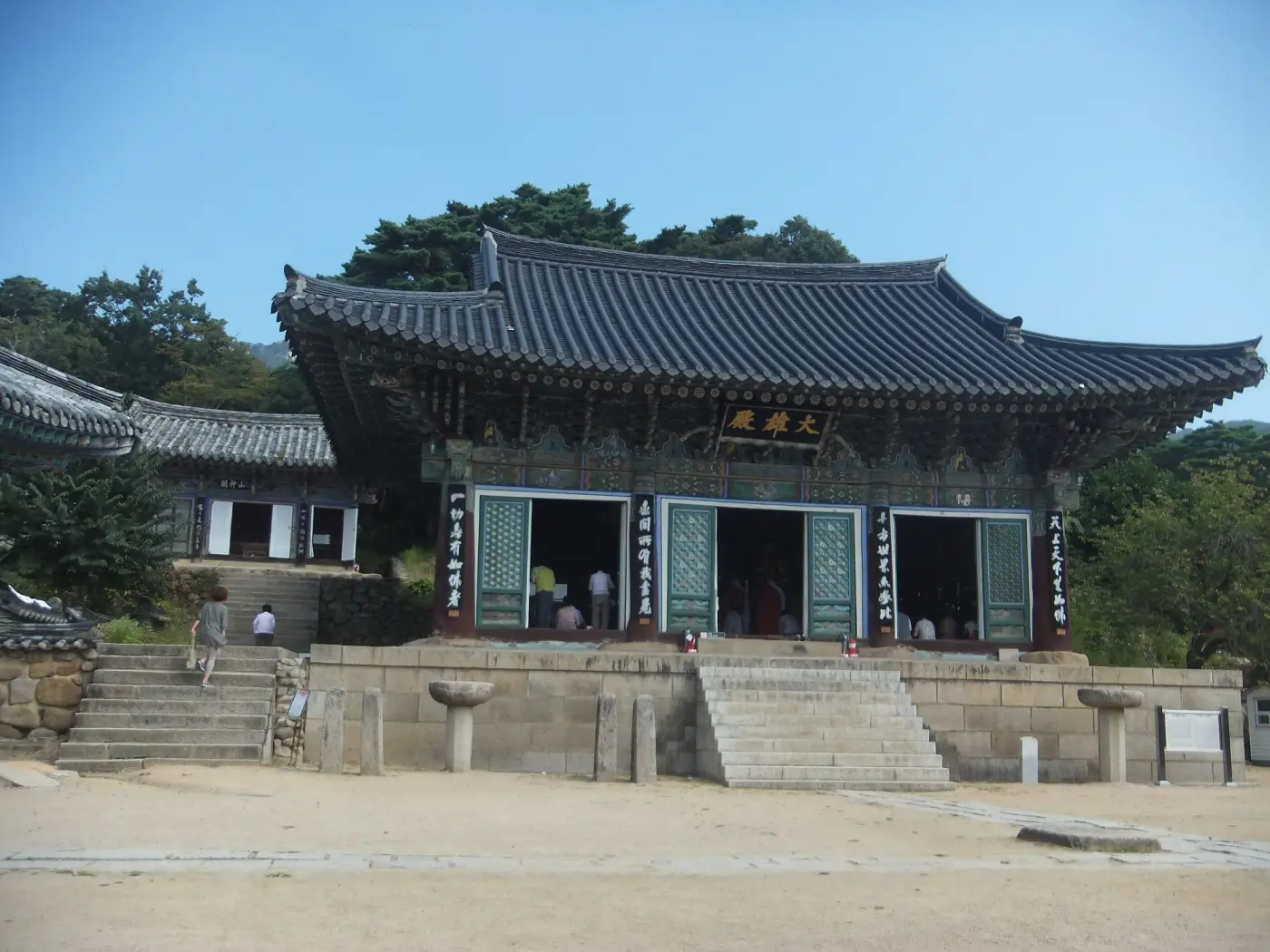
Daegu is Korea's big inland city, a basin ringed by mountains about halfway between Seoul and Busan on the high-speed line. Many visitors only see it through a train window on the way south, which is a pity. Within a few metro stops of the station you have the city's largest permanent market, a herbal medicine street with roots in the Joseon dynasty, a walkable district of early twentieth-century churches and mission houses, and a hill cable car that looks out over the whole basin. Further out, Donghwasa temple sits in the forest on the slopes of Palgongsan.
This guide covers how to get there, how the three metro lines (one of them an elevated monorail) fit together, what each main sight is and which station exit to use, a little about Daegu food, and how to cope with the city's hot summers. At the end there is a one-day plan and a one-night plan. Opening days and times below come from the city, district and operator pages listed under Sources; they change, so check those pages before you set off.
Getting to Daegu: KTX and SRT to Dongdaegu Station
The main gateway is Dongdaegu Station on the east side of the city centre. KTX trains on the Seoul–Busan high-speed line stop here, and the SRT, which starts from Suseo Station in southeast Seoul, also lists Dongdaegu on its Gyeongbu high-speed route. The city's tourism site gives KTX journey times of about 1 hour 40 minutes from Seoul and about 1 hour on to Busan, with Daejeon around 45 minutes away. Actual times depend on the train and the number of stops, so treat these as a guide and check the timetable when you book.
Dongdaegu also has a transfer centre that the city describes as a one-stop link between KTX, the urban railway and express and intercity buses, which is handy if you are continuing to Gyeongju or Andong by bus. For booking and seat classes, our KTX guide explains how the high-speed network works for visitors.
Getting around: three metro lines and a monorail
Daegu Transportation Corporation runs three lines. According to its operating figures (updated in 2026), Line 1 runs from Seolhwa-Myeonggok to Hayang with 35 stations, Line 2 runs from Munyang to Yeungnam University with 29 stations, and Line 3 runs from Chilgok Kyungpook National University Medical Center to Yongji with 30 stations. Trains run from roughly 5:30 in the morning until around midnight. Dongdaegu Station is on Line 1, and the centre of town is only a few stops away.
Line 3 is the one visitors remember. It is an elevated monorail that opened along its whole length in April 2015, running on rubber tyres above the streets, and the city's tourism site lists it among its 30 representative attractions. The operator itself calls it the Line 3 sky train and describes the city views as part of the appeal. An end-to-end trip takes about 48 minutes one way, so even a short ride between Seomun Market and Suseongmot Lake gives you a good look at the rooftops and the surrounding mountains.
There are three transfer stations, and they are worth memorising because they are also near the sights: Banwoldang (Lines 1 and 2), Myeongdeok (Lines 1 and 3) and Cheongna Hill (Lines 2 and 3). Cheongna Hill station was formerly called Sinnam, and older maps and some signs still use that name.
- Line 1 (Seolhwa-Myeonggok–Hayang)35stations
- Line 2 (Munyang–Yeungnam Univ.)29stations
- Line 3 monorail (Chilgok KNU Medical Center–Yongji)30stations
Daegu's main sights at a glance
| Place | What it is | Nearest station & exit | Time to allow |
|---|---|---|---|
| Modern culture alleys (Cheongna Hill, Gyesan Cathedral) | 1.64 km heritage walk past mission houses, the March 1st Movement Road and old churches | Cheongna Hill (Lines 2/3) exit 9, or Banwoldang exit 18 | About 2 hours |
| Seomun Market | Daegu's largest permanent market: fabrics, kitchenware, dried seafood, food stalls | Seomun Market (Line 3) exit 3 | 1–2 hours |
| Seomun Night Market | Evening street-food stalls in the market, Friday to Sunday in season | Seomun Market (Line 3) exit 3 | 1–2 hours, after 7 pm |
| Yangnyeongsi Herbal Medicine Market & Museum | Street of herbal medicine shops and a museum of Korean traditional medicine | Jungangno (Line 1) exit 1, or Banwoldang exit 14 | About 1 hour |
| Kim Kwang-seok-gil | Mural street by Bangcheon Market dedicated to the singer Kim Kwang-seok | Kyungpook Nat'l Univ. Hospital (Line 2) exit 3 | 45–60 minutes |
| Apsan Park, cable car & observatory | Mountain park on the south side with a cable car and a city-view observatory | Anjirang (Line 1) exit 3 for Apsan Park | 2–3 hours |
| Donghwasa (Palgongsan) | Large Buddhist temple in the forest on the southern side of Palgongsan | No metro: city bus or taxi | Half a day |
| Line 3 monorail ride | Elevated line with views over the city | Any Line 3 station | Under 1 hour end to end |
Seomun Market and its night market
Seomun Market has been at its present site since 1920, and its name comes from its position at the western end of the old Daegu fortress. It began as a textile market, and silk, cotton and fabric shops are still a big part of it, alongside kitchenware, fruit, dried fish and seafood. The city's Korean-language page counts around 5,500 shops across eight sections. Daytime trading hours are listed as 9 am to 6 pm, and the Korean page notes closures on the first and third Sundays of the month.
Come hungry. The city's own travel course names three Seomun Market foods to try: kalguksu (knife-cut noodle soup), napjak mandu (thin, flat dumplings) and ssiat hotteok (a griddled sweet pancake filled with seeds). Most stalls are simple counters, so it helps to have a little cash and to point at what you want.
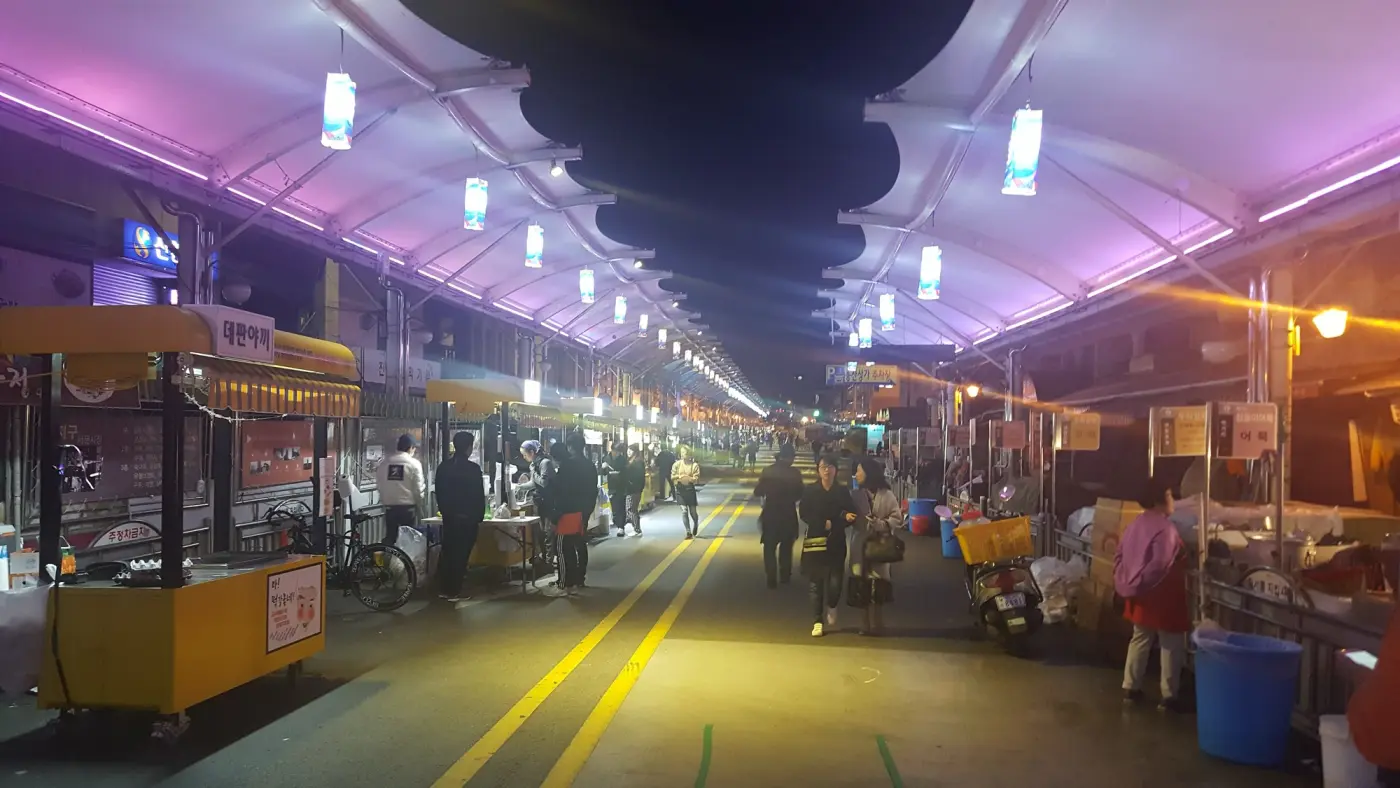
When the day shops close, the night market takes over. For the 2026 season the city announced that the Seomun Night Market runs from March to December on Fridays, Saturdays and Sundays, from 7 pm to 11:30 pm on Friday and Saturday and from 7 pm to 10:30 pm on Sunday, with busking and dance performances on those evenings. The stalls change each year; the 2026 line-up includes grilled makchang among more recent street-food ideas. The schedule is set season by season, so check the city's announcement for the year you visit.
Modern culture alleys: Cheongna Hill to Gyesan Cathedral
Jung-gu district runs five themed alley walks through the old centre. The most popular is Course 2, the modern culture alley, a 1.64 km route that the district says takes about two hours because there is so much to stop for. It starts at Cheongna Hill, with the early twentieth-century mission houses on the Dongsan hill, then drops down the March 1st Movement Road steps to Gyesan Cathedral and Jeil Church. From there it continues past the old houses of the poet Lee Sang-hwa and of Seo Sang-don, who led the National Debt Repayment Movement, through Yangnyeongsi and the herbal medicine museum, and finishes in the narrow Jongno and Jingolmok lanes.
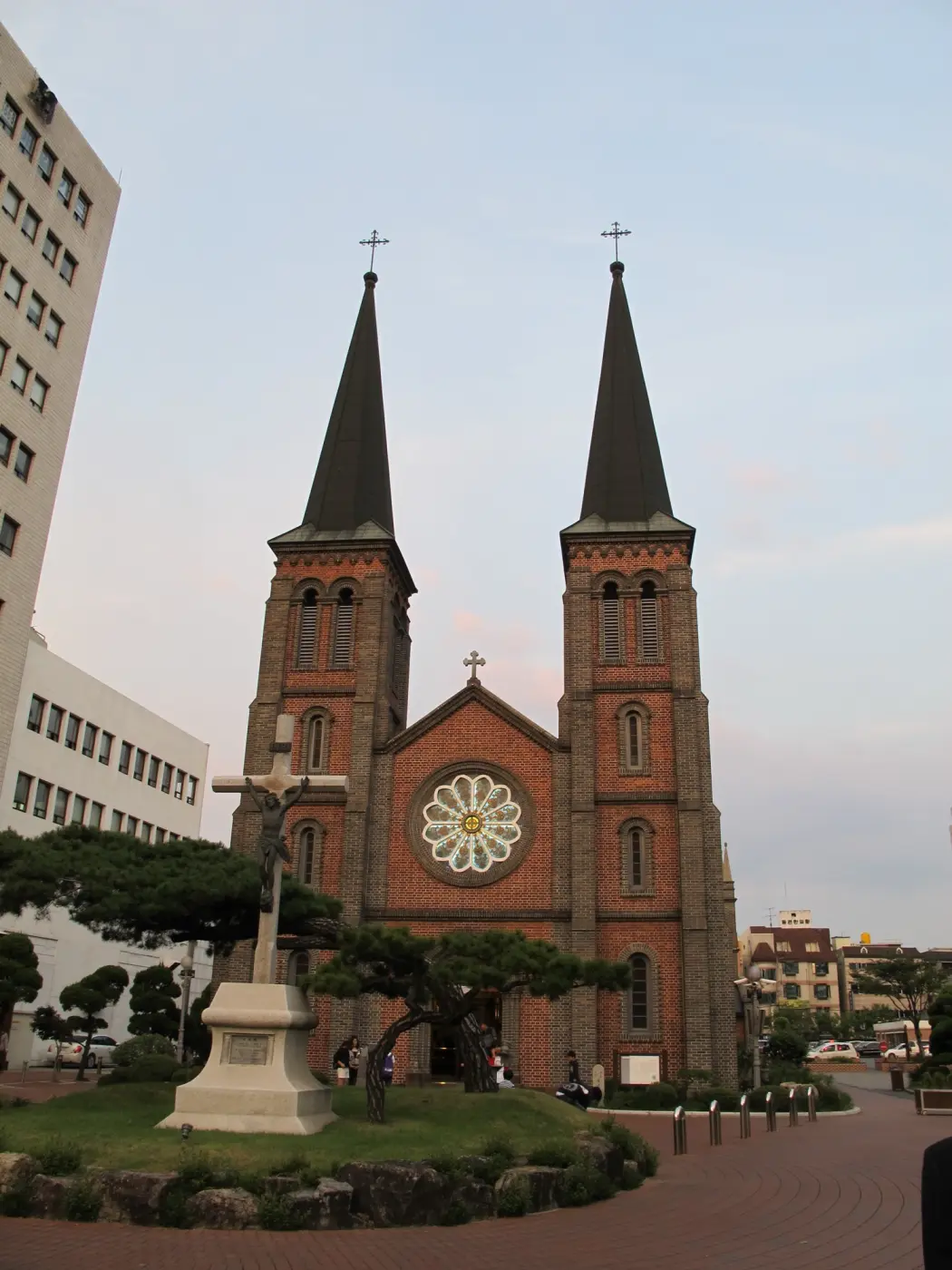
You can walk the route on your own with the district's map, or join a guided walk. The Jung-gu page lists regular free tours on Saturdays at 10 am and 2 pm, booked through the district website, starting in front of the mission museum on Cheongna Hill. For access, the district suggests exit 9 of Cheongna Hill station (about 300 m) or exit 18 of Banwoldang (about 500 m). The houses and churches are still in use, so keep voices down near services and follow any signs about photography inside.
Yangnyeongsi Herbal Medicine Market and Museum
A few minutes' walk from the alleys, Yangnyeongsi is a street of herbal medicine wholesalers, traditional pharmacies, tea shops and clinics. Its history goes back to a market for medicinal herbs set up by the provincial governor in the Joseon dynasty, in the seventeenth century, and the city's tourism site describes the present cluster stretching for about 650 m along Namseong-ro. Even if you are not buying, the smell of dried roots and bark, and the sacks and bundles stacked outside the shops, make it one of the most distinctive streets in Daegu.
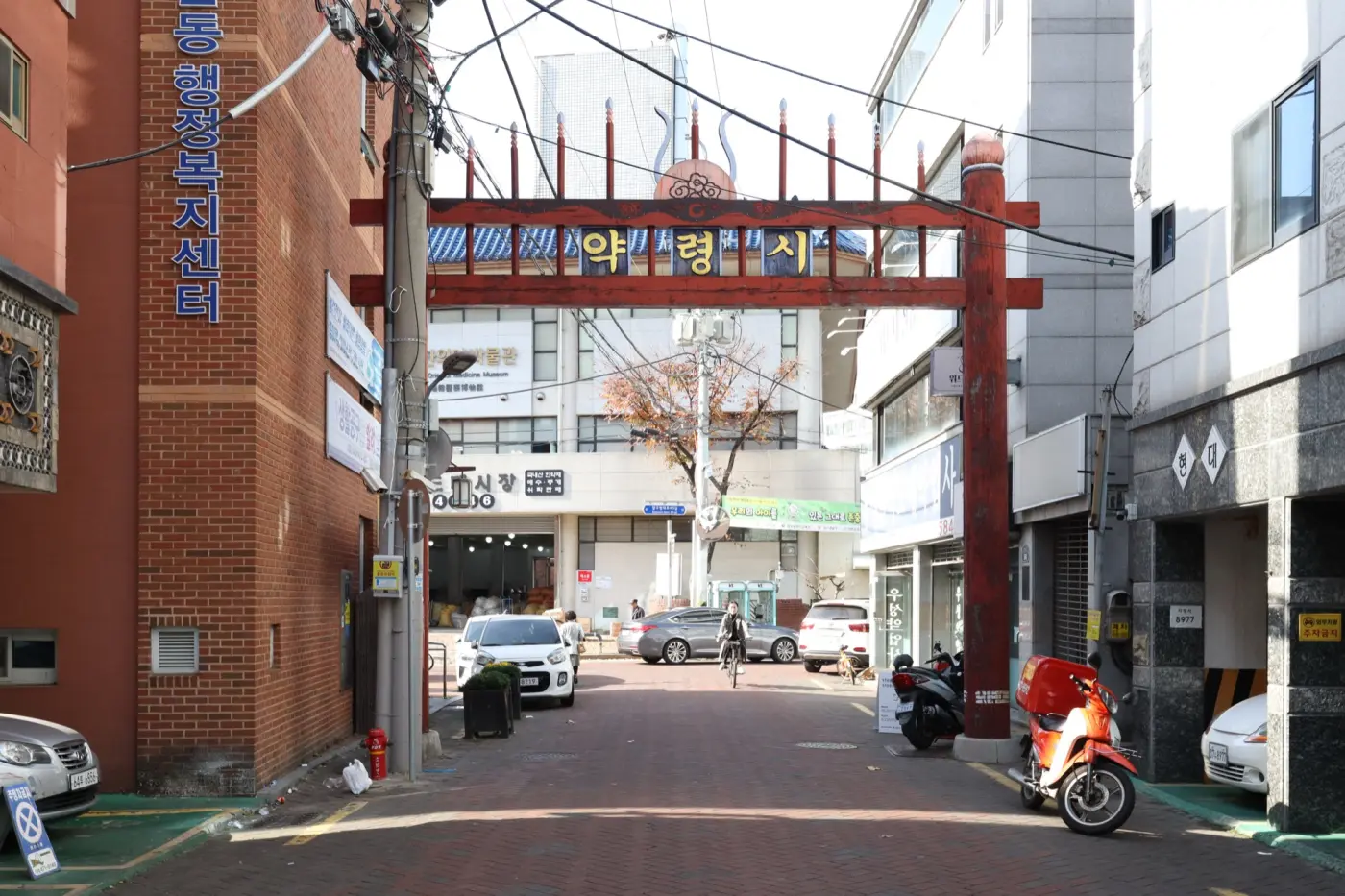
The city lists the Yangnyeongsi Museum of Oriental Medicine alongside the market. Its opening days differ between the city's listings, so check the current hours on the city tourism page before you go. The district also holds an annual Yangnyeongsi festival. The nearest metro exits are Jungangno station exit 1 on Line 1, which the operator lists for Yangnyeongsi, or Banwoldang exit 14.
Kim Kwang-seok-gil
Next to Bangcheon Market in Daebong-dong, Kim Kwang-seok-gil is a mural street dedicated to the singer-songwriter Kim Kwang-seok, who lived in the area. The city describes a wall of about 350 m with statues and murals about his life and music. It is a short, easy walk and fits well between the old centre and Apsan. Get off at Kyungpook National University Hospital station on Line 2 and use exit 3, which the operator lists for Bangcheon Market.
Apsan Park: cable car and observatory
Apsan is the mountain park on the city's southern edge. The Nam-gu district office says the Apsan cable car was installed in May 1974 and covers a 795 m one-way trip in about five minutes. From the upper area you continue to Apsan Observatory, which looks out over the whole of downtown Daegu and is a popular spot for night views. Both the district and the city tourism site describe two ways up: from the Keungol entrance using the cable car (about 3.2 km and 40 minutes in total), or on foot from Anjiranggol past Anilsa temple (about 2.5 km, roughly an hour).
Anjirang station on Line 1 is the closest metro stop; the operator lists Apsan Park at exit 3. From there it is an uphill walk or a short taxi ride to the trail and cable car entrances. Near the Anjiranggol side, the district promotes a gopchang alley (grilled intestines), a cafe street and a food street, which makes Apsan an easy pairing with dinner.
Donghwasa temple at Palgongsan
Donghwasa sits at the southern foot of Palgongsan, about 22 km northeast of the city centre according to the city tourism site. The site dates the temple's founding to 493, under the name Yugasa, and its renaming as Donghwasa to 832, when paulownia trees were said to be blooming there in winter. Most of the present buildings date from rebuilding in the eighteenth century, and the temple and its hermitages hold several stone pagodas and Buddha carvings designated as Treasures.
The temple is open all year. Culture and tourism guides who speak English or Japanese can be arranged on weekdays or for group bookings, and the city lists a temple stay programme here, which our templestay guide explains in general terms. There is no metro to Donghwasa, so allow half a day including the bus or taxi ride, and bring a layer: it is noticeably cooler in the mountains than in the basin below.
83 Tower and Duryu Park
On the west side of the city, Duryu Park is home to the E-World theme park and 83 Tower, a 202 m tower with views across Daegu. It is a modern landmark and is not pictured here, but it is a convenient evening viewpoint if Apsan is too far. Use Duryu station on Line 2, where the operator lists E-World at exit 12. Opening hours and fees vary by facility, so check the operator's site.
What to eat in Daegu
Daegu has its own list of local dishes, and three are easy to find. Makchang is grilled pork or beef intestine, usually cooked at the table and eaten with a dipping sauce; you will see it at the night market and around the gopchang alley near Apsan. Jjimgalbi is short ribs braised with garlic and chilli, and the city's travel course points to the Dongin-dong braised short rib alley in Jung-gu. Napjak mandu, the thin flat dumpling, is a Seomun Market staple.
Spice levels can be high, especially for jjimgalbi, so ask for a milder version if you are unsure. Our food pages explain gopchang and kalguksu in more detail, and the eating-out guide covers ordering, sharing dishes and paying.
Daegu in summer: planning for the heat
Because Daegu sits in a basin surrounded by mountains, it is known for hot, dry summers, and the city's own tourism site talks about the street trees planted to cope with the heat. If you are visiting in July or August, it helps to know how the Korea Meteorological Administration (KMA) warns about heat. A heat wave advisory is issued when the daily maximum apparent temperature is expected to be 33°C or higher for at least two days, and a heat wave warning when it is expected to reach 35°C or higher for at least two days.
- KMA advice is to avoid outdoor activity during the hottest part of the day, between 2 pm and 5 pm, which is a good time for the museum, the covered markets or a monorail ride.
- Drink water regularly and go easy on caffeine and alcohol in the heat.
- Wear a wide-brimmed hat and light clothing, and carry a water bottle.
- Public cooling shelters open in summer; dizziness, nausea or headache are signs to move somewhere cool, and 119 is the emergency number.
Save Apsan and Donghwasa for the morning or late afternoon, and do the alley walk early. Spring and autumn are more comfortable for walking, and our best-time-to-visit guide compares the seasons across Korea.
A one-day plan for Daegu
- Morning: arrive at Dongdaegu Station and take Line 1 to Jungangno (exit 1) for Yangnyeongsi. Walk into the modern culture alleys and follow them to Cheongna Hill, or do the route in reverse from Cheongna Hill exit 9.
- Lunch: walk or ride one stop on Line 3 to Seomun Market (exit 3) for kalguksu, napjak mandu and ssiat hotteok.
- Afternoon: ride the Line 3 monorail for the views, then change at Cheongna Hill to Line 2 for Kim Kwang-seok-gil (Kyungpook Nat'l Univ. Hospital, exit 3).
- Evening: on a Friday, Saturday or Sunday in season, go back to the Seomun Night Market from 7 pm; otherwise take Line 1 to Anjirang for Apsan and the observatory at dusk, then makchang or gopchang nearby.
A one-night plan
- Day 1: follow the one-day plan, ending at the night market or on Apsan. Staying near Banwoldang, Jungangno or Dongdaegu keeps both days simple.
- Day 2 morning: go out to Donghwasa at Palgongsan by bus or taxi while it is cool, and allow half a day.
- Day 2 afternoon: if you skipped Apsan, do the cable car and observatory now, or view the city from 83 Tower near Duryu station. Jjimgalbi makes a good last meal before the train.
- Onward: Daegu is a natural base for Gyeongju and Andong, and Busan is about an hour away by KTX, so it works well as a stop on a longer trip south.
Daegu rewards a slower look than the view from a passing KTX. In one day you can cover the markets and the old centre on foot and by monorail; with a night you add the mountains, a temple and a proper evening of street food. Check the night market season, keep the heat in mind in summer, and use the station exits above, and the city is easy to get around without a car.
Comments
Sign in to leave a comment.
Sign in ·No account? Create one
Confirm your email address to comment — it takes one click.
No comments yet.