
Busan for First-Timers: Where to Go and How to Get Around
First trip to Busan? How to get there from Seoul by KTX, how the city is laid out, six areas worth your time and a simple two-to-three-day plan.
Busan is where most first trips to Korea go after Seoul, and for good reason. VisitKorea calls it the country's second largest city, and it feels nothing like the capital: it is a port, spread along a long and hilly coastline, with beaches on one side of town, fishing harbours on the other, and neighbourhoods that climb straight up the slopes in between.
That shape is also the thing that catches first-time visitors out. The pictures you have probably seen, a white suspension bridge lit up at night, a hillside of painted houses, a temple on the rocks above the waves, are not in one centre. They are strung out along the coast, some of them an hour apart. Getting the geography straight before you arrive is the difference between a relaxed few days and a few days spent on the subway. This guide covers the train from Seoul, how the city fits together, the six areas most visitors want to see, and a simple plan for two or three days. Hours and transport details come from Busan Metropolitan City and Visit Busan, the city's official tourism site, as listed in October 2026.
Getting there from Seoul: KTX to Busan Station
The train is the easy answer. VisitKorea describes the Gyeongbu Line as a 447.1-kilometre route connecting Seoul and Busan that carries more passengers than any other line in Korea. High-speed KTX trains run on it from Seoul Station, and some services start at Yongsan. SRT, a separate high-speed operator, runs to Busan from Suseo Station in south-east Seoul, which can be handier if you are staying around Gangnam. Whichever you take, you arrive at Busan Station, the end of the line and the city's main rail hub.
Journey times are not all the same. Trains that make more stops take noticeably longer, so compare the duration when you book, not just the departure time; our Busan region page explains why this matters. Booking works the same way as anywhere else in Korea, and our KTX guide walks through it. Busan's city government lists Korail's online booking in several languages, including English and Japanese, and a help line for foreign passengers on 1599-7777. Weekends and the big holidays sell out first, so book early if your dates fall on them.
When you step off the train you are already on the metro: Busan Station is a stop on Metro Line 1, the line that also serves the old centre and the west side of the city.
How Busan is laid out
The simplest way to picture Busan is as three stretches of coast. The old centre sits around Busan Station and Nampo-dong. This is where the port city grew up: Jagalchi Market, Yeongdodaegyo Bridge to Yeongdo island, and the shopping streets that run up to Yongdusan Park. To the south and west are the hillier, older neighbourhoods: Gamcheon Culture Village in Saha-gu, and Yeongdo island itself, with Taejongdae at its southern tip.
To the east are the beaches. Gwangalli in Suyeong-gu comes first, then Haeundae, and further up the coast, in Gijang County, Haedong Yonggungsa temple. Between the two halves sits Seomyeon in Busanjin-gu, which Visit Busan calls the largest downtown in the city. It matters to you mainly because it is where Metro Lines 1 and 2 meet. As a rule of thumb, Line 1 is your line for the old centre and the west, and Line 2 is your line for the eastern beaches, with Seomyeon as the place you change.
Getting around: the metro does most of the work
Busan's metro has four numbered lines, each with its own colour. According to the city, station announcements are made in several languages including English and Japanese, and stations where you can change lines are marked by the sound of birdsong before the announcement. On top of the four lines, the Donghae Line, a Korail commuter service, runs up the east coast through Centum, BEXCO, Shin-Haeundae, Songjeong and Osiria, which is the useful stop for Haedong Yonggungsa. There is also a light rail line to neighbouring Gimhae.
For three of the six areas in this guide, Gamcheon, Taejongdae and Haedong Yonggungsa, the metro gets you close and a short bus ride does the rest. The city's advice for local buses is straightforward: pay with a transportation card or cash as you board, press the bell on the wall when you want to get off, and leave by the back door. A transportation card covers both buses and the metro, and the city notes that cash fares are higher and do not qualify for transfer discounts, so it is worth loading a card on day one. Our getting-around guide covers how the cards work.
Taxis are plentiful and fill the gaps, especially early in the morning or with luggage. If you get stuck explaining a destination, the city points visitors to the 1330 travel hotline for interpretation. Busan also runs a hop-on, hop-off City Tour Bus: Visit Busan lists a Red Line from Busan Station with a stop at Gwangalli, and a Blue Line around Haeundae that stops at Haedong Yonggungsa.
The six areas at a glance
| Area | What it is like | Getting there | Good time to go |
|---|---|---|---|
| Haeundae and Dongbaekseom | Busan's best-known beach, high-rises behind it, a pine-forest coastal trail at the western end | Line 2, Haeundae Station exit 3 or 5, then about 5 minutes on foot | Morning for the trail; swimming season runs late June to mid-September |
| Gwangalli | Crescent beach with cafés facing Gwangandaegyo Bridge | Line 2, Gwangan Station exit 5, then about 13 minutes on foot | After dark; drone show on Saturday evenings |
| Gamcheon Culture Village | Painted houses stacked up a hillside, murals, lanes where people live | Line 1, Toseong Station exit 6, then village bus Saha 1-1, Seo-gu 2 or Seo-gu 2-2 to Gamjeong Elementary School | Daytime; listed hours 09:00–18:00 (to 17:00 from November to February) |
| Jagalchi Market and Nampo-dong | A big seafood market on the harbour, with shopping streets behind it | Line 1, Jagalchi Station exit 10 or Nampo Station exit 2, then about 6 minutes on foot | Early morning for the market; closed on the 1st, 3rd and 5th Tuesdays |
| Haedong Yonggungsa | A Buddhist temple built on the rocks above the sea | Line 2, Haeundae Station exit 7 and bus 181, 100 or Haeundae 9; or Donghae Line, Osiria Station exit 1 and bus 139 | Early: open from 04:30, last entry 18:50 |
| Taejongdae | Sea cliffs, forest paths and a lighthouse at the southern tip of Yeongdo | Line 1, Busan Station exit 7, then bus 17, 88 or 101 to Taejongdae | Daytime; the Danubi road train does not run on Mondays |
Haeundae and Dongbaekseom
Haeundae is the beach most people picture when they think of Busan, and the city's own page calls it the most popular and well-known beach in Korea. Visit Busan describes 1.5 kilometres of white sand and says it draws more than 10 million visitors each season. The official swimming season in 2026 ran from 26 June to 15 September, with lifeguarded hours of 09:00 to 18:00. Outside those dates the sand is still open and much calmer, which makes autumn and spring lovely times for a long walk along the water.
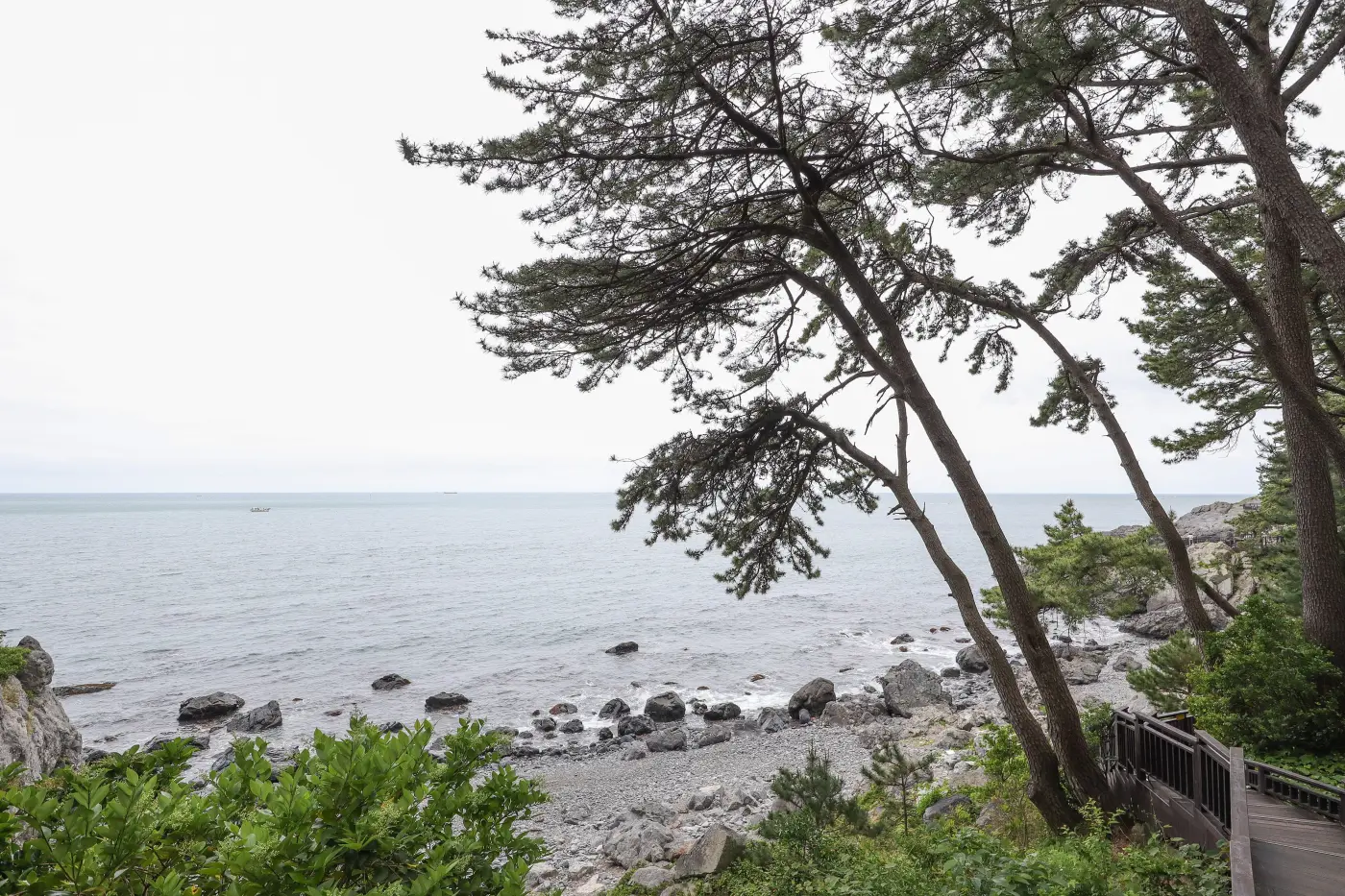
Do not stop at the beach itself. At its western end, Dongbaekseom was once a separate island and is now joined to the shore; the Dongbaek Coastal Trail loops around it through pine trees, with the open sea on one side. It is an easy walk and the best antidote to the crowds on the sand. Haeundae Station on Line 2 is close: the city says to use exit 3 or 5 and allow about five minutes on foot.
Gwangalli and the bridge view
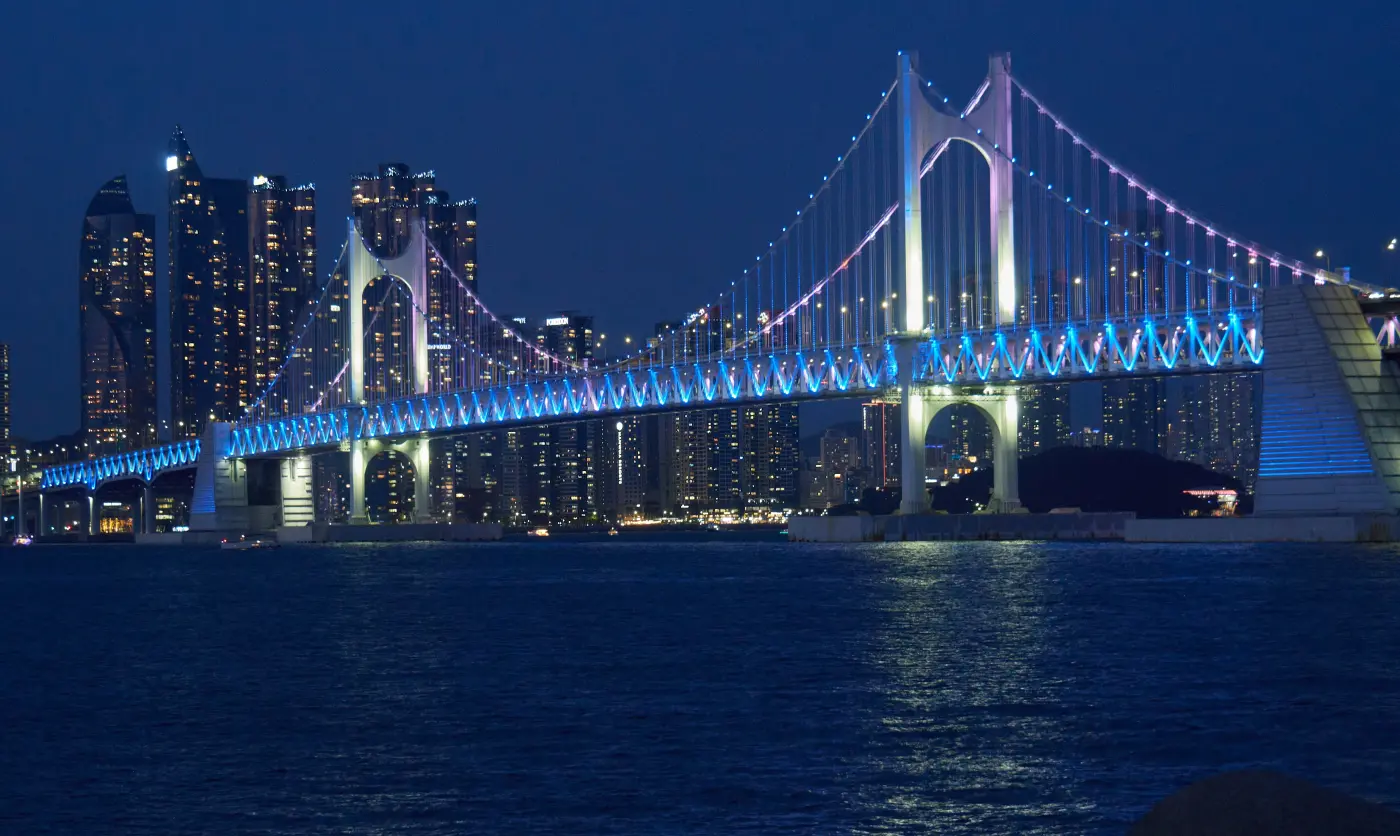
Gwangalli is the beach closest to the city centre, a crescent of sand lined with cafés and restaurants that all face the same view: Gwangandaegyo Bridge. The city lists the bridge at 7,420 metres long, a two-storey road bridge linking the Gwangalli side with Centum City on the Haeundae side. In the daytime it is a backdrop. After dark it is the reason to come, and Visit Busan notes that its lighting shifts colour as you watch. Nearby Millak Waterside Park is the quieter place to sit with the view.
On Saturdays there is a bonus. The city runs a free drone light show over Gwangalli Beach every Saturday of the year, about 12 minutes long, at 19:00 and 21:00 from October to February and at 20:00 and 22:00 from March to September. Rain, strong wind or a typhoon can cancel it, and the organisers post changes the day before or on the day. To get there, take Line 2 to Gwangan Station; Visit Busan puts the walk from exit 5 at about 13 minutes.
Gamcheon Culture Village
Gamcheon is the hillside of pastel houses that appears on half the postcards of Busan. Its story is less pretty than its colours. Visit Busan explains that refugees settled here during the Korean War and built homes on the steep slope to make a living. In 2009, students, artists and residents began decorating the lanes as part of a village art project, and the murals, artworks and small workshops grew from there. The village information centre sells a stamp map that turns the maze of alleys into a route.
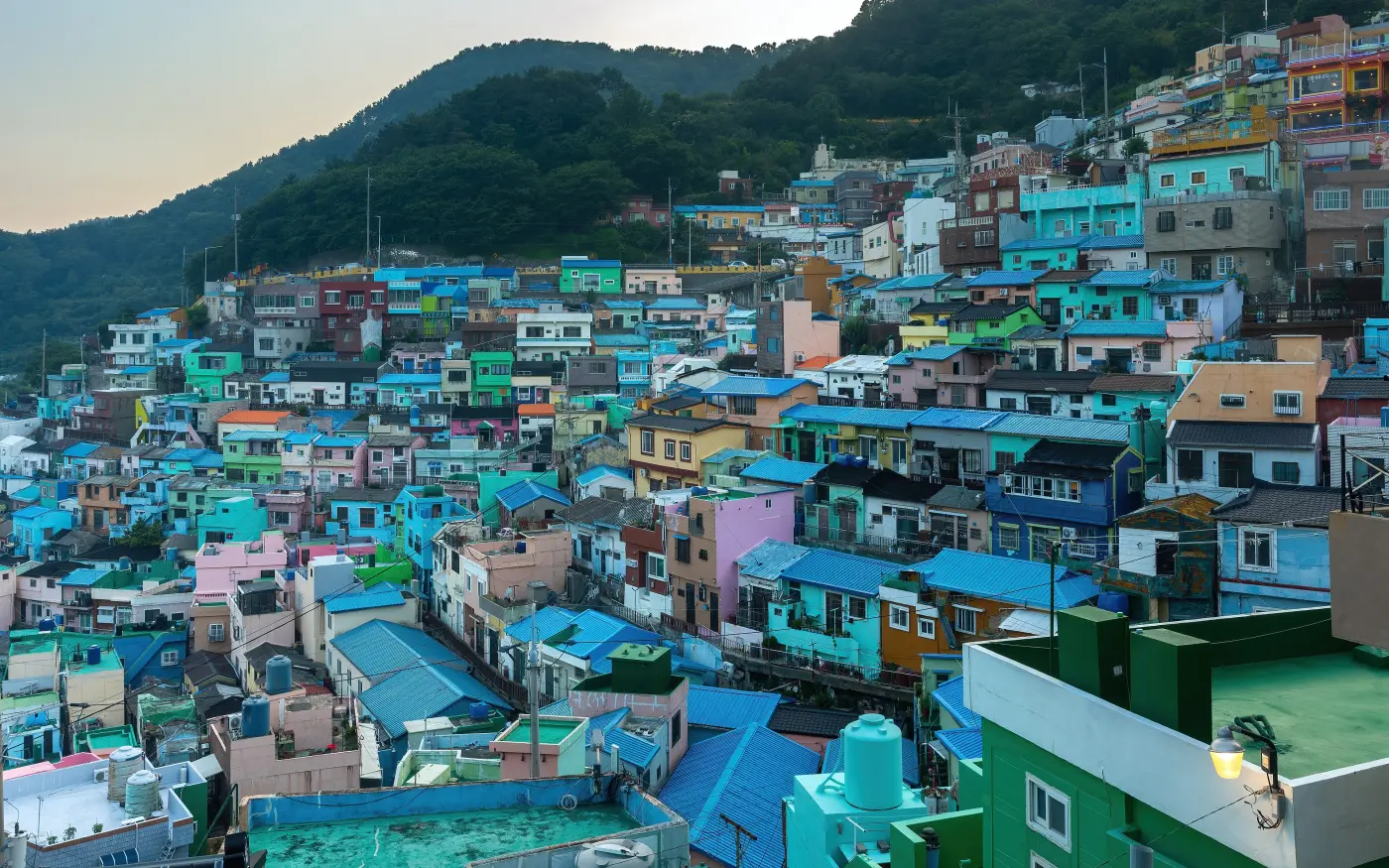
The most important thing to remember is that people live in every one of these houses. The official etiquette is short: keep quiet and keep the area clean, because it is a residential neighbourhood, and do not fly drones. The listed visiting hours are 09:00 to 18:00 from March to October and 09:00 to 17:00 from November to February. To get there, take Line 1 to Toseong Station, leave by exit 6, and take village bus Saha 1-1, Seo-gu 2 or Seo-gu 2-2 to Gamjeong Elementary School, from where it is about five minutes on foot.
Jagalchi Market and the old centre
Jagalchi is Busan's great fish market, right on the harbour in Jung-gu. Visit Busan traces the name to the large pebbles, jagal, that once covered the shore here, and its growth to the years after the Korean War, when refugees crowded into the area and fish stalls multiplied into a full market. Today it has two faces: the outdoor stalls under colourful parasols, with octopus in basins and seafood piled on the stalls, and a modern indoor market full of tanks where you can choose seafood and eat it as sliced raw fish, grilled fish or a spicy stew.
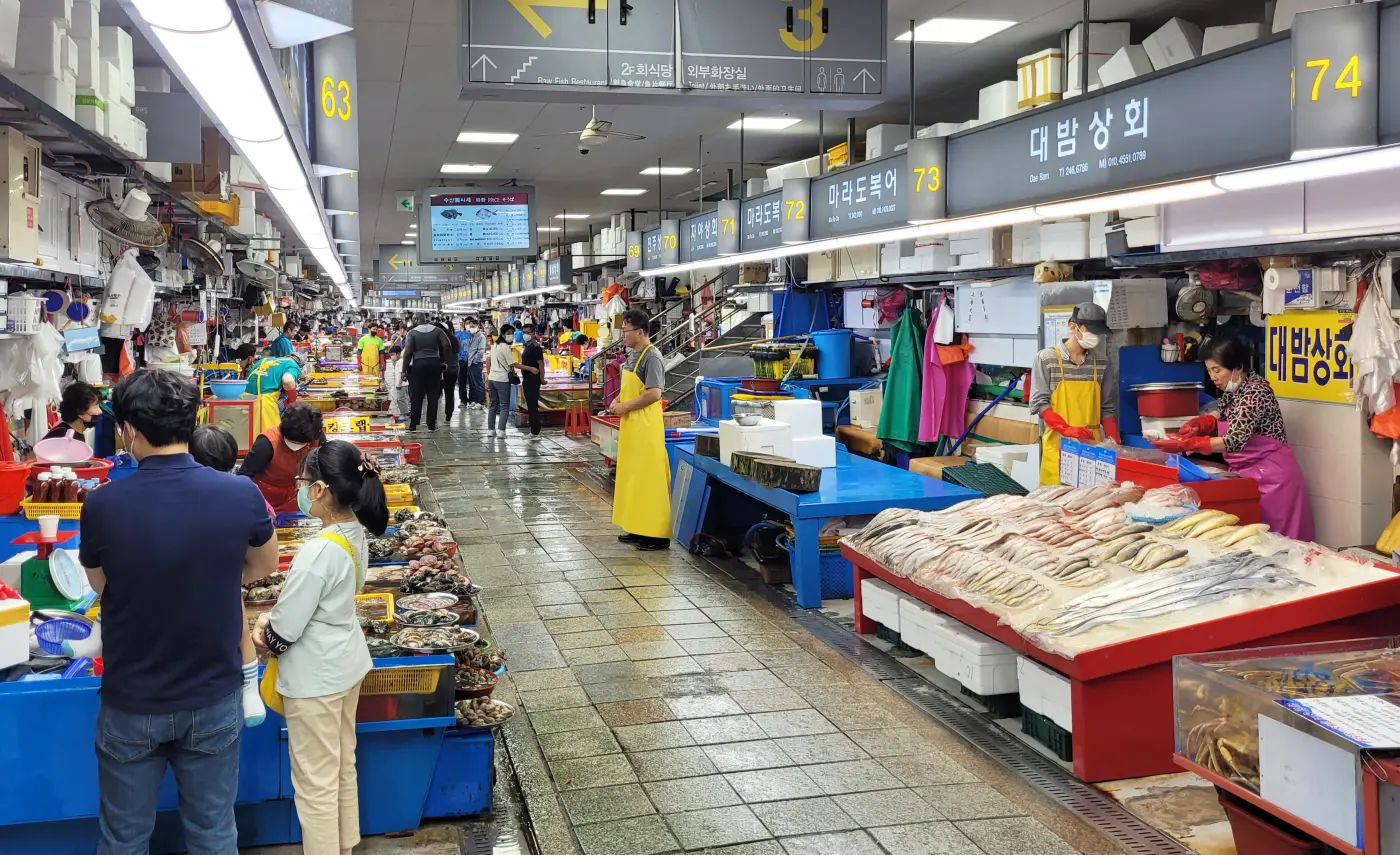
The market lists its hours as 05:00 to 22:00, with individual stores varying, and closes on the 1st, 3rd and 5th Tuesdays of the month. Come early if you want to see it at its liveliest. From Line 1, use Jagalchi Station exit 10 or Nampo Station exit 2 and walk for about six minutes. The rest of Nampo-dong is right behind you: shopping streets, Yongdusan Park on its hill, and Yeongdodaegyo Bridge, which the city says is lifted once a week, for 15 minutes at 2 p.m. on Saturdays.
Haedong Yonggungsa
Most Korean temples sit deep in the mountains. Haedong Yonggungsa sits on the coast in Gijang, built on the rocks right above the waves, and that is exactly why it is so popular. Visit Busan tells the story of its name, which comes from a dream of the monk Jeongam, and describes the approach: a row of statues of the twelve zodiac animals, then a gate, then 108 steps through the pine trees until the temple and the sea open up in front of you.
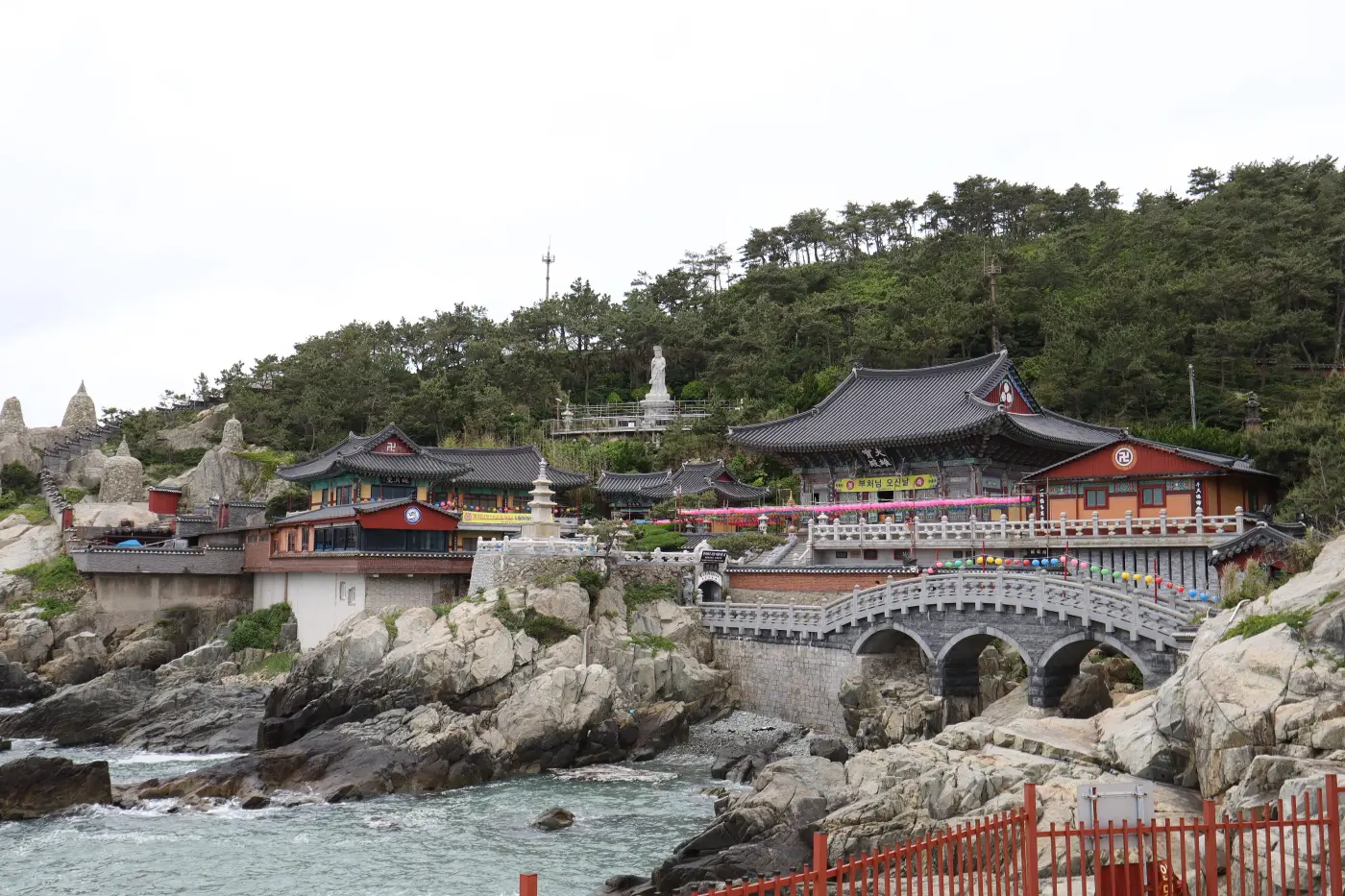
The temple is open every day from 04:30 to 19:20, with last entry at 18:50, and there is no admission charge. It is busiest in the middle of the day, so this is the one place worth getting up early for: Visit Busan singles out a sunrise rock on the coastal path. It is also a working temple, and the etiquette is simple: lower your voice, use the side doors rather than the central door of a hall, which is for monks, and line up your shoes. To get there, take Line 2 to Haeundae Station, leave by exit 7 and take bus 181, 100 or Haeundae 9; or take the Donghae Line to Osiria Station, exit 1, and bus 139.
Taejongdae
At the southern tip of Yeongdo island, Taejongdae is where Busan stops being a city. Dense forest runs down to sea cliffs and rocks shaped by years of crashing waves. Visit Busan says it takes its name from King Taejong Muyeol of Silla, who is said to have come here to practise archery because he loved the view. Most visitors use the Danubi, a small road train that loops around the park and stops at the observatory, but the paths are well kept and it is a pleasant walk in good shoes.
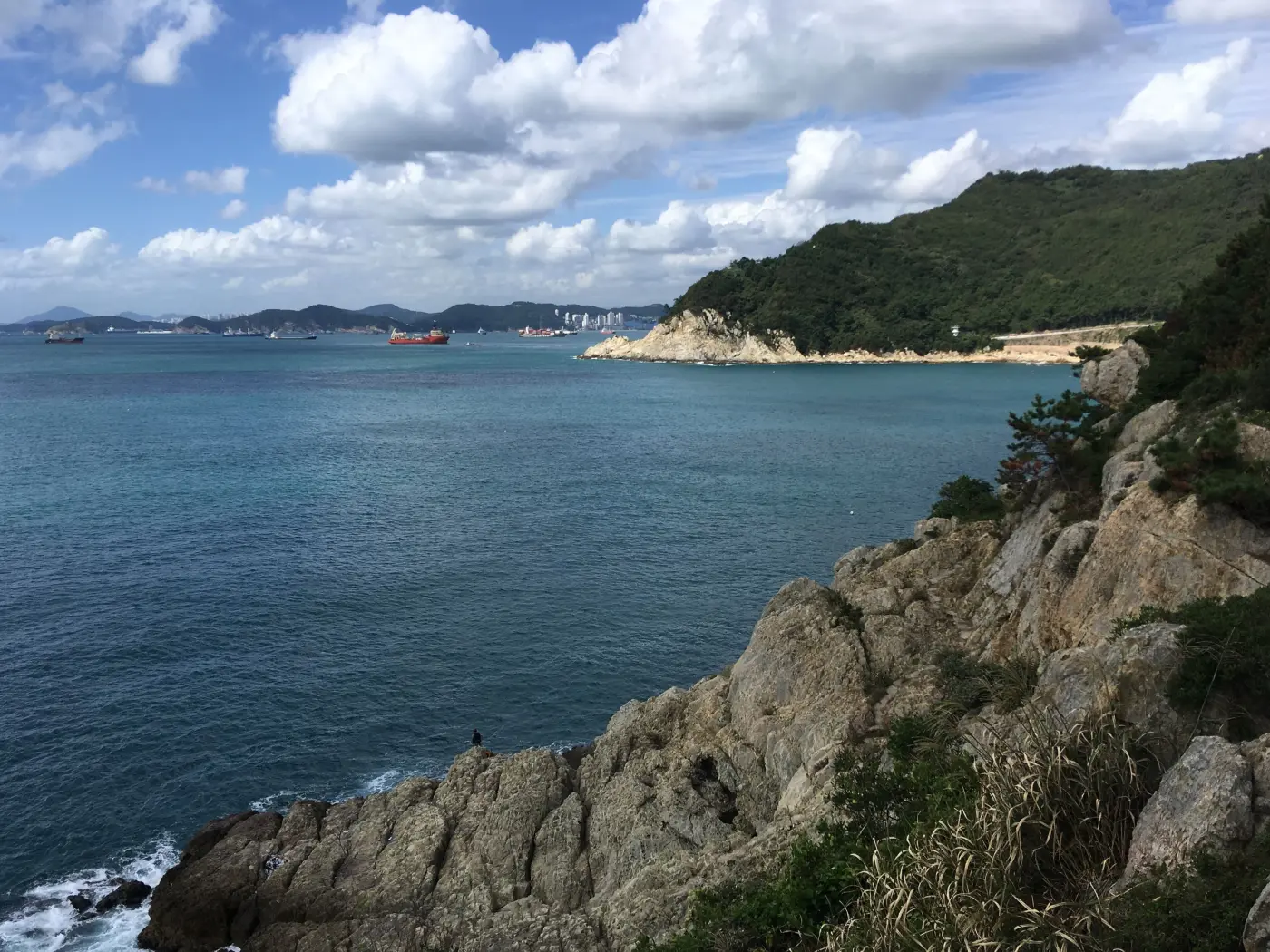
Below the observatory stands Yeongdo Lighthouse, whose light, according to Visit Busan, has not gone out since 1906. On a clear day you can see as far as the Oryukdo islets and Tsushima. Entry to the park is free; the Danubi charges separately and does not run on Mondays. To get there, take Line 1 to Busan Station, leave by exit 7 and take bus 17, 88 or 101 to the Taejongdae stop.
A simple plan for two or three days
The trick is to group areas by side of the city, so that each day runs along one line instead of zig-zagging across it. Here is a three-day version for someone arriving by KTX:
- Day 1, the old centre and the west: arrive at Busan Station and drop your bags. Take Line 1 to Toseong for Gamcheon in the late morning, then ride back along Line 1 to Jagalchi for a late seafood lunch. Spend the rest of the afternoon in Nampo-dong and up at Yongdusan Park.
- Day 2, Yeongdo, then east: go to Taejongdae in the morning by bus from Busan Station, and walk the cliffs while you are fresh. In the afternoon, take Line 1 to Seomyeon and change to Line 2 for Gwangan. Watch the sunset and the bridge lights from Gwangalli, and stay for the drone show if it is a Saturday.
- Day 3, the far east coast: take an early bus to Haedong Yonggungsa before the crowds. Come back to Haeundae for a late-morning walk on the beach and the Dongbaek Coastal Trail, then take Line 2 to Seomyeon and Line 1 back to Busan Station for your train.
With only two days, keep Day 1 as it is, and on Day 2 go straight to Haedong Yonggungsa in the morning, Haeundae at midday and Gwangalli in the evening, saving Taejongdae for your next visit. As for where to stay, one base near Busan Station or Nampo-dong makes early trains and the west side easy, while Haeundae or Gwangalli puts you next to the sea in the evenings. Moving once, halfway through, works well. Before you fix the days, check three things: the Danubi train does not run on Mondays, Jagalchi closes on some Tuesdays, and the drone show only happens on Saturdays.
Before you go
- Load a transportation card on day one. It works on both the metro and city buses, and paying cash costs more and loses the transfer discount.
- Treat Gamcheon as a neighbourhood, not a theme park: quiet voices, no drones, and no photos into people's homes.
- At Haedong Yonggungsa, dress for a temple and leave the central doors of the halls to the monks.
- Busan pairs naturally with Gyeongju, the old Silla capital, so if you have an extra day, see our two-day Gyeongju plan.
If you want to go deeper than six highlights, our Busan city guide PDF reads the city in the same three parts, the old centre, the eastern beaches and the western side, and ends with how to get there and get around.
Comments
Sign in to leave a comment.
Sign in ·No account? Create one
Confirm your email address to comment — it takes one click.
No comments yet.