
Cherry Blossom Season in Korea: When and Where to Go
When Korea's cherry blossoms open, from Jeju and Jinhae to Seoul, how to read the official bloom reports, and which festival spots to plan a spring trip around.
For two or three weeks every spring, Korea's streets, rivers and old royal sites turn pink and white. Cherry blossom season is one of the most popular times to visit, and also one of the trickiest to plan, because it is short, it moves from place to place, and its dates shift from year to year with the weather.
Planning a trip around it comes down to two ideas. First, the blossoms open in the south and work their way north, so Jeju and the southern coast bloom before Seoul. Second, nobody can promise you exact dates months ahead, not even the weather service, so the smart move is to understand the usual window, keep a little slack in your plans, and check the official bloom reports that Koreans use themselves. This guide covers all three, then walks through the best-known blossom spots using what their official pages actually say.
How the blossom front moves from south to north
Korea's cherry season starts on Jeju and the warm southern coast and travels north over a couple of weeks. VisitKorea, the national tourism organisation, publishes a forecast each year. Its 2026 edition, credited to the private forecaster Weather i, expected the first blossoms in Jeju and Busan around 25 March, Jeonju and Gyeongju around 28 March, Gangneung around 1 April, Seoul around 3 April and Incheon around 7 April. The same page warned that actual dates may differ depending on the weather.
They did. The Korea Meteorological Administration (KMA) declared Seoul's cherry blossoms open on 29 March 2026, five days ahead of that forecast and ten days ahead of the normal date. That is the real lesson of any blossom forecast: it tells you the order and the rough window, not the day.
The order is also not a perfectly neat line up the map. The table below shows the first-bloom dates KMA recorded in major cities in 2020. Daegu, which sits inland, opened before Busan and Jeju that year, and Seoul and Incheon came last. Local conditions such as sunshine, shelter and the warmth of the preceding weeks all play a part.
| City | First bloom in 2020 | Observed since |
|---|---|---|
| Daegu | 21 March | 1924 |
| Busan | 23 March | 1921 |
| Ulsan | 23 March | 1936 |
| Gwangju | 23 March | 1939 |
| Jeju | 24 March | 1940 |
| Daejeon | 24 March | 1973 |
| Jeonju | 26 March | 1921 |
| Gangneung | 26 March | 2009 |
| Seoul | 27 March | 1922 |
| Incheon | Not yet open on 27 March | 1921 |
How Korea decides the blossoms are open
When Korean news says "the cherry blossoms have opened in Seoul", it is quoting an official observation. KMA has recorded Seoul's blossoms since 1922 using a designated king cherry tree at the Seoul Weather Station in Jongno-gu, the same site as the National Weather Museum. The rule is precise: the blossoms count as open when at least three flowers are fully open on any one branch of the reference tree. Full bloom is declared when about 80 percent or more of the flowers on a tree are open. Since 2000, KMA has also watched three numbered trees on Yunjung-ro in Yeouido, Seoul's best-known blossom avenue.
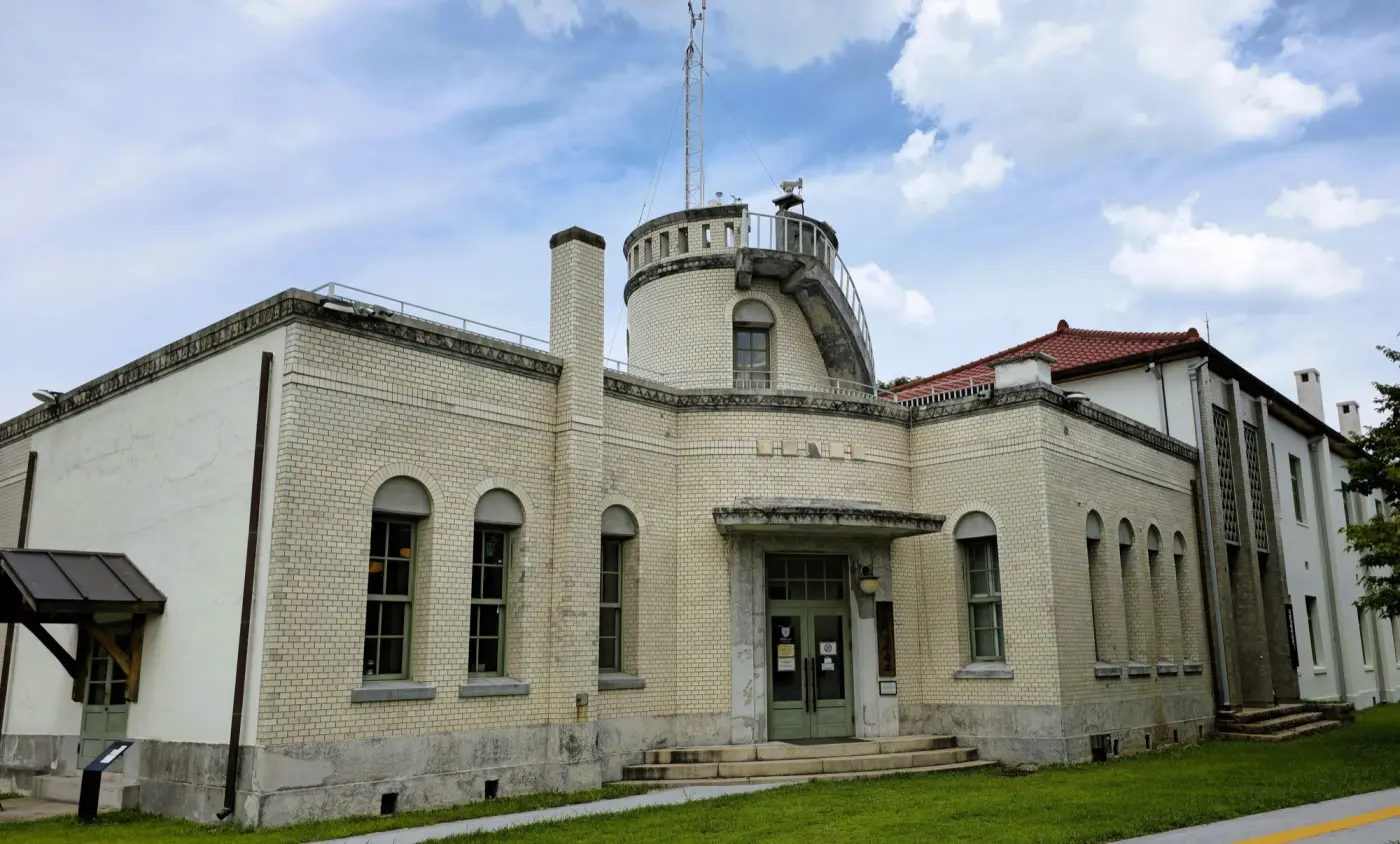
KMA's normal dates for Seoul are 8 April for first bloom and 10 April for full bloom. For Yunjung-ro, the normal first bloom is 6 April. Recent years have mostly run earlier than that. KMA's records show Seoul's first bloom on 24 March in 2021 (the earliest since observations began), 4 April in 2022, 25 March in 2023, 1 April in 2024, 4 April in 2025 and 29 March in 2026. In the five years from 2021 to 2025, full bloom followed first bloom by between three and six days.
Put together, those numbers give a practical rule for Seoul: the blossoms will most likely be out somewhere between the last week of March and the middle of April, and each tree is at its best for only a few days. If you can, book the Seoul part of your trip for the first week of April and keep two or three days of flexibility either side.
Where to check bloom reports before you go
- KMA Weather Nuri, the weather service's public site, has a spring flower status page with photos of the observation trees at major cherry blossom and azalea spots around the country, labelled before bloom, first bloom and full bloom. The page is in Korean and only runs from early March to late May. Find it under Current Weather, then Spring Flowers and Autumn Foliage.
- KMA issues a press release when Seoul and Yunjung-ro officially bloom, and Korean news repeats it the same day.
- VisitKorea's yearly cherry blossom forecast gives expected dates city by city in English, with the caveat that real dates may differ.
- Local tourism sites post their own updates. Gyeongju's tourism site ran a series of cherry blossom alerts through spring 2026, the last of them on 22 April, and the Jinhae festival site has a cherry blossom blooming information page.
- The 1330 Travel Hotline, listed on VisitKorea's festival pages, answers travel questions in Korean, English and Japanese.
Jinhae: the Gunhangje Festival in Changwon
Jinhae, a coastal district of the city of Changwon in South Gyeongsang Province, hosts what VisitKorea calls Korea's premier cherry blossom destination. The festival committee traces the Jinhae Gunhangje Festival to a memorial ceremony for Admiral Yi Sun-sin held at Bukwon Rotary in 1952. It became a full festival in 1963 and now draws more than two million visitors a year. Alongside the blossoms there are memorial rites for Admiral Yi, a victory parade, a military band and honour guard festival, and temporary access to the Korea Naval Academy and naval base, which are normally closed to the public.
The 64th festival ran from 27 March to 5 April 2026, centred on Jungwon Rotary and the Jinhaeru area. Dates for 2027 had not been announced when this was written in November 2026; they are usually announced in early spring, so check the official site before you book.
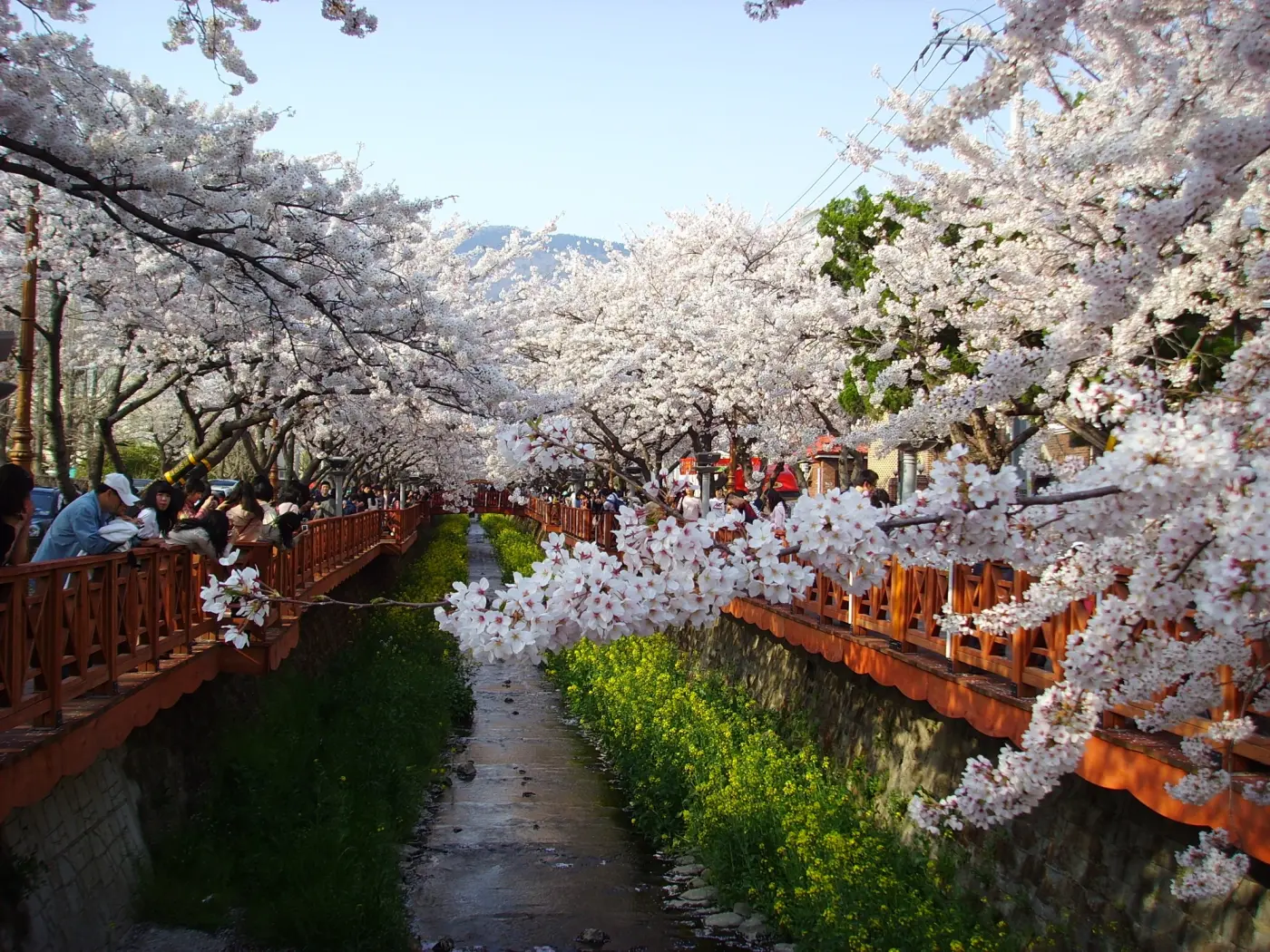
Two spots appear in almost every guide, and VisitKorea describes both. Yeojwacheon Stream has a blossom tunnel about 1.5 kilometres long, and one of its bridges is known as Romance Bridge after the 2002 MBC drama Romance was filmed there. At Gyeonghwa Station, rows of cherry trees line an 800-metre stretch of railway track. The cover photo of this article shows Yeojwacheon in early April.
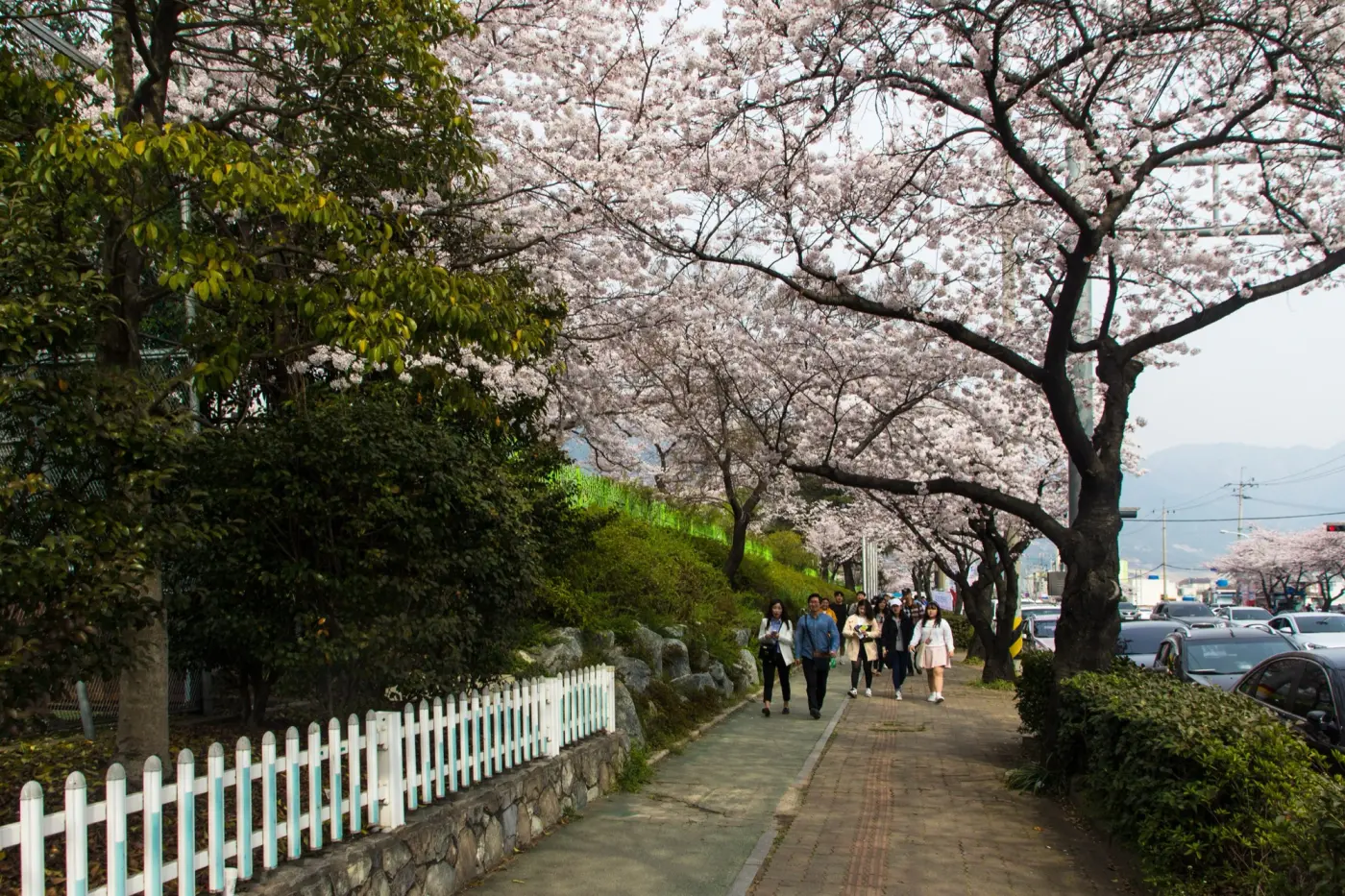
Jinhae is busy during the festival, and driving is the hard way to see it. The official festival site has a transport section covering shuttle buses, a military base shuttle, a city tour bus and city buses, together with car-free streets, one-way traffic and live traffic cameras at the main junctions. The details are updated each year, so read them shortly before you go.
Busan: riverside tunnels and a late finish
Busan blooms early: VisitKorea's 2026 forecast put it level with Jeju, around 25 March. Its best-known blossom route follows the Nakdong River on the west side of the city, where Visit Busan, the city's official tourism site, describes a 12-kilometre stretch of riverside turning into a tunnel of cherry blossoms during the Samnak Cherry Blossom Festival. The 2026 festival ran from 27 March to 12 April and was free, and Visit Busan's directions put it a seven-minute walk from Exit 1 of Gwaebeop Renecite Station on the Busan-Gimhae Light Rail, or reachable on buses 123, 126 and 138-1.
For travellers who arrive late, VisitKorea notes that Democracy Park on Bosusan Mountain has double-flowered cherry blossoms that bloom in mid to late April, reachable on bus 38 to the Jungang Park-Democracy Park stop. Our first-timer's guide to Busan covers the KTX and the metro.
Gyeongju: blossoms among royal tombs
Gyeongju, the old Silla capital, may be the most atmospheric place in Korea to see the blossoms, because the trees frame grassy royal tombs and stone monuments rather than apartment blocks. According to Gyeongju City, its cherry blossom festival takes place during the flowering season each year, mostly in early April. The festival venues are the East Historic Site District around Cheomseongdae Observatory and Gyerim Forest, and the Bomun Tourism Complex, and the city lists Daereungwon, Cheomseongdae and Donggung Palace and Wolji Pond among the places to see the blossoms. VisitKorea places the festival around the stone-walled road beside the Daereungwon tomb park.
Bomun Lake, a man-made lake on the east side of town popular with walkers and cyclists, is the other big blossom area, and the Gyeongju Cherry Blossom Marathon starts there in early April. Our two-day Gyeongju itinerary explains the KTX station and the city bus loop that links the old centre with Bomun and Bulguksa.
Seoul: Yeouido and Seokchon Lake
Seoul's classic blossom walk is Yeouiseo-ro, still widely called by its old name Yunjung-ro, behind the National Assembly on Yeouido. VisitKorea describes a 1.7-kilometre road of cherry trees along the Hangang River. The Yeongdeungpo Yeouido Spring Flower Festival, hosted by the Yeongdeungpo-gu Office and free to attend, ran from 3 to 7 April in 2026. The main section is closed to traffic during the festival, and VisitKorea suggests Yeouinaru Station on Line 5 or National Assembly Station on Line 9. Note that festival dates are fixed in advance: in 2026 the Yunjung-ro trees opened on 29 March, several days before the festival began.
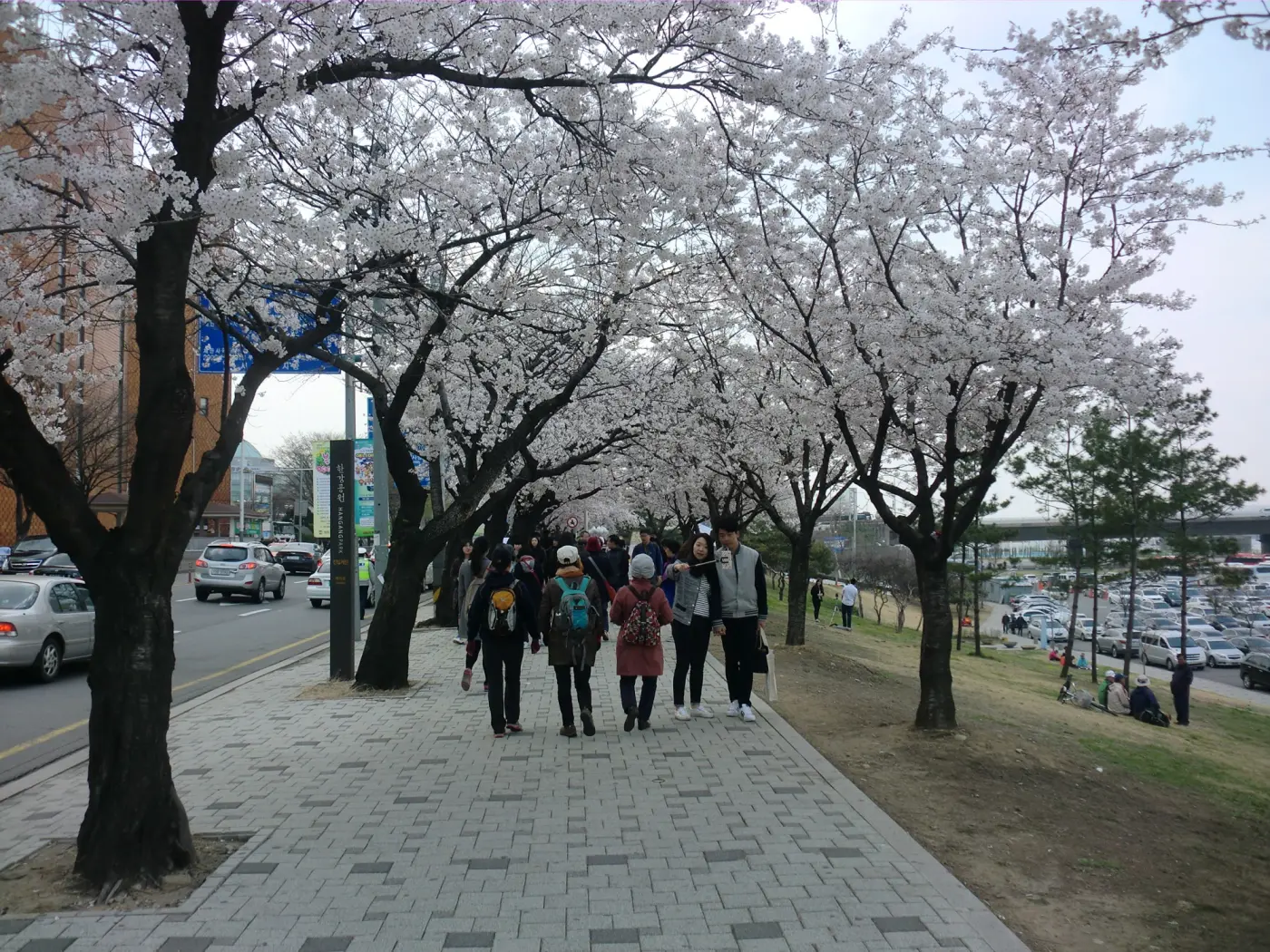
After the blossoms, Yeouido Hangang Park next door is a natural place to sit by the river, and our Han River parks guide covers its exits, bike rentals and food delivery zones.
Across the city in Jamsil, Seokchon Lake Park is the other big name. Visit Seoul describes it as a lake divided into a West Lake and an East Lake by Songpa-daero, with a 2.5-kilometre path around it and a cherry blossom festival each spring. It is open 24 hours, and the nearest stop is Jamsil Station on Lines 2 and 8, Exit 2, about 282 metres away. Visit Seoul estimates 30 to 40 minutes to walk both sides.
Jeju: the first big festival of the season
Jeju usually hosts the season's first major festival. VisitKorea describes Jeonnong-ro in Jeju City as a 1.2-kilometre road lined with king cherry trees that arch over both sides of a two-lane street, about ten minutes' drive from Jeju International Airport. During the Jeju Cherry Blossom Festival in late March, the road is closed to traffic so visitors can walk under the trees. The festival, hosted by Jeju City and free to attend, also takes place at Jangjeon-ri in Aewol-eup, a village west of the city. VisitKorea's festival page adds a point worth remembering: the peak of the bloom lasts only two to three days. If you are getting around the island by bus, our guide to Jeju without a car explains the routes from the airport and the city bus terminal.
At a glance: timing and getting there
| Place | Usual timing (official information) | How to get there |
|---|---|---|
| Jeonnong-ro and Jangjeon-ri, Jeju | Late March; Jeju Cherry Blossom Festival in late March | Jeonnong-ro is about 10 minutes' drive from Jeju International Airport; Jangjeon-ri is in Aewol-eup, west of Jeju City |
| Nakdong riverside (Samnak), Busan | Late March to April; 2026 festival 27 March to 12 April | 7-minute walk from Exit 1, Gwaebeop Renecite Station, Busan-Gimhae Light Rail |
| Democracy Park, Busan | Double-flowered blossoms in mid to late April | Bus 38 to the Jungang Park-Democracy Park stop |
| Jinhae (Changwon) | Late March to early April; 2026 festival 27 March to 5 April | Festival shuttle buses and city buses; check the festival site's transport page |
| Gyeongju (Daereungwon, Cheomseongdae, Bomun Lake) | Festival mostly in early April | KTX or express bus to Gyeongju, then city bus or taxi |
| Yunjung-ro, Yeouido, Seoul | Normal first bloom 6 April; 2026 festival 3 to 7 April | Yeouinaru Station (Line 5) or National Assembly Station (Line 9) |
| Seokchon Lake, Seoul | Festival each spring; Seoul's normal first bloom is 8 April | Jamsil Station (Lines 2 and 8), Exit 2, about 282 m |
Crowds and transport: practical tips
- Go early on a weekday. The famous streets are at their calmest in the first hours of the morning, and weekends during festivals are by far the busiest time.
- Leave the car behind. Both Jinhae and Yeouido close roads during their festivals, and parking near the main spots is scarce. Subways, light rail and festival shuttles are quicker.
- Book long-distance trains early if your dates fall on a weekend, and build in a spare day so you can move your blossom day if the weather turns.
- Expect festival dates and bloom dates to drift apart. A festival may open before the trees are at their best, or after the petals have started to fall.
- Look beyond the famous names. Most Korean cities have riverside paths, parks and campuses lined with cherry trees that are far quieter than the festival streets.
What to wear, and the spring dust question
Spring in Korea is changeable. A sunny afternoon can feel warm, while early mornings and evenings by the water stay cold well into April, so layers work best: a T-shirt, a light knit and a jacket you can carry. Our guide to the best time to visit Korea explains the season month by month, and our packing list covers what to bring for spring.
Spring is also when Korea gets its dusty days, both the everyday fine dust and the wind-blown yellow dust known as hwangsa. Most spring days are fine, but it is worth checking the air quality grade in the morning, keeping an indoor plan in reserve, and carrying a certified health mask in case the air is poor. Our fine dust guide explains the grades and where to check them.
A simple way to plan a blossom trip
If your trip lasts a week or more around the end of March, follow the blossoms north: start in Jeju or on the southern coast in Busan and Jinhae, continue to Gyeongju, and finish in Seoul. If you only have Seoul, aim for the first week of April and keep your plans flexible, check the KMA and VisitKorea pages in the last two weeks before you travel, and choose refundable bookings where you can. Even if you miss the peak, late blossoms, fresh green leaves and spring flowers such as azaleas keep the season going into April and May.
Comments
Sign in to leave a comment.
Sign in ·No account? Create one
Confirm your email address to comment — it takes one click.
No comments yet.