
Jeju Without a Car: Buses, Taxis and Where to Stay
Not driving in Jeju? How the island's buses, taxis and tours really work, where to base yourself, and which sights you can reach without a car.
Jeju is the island most first-time visitors add to a Korea trip, and the standard advice is to rent a car the moment you land. That works for plenty of people, but not for everyone. Some travellers don't have a licence they can use in Korea, some would rather not drive on unfamiliar roads on the right-hand side, and some simply want a slower holiday where the day isn't spent looking for parking. The good news, from people who live here: you can see a great deal of Jeju without touching a steering wheel.
The island has a dense bus network managed by the provincial government, metered taxis in every town, and plenty of day tours for the places buses serve badly. The trick is to plan with the buses rather than against them. This guide explains how Jeju's buses are organised, what they cost, how to use taxis and tours to fill the gaps, where to base yourself, and which highlights are easy, possible or genuinely awkward without a car. Route numbers, fares and trail rules below come from the official Jeju Bus Information System and Hallasan National Park sites as we read them in October 2026. Jeju reshuffles routes from time to time, so check the live pages before you set out.
How Jeju's buses are organised
The first thing to learn is that the route number tells you what kind of bus you are looking at. The official Jeju Bus Information System sorts every route by its first digit:
- 100s: express buses with limited stops, linking the airport and Jeju City with the far corners of the island.
- 200s: general trunk routes that cross or circle the island, for example along the east and west coastal roads.
- 300s and 400s: trunk and branch routes inside Jeju City.
- 500s and 600s: trunk and branch routes in and around Seogwipo on the south coast.
- 700s: town and village routes in the countryside, usually shorter and less frequent.
- 810 and 820: two tourist circulation loops, in the east and the west of the island.
- 600/601 and 800/801/800-1: airport limousine buses with space for luggage.
Visit Jeju, the island's official tourism site, explains the colours you will see on the street: red for express buses, blue for trunk routes and green for branch and village routes. It also notes that buses carry free Wi-Fi and that many stops have screens showing when the next bus will arrive, which takes a lot of the guesswork out of waiting at a roadside shelter.
The two hubs: the airport and Jeju Bus Terminal
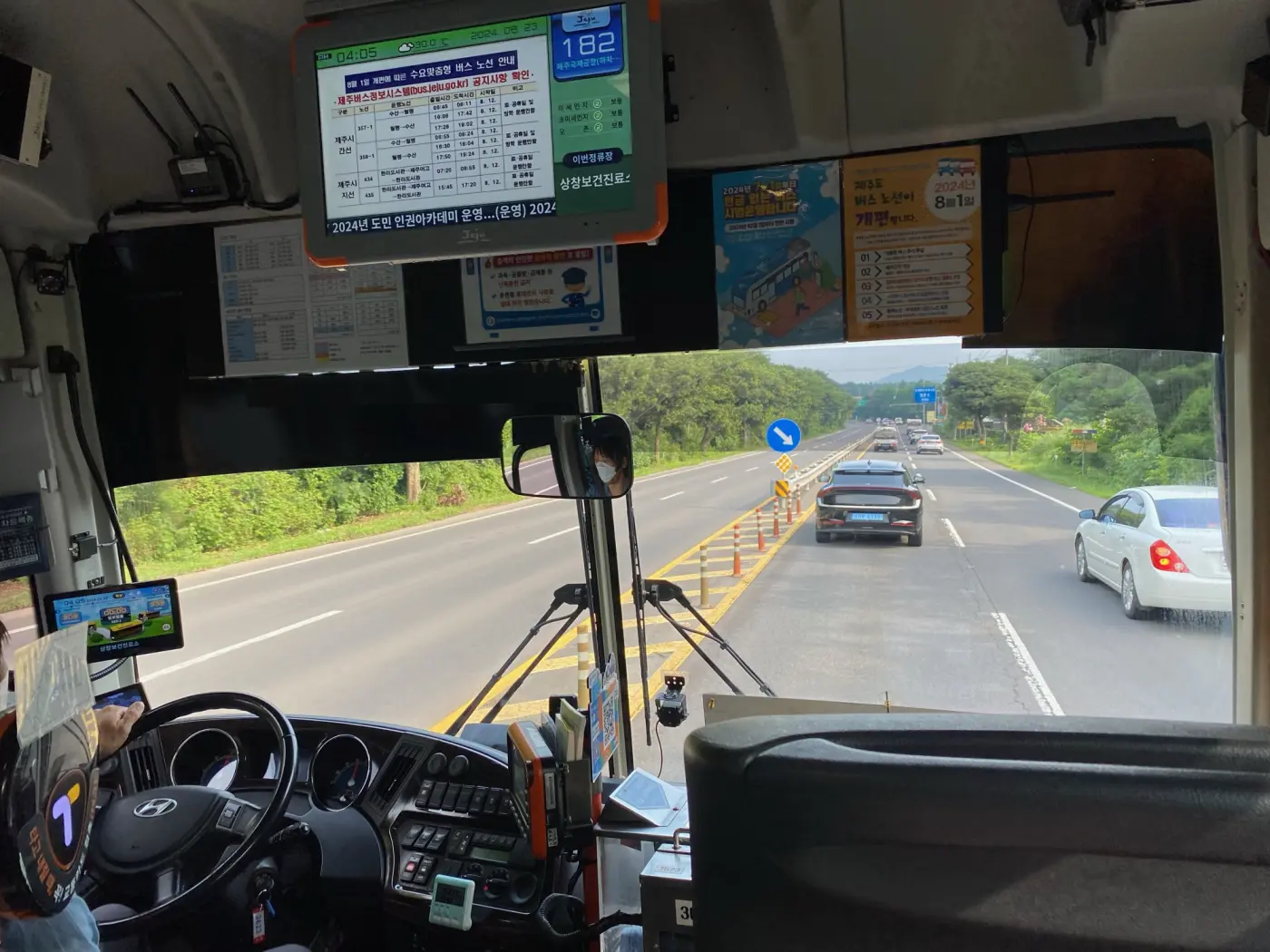
Jeju International Airport sits inside Jeju City, so you land almost in town, and many express routes start right there. According to the official route list, 101 runs along the east coastal road to Namwon, 111 heads east via Songdang to Seongsan Port, 121/122 and 131/132 cut across the middle of the island towards Pyoseon and Namwon, and 181/182 make a long loop between the airport, Jeju Bus Terminal and Seogwipo using the 5.16 Road on one side of Hallasan and Pyeonghwa-ro on the other.
The second hub is Jeju Bus Terminal in the city centre, where the most useful 200-series routes begin. Route 201 follows the east coast via Seongsan Ilchulbong to Seogwipo, 202 follows the west coast via Gosan, 240 climbs the 1100 Road past the Eorimok trailhead to Jungmun, and 281 crosses the island on the 5.16 Road to Seogwipo. Learn those four numbers and you already know how to reach a large share of the island's big sights.
Airport limousines to Jungmun and Seogwipo
If you are heading straight to the south coast, the airport limousines are the easiest choice because they are built with a luggage compartment. The Jeju Bus Information System describes route 600 as running from the airport through the Jungmun resort area, past the International Convention Center, the World Cup Stadium and Seogwipo port, and ending at the KAL Hotel in Seogwipo. Route 800 runs from Jeju Bus Terminal via the airport to Seogwipo Bus Terminal and, unlike the 600, does not go through Jungmun. A variant, 800-1, runs only in the early morning and late at night. Visit Jeju's transport guide puts the ride at about 50 minutes from the airport to Jungmun and roughly 70 to 80 minutes into Seogwipo.
Fares, cards and transfers
Buses are the cheapest way to cover distance on Jeju. These are the adult fares listed on the Jeju Bus Information System in October 2026:
- Ordinary trunk and branch buses, including the tourist circulation loops: 1,150 won by transport card, 1,200 won in cash.
- Express buses: 2,000 won by card when you board, plus a distance-based top-up when you tap off on longer rides, up to a maximum of 3,000 won. Cash passengers pay the maximum.
- Airport limousine 600: 1,300 to 5,500 won depending on distance. Route 800: 1,300 to 5,000 won.
The official site lists two kinds of card: nationwide prepaid transport cards such as T-money, which you can buy and top up at convenience stores, and credit cards that include a postpaid transport function. Paying by card brings a transfer discount if you board your next bus within 40 minutes of tapping off, up to twice, as long as it is not the same route number. So tap your card on the reader when you get off, not just when you get on. You can pay for a small group on one card by telling the driver how many are boarding, but after that only one person gets the transfer discount. Our guide to money in Korea explains T-money and when cash still helps.
Checking times: use the website, not the old app
The provincial government's Jeju Bus Information System shows routes, stops, timetables and real-time bus positions, with English and Japanese menus. Its dedicated app has been withdrawn, and a July 2026 notice on the site explains how to add the web page to your phone's home screen instead. Visit Jeju also recommends Korean map apps such as KakaoMap, which can plan bus journeys and show buses moving in real time. When services are cancelled, the bus information site posts a notice.
Timetables vary by route, but Visit Jeju's rule of thumb is that most buses run from around 6 a.m. until about 10 p.m. City routes come often. Away from the towns and the major sights, Visit Jeju warns that you may wait an hour or more. That single fact shapes almost every car-free plan on the island: the coasts and the main roads over Hallasan are easy, the quiet interior is slow.
Where to base yourself
Jeju City is the practical base. The airport, Jeju Bus Terminal and nearly every express route are here, so you can reach the east coast, the west coast and the Hallasan trailheads without changing buses, and you will find the widest choice of places to eat and sleep. The downside is that the city itself is not the scenic part of Jeju, and the south coast is a long ride away.
Seogwipo is the scenic base. Waterfalls and sea cliffs sit within local-bus range of the town centre: the official route list shows loops 641 and 642 stopping at Cheonjiyeon Falls and route 615 running out to the Oedolgae sea stack. Limousines 600 and 800 connect it with the airport, route 281 links it with the Seongpanak trailhead, and the Jungmun resort area is on limousine 600 and route 240. Fewer routes reach the western and eastern interior from here, and evenings are quieter.
For a trip of four nights or more, splitting your stay is the simplest answer: a couple of nights in Jeju City for the north, the east coast and Hallasan, then a couple in Seogwipo for the south coast. If a sunrise matters to you, sleep near it, because the first buses leave only around 6 a.m.
| Area | By bus? | Tip |
|---|---|---|
| Jeju City and the airport | Easy | Express routes start at the airport; routes 201, 202, 240 and 281 start at Jeju Bus Terminal. |
| Seogwipo town and coast | Easy | Limousine 600 or 800 from the airport; loops 641/642 for Cheonjiyeon Falls, route 615 for Oedolgae. |
| Jungmun resort area | Easy | Limousine 600 runs through it; route 240 comes over the 1100 Road from Jeju City. |
| Seongsan Ilchulbong | Yes | Route 201 stops there on the east coast road; express 111 runs from the airport to Seongsan Port. |
| Hallasan: Seongpanak trail | Yes | Routes 281 and 181 on the 5.16 Road; summit hike must be reserved in advance. |
| Hallasan: Eorimok and Yeongsil | Yes | Route 240; at Yeongsil, the first 2.5 km from the ticket office is a road section. |
| West coast (Hallim, Gosan, Moseulpo) | Yes, slower | Route 202 follows the coast; express 102 runs to Moseulpo South Port. |
| Eastern forests and volcanic cones | Possible | Village route 711-1 and loop 810 from Daecheon; expect long gaps between buses. |
| Dawn and late-night plans | Hard | Most buses run about 6 a.m. to 10 p.m.; stay nearby or use a taxi. |
Seongsan Ilchulbong by bus
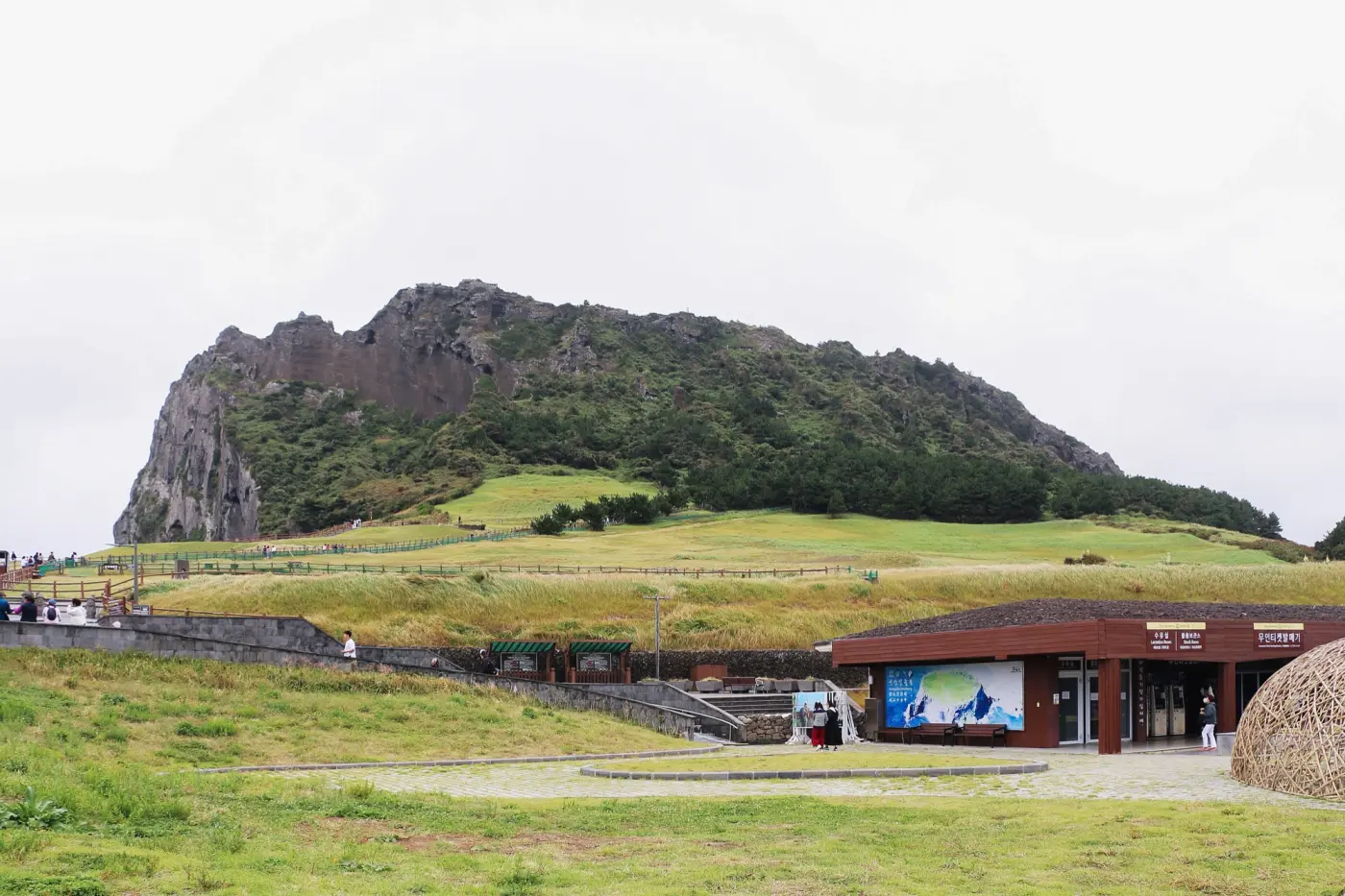
The tuff cone on Jeju's eastern tip, part of the UNESCO World Natural Heritage site inscribed in 2007, is one of the easiest highlights to reach without a car. The official route list names Seongsan Ilchulbong as a stop on route 201, which runs along the east coastal road between Jeju Bus Terminal and Seogwipo, so you can visit it on the way from one base to the other. Express 111 is the faster option from the airport, ending at Seongsan Port via Songdang.
Visit Jeju says the paid section up to the summit is a series of stairs that takes about 30 to 40 minutes, while a free section with a gentler slope leads around the base towards the shore. The name means Sunrise Peak, but a bus-only traveller staying in Jeju City or Seogwipo will not get there for dawn. If sunrise is the point, spend a night in Seongsan village and walk over.
Hallasan is easier without a car than you think
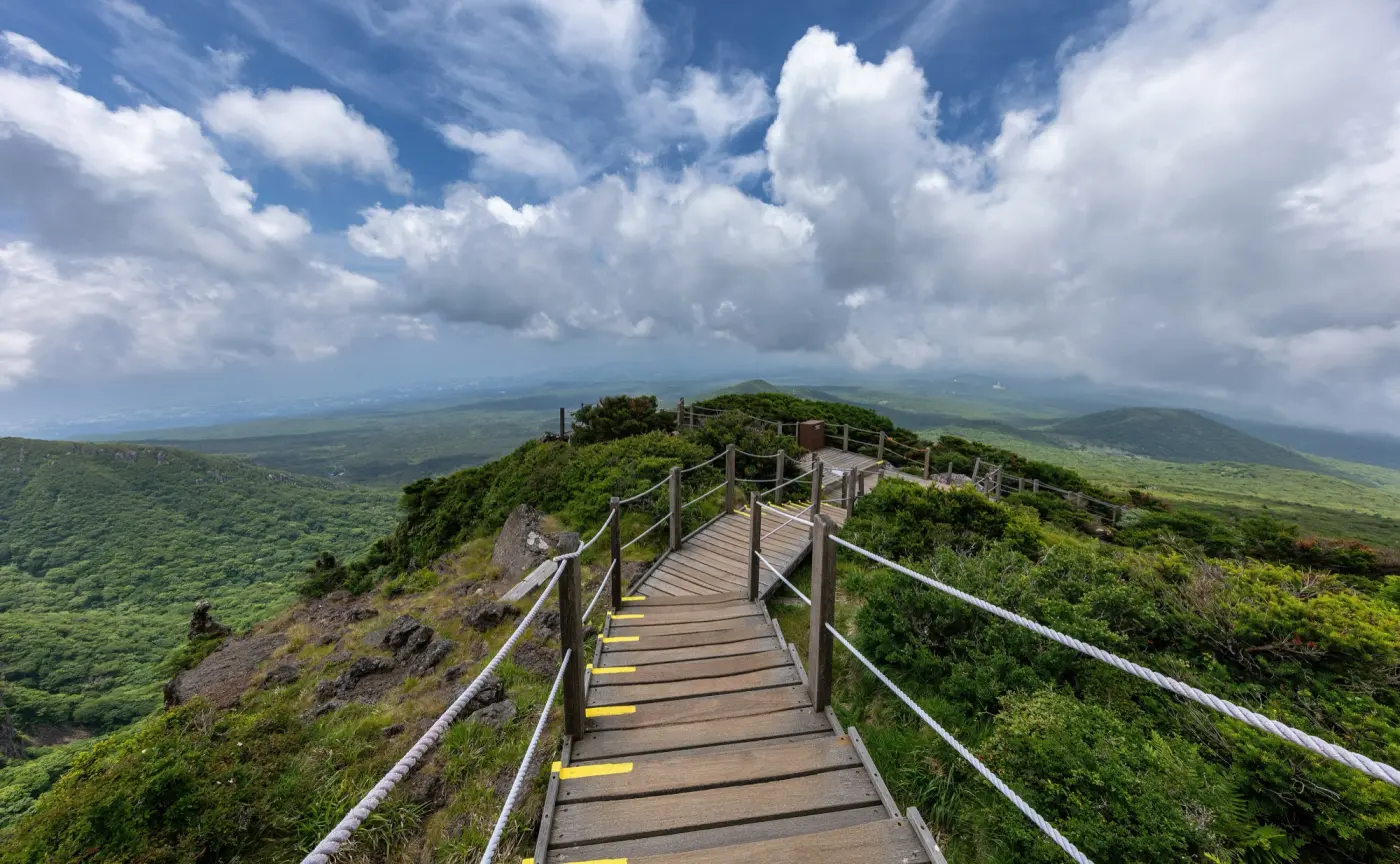
Korea's highest mountain, 1,950 metres according to the park, is one place where not having a car is almost an advantage. The park's own page for the Seongpanak trail says the car park is small and often full before hiking hours in peak season, and asks hikers to come by public transport. Routes 281 (from Jeju Bus Terminal) and 181 (from the airport) both run along the 5.16 Road, and the trail entrance is about a two-minute walk from the stop. The Hallasan reservation site gives about 45 minutes on the 281 from Jeju Bus Terminal, with buses from about 6 a.m. to 10 p.m. in both directions.
The two summit trails, Seongpanak and Gwaneumsa, require an advance reservation through the official Hallasan reservation system, which offers a foreign-language service. Bookings for a given month open at 9 a.m. on the first working day of the month before, and a QR code for entering and leaving the trail is sent to the phone number you register. Cancel if your plans change: a no-show without cancelling blocks you from booking for three months, and a second one for a year. Seongpanak is 9.6 km each way, about four and a half hours up and roughly nine hours there and back, and there are cut-off times: from April to September you must pass the trail entrance and the Jindallaebat shelter by 12:30, from October to March by 11:30.
If you would rather not commit to the summit, the Eorimok and Yeongsil trails climb to about 1,700 metres at Witse-oreum, and the official reservation system covers only Seongpanak and Gwaneumsa. The park suggests these two for visitors without recent hiking experience. Both are on route 240 from Jeju Bus Terminal: about 35 minutes to the Eorimok entrance stop, then roughly 15 minutes on foot; about 50 minutes to Yeongsil. At Yeongsil, the first 2.5 km from the ticket office to the Yeongsil rest area is a road shared with vehicles, so the park gives about 3 hours 15 minutes one way from the office compared with 2 hours 30 minutes from the rest area.
Taxis: the gap-filler
Taxis on Jeju are metered under a single island-wide fare table. Under the rates in force since 1 July 2024, a standard mid-size taxi starts at 4,300 won for the first 2 km, then charges by distance, and by time when moving slowly. A 20 percent late-night surcharge applies from 11 p.m. to 4 a.m., a long-distance surcharge kicks in beyond 20 km for small and mid-size taxis, and calling a taxi adds a 1,000 won call fee.
In practice, taxis are perfect for short hops that buses make awkward: from a bus stop to a hillside café, from your guesthouse to the terminal with heavy bags, or back to town after the last bus. Long cross-island rides add up quickly, so pair the two: take the bus for the long stretch and a taxi for the last few kilometres. In rural areas you will rarely see an empty taxi cruising past, so before you ride out somewhere remote, check the return bus times or ask your driver about getting back. Many car-free visitors also hire a taxi for a full day; if you do, agree the route and the number of hours before you set off.
Day tours
Day tours are the other way to fill gaps, especially for interior volcanic cones and forests where village buses are infrequent. Typical small-group tours bundle the sights of either the east or the west side into one day, with pick-up in Jeju City or Seogwipo. Before booking, check where the pick-up point is, which language the guide speaks, whether admission fees are included, and what happens if the weather turns. A relaxed tour with a handful of stops usually beats one that races through ten.
What is genuinely hard without a car
- Dawn and after-dark plans, from sunrise at Seongsan to stargazing, because most buses run between about 6 a.m. and 10 p.m.
- Strings of small sights in the interior, where village routes can leave you waiting an hour or more.
- Covering the far east and the far west of the island on the same day.
- Moving between hotels with large suitcases on ordinary city buses; the airport limousines are the ones built for luggage.
- Spontaneous detours to that café you spotted from the window. On a bus, you plan; in a car, you wander.
None of this is a reason to give up on the car-free idea. It simply means choosing a base well, accepting that some days will cover fewer places, and using a taxi or tour for the one or two spots that matter most to you.
Rainy and windy days
Jeju's weather changes fast, and the wind off the sea can be strong. On Hallasan, the park partly or fully closes trails when the weather service issues heavy rain, typhoon or heavy snow advisories, so check the park's site on the morning of your hike. It also warns that the area around Witse-oreum is prone to sudden fog and lightning, and asks hikers to carry spare clothing and snacks.
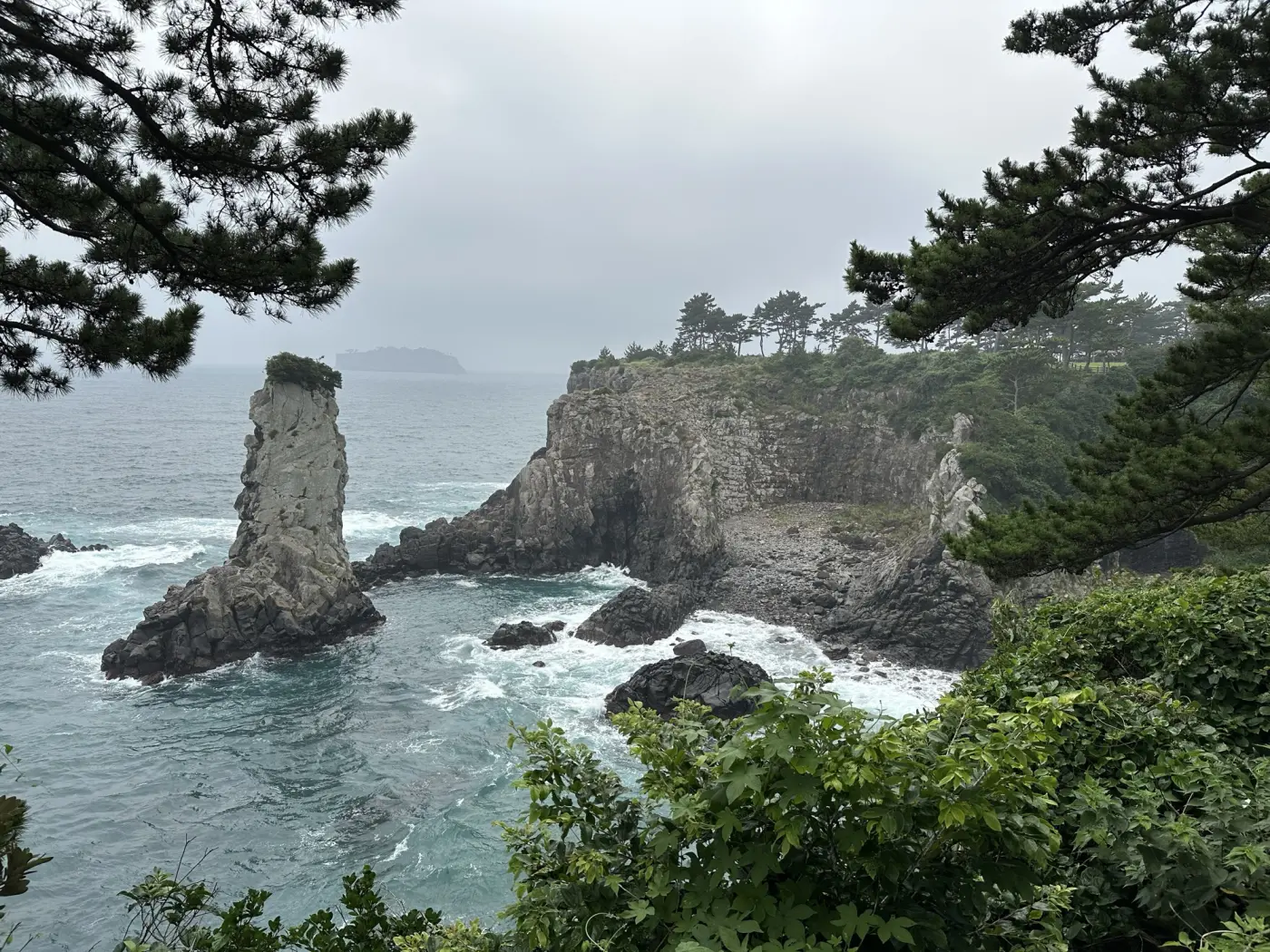
On the coast, grey days have their own drama. The sea stacks and cliffs around Seogwipo look striking in rough weather from the clifftop paths, but stay on the paths and behind the railings when waves are high. If the bus information site posts cancellations, take that as a sign to keep the day flexible: an indoor museum, a market, or a long lunch in town. Route 260 from Jeju Bus Terminal, for example, ends at the Haenyeo Museum on the northeast coast. Our guide to the best time to visit Korea covers the seasons, including the rainy season.
A simple car-free plan
- Day 1: Land, take an express bus or taxi into Jeju City, and settle in.
- Day 2: Route 201 along the east coast to Seongsan Ilchulbong, then continue on the 201 to Seogwipo.
- Day 3: Hallasan. Route 281 to Seongpanak if you have a summit reservation, or route 240 to Yeongsil or Eorimok for a shorter climb.
- Day 4: Seogwipo's coast by local bus, from Oedolgae to Cheonjiyeon Falls, then limousine 600 or 800 back to the airport.
Jeju rewards slower travel. Sitting on the 201 as it follows the coastal road through fishing villages and stone walls is not dead time; it is part of the trip. If you'd like a ready-made route built around food, our Jeju in 3 Days, Eating PDF guide maps 17 stops across the island.
Comments
Sign in to leave a comment.
Sign in ·No account? Create one
Confirm your email address to comment — it takes one click.
No comments yet.