
Tongyeong Travel Guide: Islands, Cable Car and Yi Sun-sin
How to reach Tongyeong from Seoul by express bus, plus the cable car, Gangguan harbour, Sebyeonggwan, island ferries, local food and a 1-night plan.
Tongyeong sits on Korea's south coast in Gyeongsangnam-do, on a jagged peninsula and a scatter of islands at the western edge of Geoje. For almost three centuries it was the headquarters of the Joseon navy, and the city still carries that history in its street names, its old command hall and the replica turtle ships moored in its harbour. Today the city is just as much about the sea: the island-dotted waterway called Hallyeosu-do, ferries leaving every morning, and seafood markets that are busy from early in the day.
This guide covers how to reach Tongyeong from Seoul, the places the city itself puts first, the islands you can reach by ferry, what to eat, and a simple one-night, two-day plan. Facts below come from Tongyeong City's tourism portal, the city's English website, the cable car operator and the Korea Heritage Service. Where two official pages disagree, the difference is pointed out instead of choosing one.
Getting to Tongyeong from Seoul
The express bus is the straightforward option. Tongyeong City's English transport page lists two Seoul routes: a nonstop service from Seoul Nambu Terminal and an express service on the Gyeongbu line from the Seoul Express Bus Terminal, both running from early morning into the evening, with late-night buses as well. The city's tourism portal confirms that buses from Tongyeong go to both terminals, as well as to Dong Seoul and Incheon Airport.
On journey time, the city's own pages do not quite agree. The English express bus page gives 4 hours 10 minutes, while an older FAQ on the same website says about 5 hours. Treat the trip as a half-day journey, leave early, and check the time shown when you book your seat. The city adds that times are subject to change.
There is no train option on the city's page of directions, which lists air, express bus and rental car only. If you prefer to fly, the tourism portal lists flights from Gimpo to Sacheon Airport near Jinju and to Gimhae Airport in Busan, with onward buses to Tongyeong. Coming from Busan, both city pages give about 2 hours 10 minutes on the nonstop bus from Busan's Seobu terminal, which makes Tongyeong an easy add-on to a south coast trip.
Tongyeong's bus terminal is not in the old centre; the city lists its tourist information centre on Jukrim 4-ro in Gwangdo-myeon. City buses connect it with downtown, and the cable car operator names bus 141 as the route from the intercity bus terminal to the stop in front of the cable car. There is also a tourist information centre at the terminal, at the ferry terminal, beside Gangguan and at the foot of the cable car.
The main sights at a glance
| Place | What it is | How to get there | Time to allow |
|---|---|---|---|
| Mireuksan and Tongyeong Cable Car | 1,975 m cable car to just below the 461 m summit, with views over the Hallyeosu-do islands | City bus 141 from the intercity bus terminal to the cable car stop in Donam-dong | 2 hours, including the short walk to the top |
| Gangguan harbour | The old inner harbour, with full-size replicas of three turtle ships and one panokseon | In the city centre, on the waterfront in Jungang-dong | 30 to 60 minutes |
| Jungang Market | Live-fish and seafood market opposite Gangguan | A short walk across the road from the harbour | 30 to 60 minutes |
| Dongpirang | Hillside village of painted walls with the Dongporu lookout at the top | Uphill on foot from Gangguan | About 1 hour |
| Sebyeonggwan and Tongjeyeong | National Treasure hall of the Joseon naval headquarters, first built in 1605 | Sebyeong-ro 27, Munhwa-dong, a walk inland from Gangguan | About 1 hour |
| Jeseungdang, Hansan-do | Admiral Yi Sun-sin's command post during the Imjin War | Ferry from Tongyeong Port Ferry Terminal, about 20 minutes | Half a day with the ferry |
| Bijin-do | Island with a 550 m sandy beach backed by old pines | Ferry from Tongyeong Port Ferry Terminal | A full day |
| Somaemul-do and Deungdaeseom | Rocky island and lighthouse islet joined by a pebble path at low tide | Ferry from Tongyeong Port Ferry Terminal | A full day |
Mireuksan and the cable car: the Hallyeosu-do view
Mireuksan is the 461-metre mountain in the middle of Mireukdo, the island just south of the city centre. Its name refers to Maitreya, the Buddha of the future, and old temples sit on its lower slopes. The easy way up is the Tongyeong Cable Car, which the city describes as Korea's longest tourist cable car at 1,975 metres. It opened in April 2008 and uses 48 eight-person cabins that circulate continuously from the lower station in Donam-dong to an upper station high on the mountain.
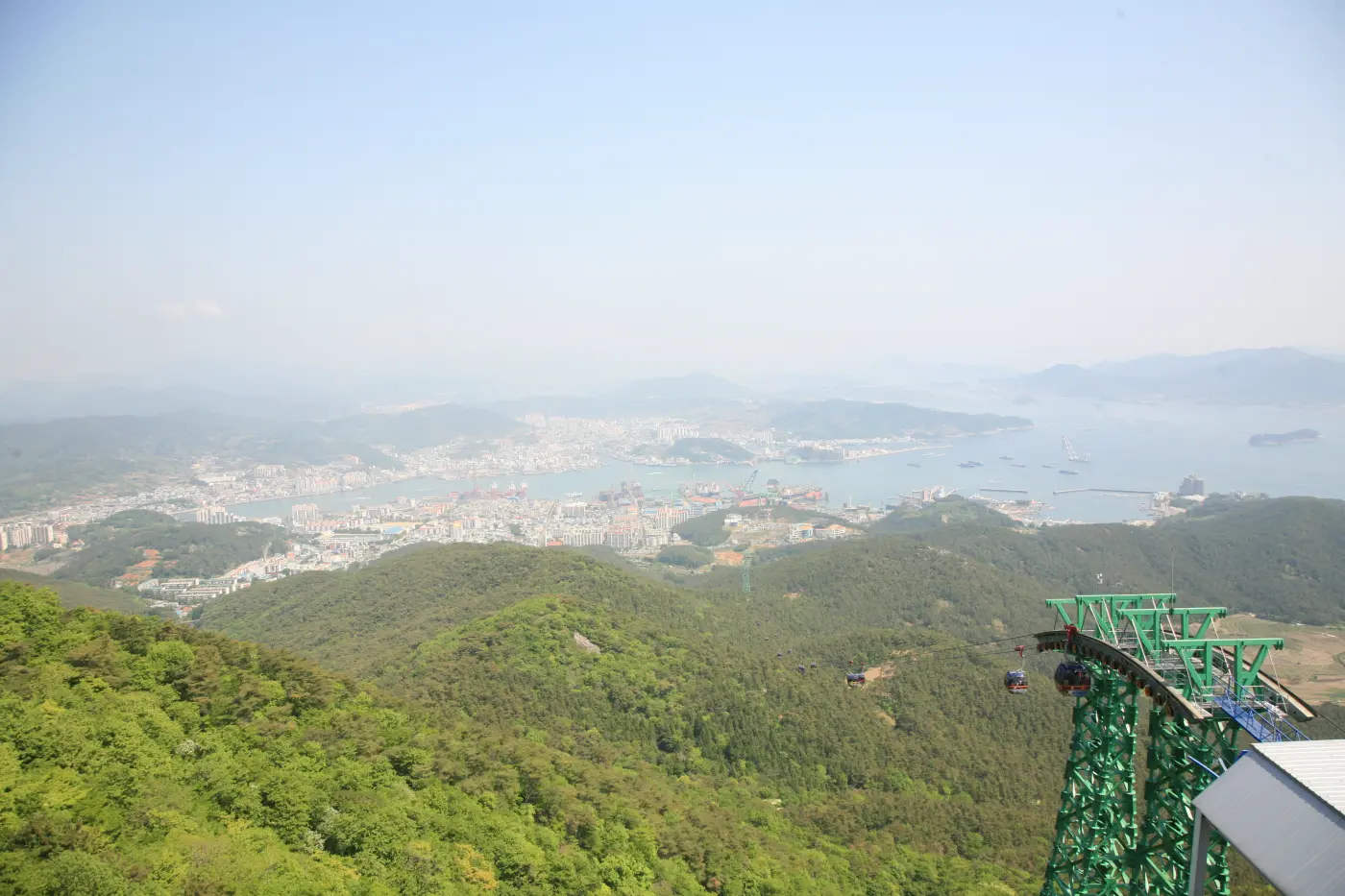
From the upper station, a walk along timber decks leads to the summit and a series of lookouts. The city lists what you can see: Tongyeong harbour, the islands of Hallyeosu-do in the Hallyeo Maritime National Park, the site of the 1592 Battle of Hansan, an old beacon-fire station and, on clear days, as far as Tsushima, Jirisan's Cheonwangbong peak and Dolsan in Yeosu. Wear comfortable shoes for the walk.
Opening hours change with the season. The city's page gives summer hours of 09:30 to 18:00, and the operator's own page lists shorter hours from October to March. The operator also warns that wind or weather can stop the line, that ticket sales may close two to three hours before the end of operation, and that it posts a monthly timetable. Check it on the day you plan to go, and go earlier rather than later.
Gangguan harbour and the turtle ships
Gangguan is the small inner harbour at the heart of town. The name, the city explains, means the mouth where a stream flows into the sea. In the Joseon period it was part of the naval port of the headquarters; part of its tideland was reclaimed during the colonial period, and today the waterfront is a public square where the city's street performances and night events take place.
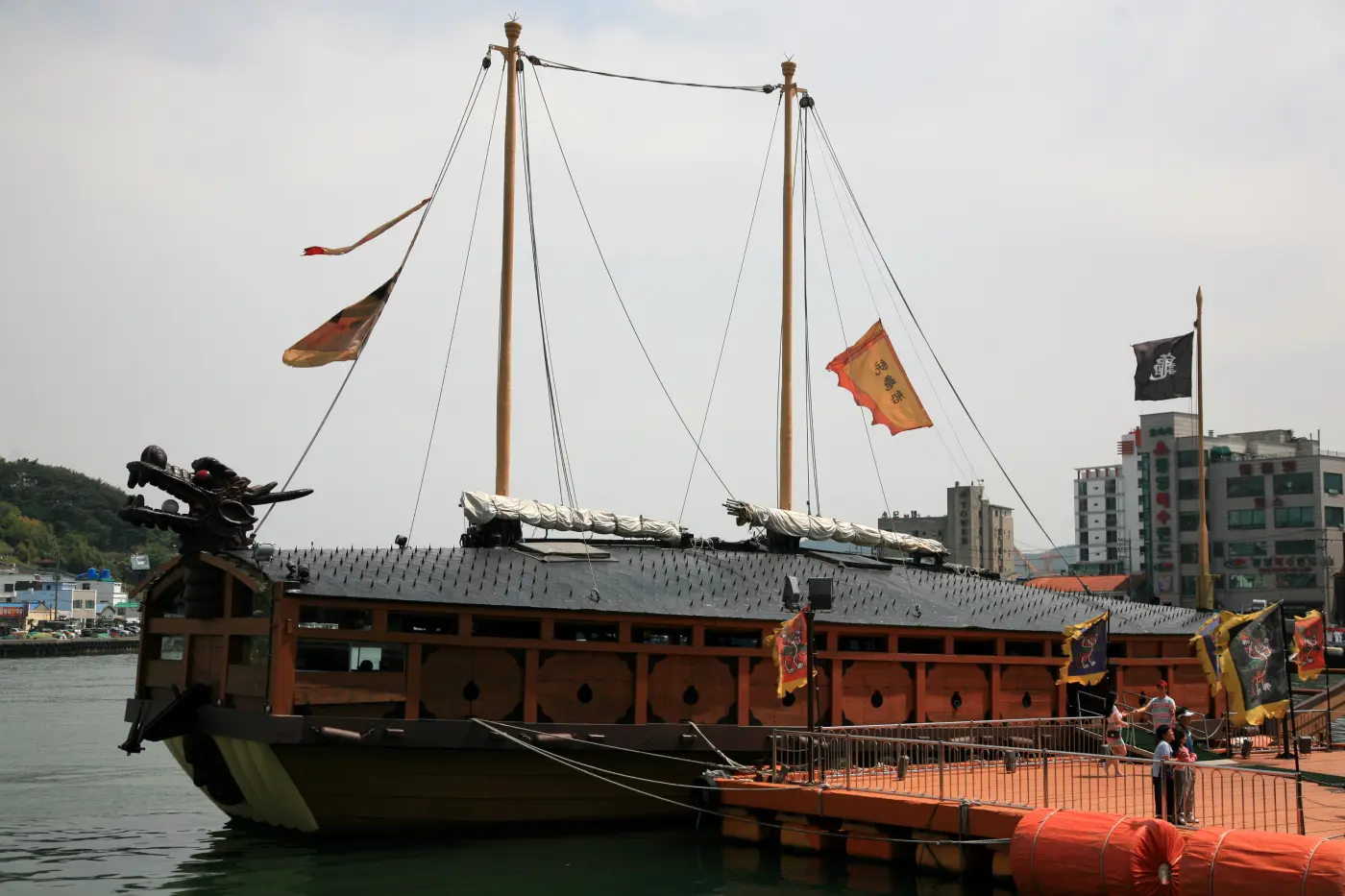
The main draw for visitors is the line of replica warships: three geobukseon, the iron-roofed turtle ships associated with Admiral Yi Sun-sin, and one panokseon, the Joseon navy's standard warship. According to the city, they were built in 1990 for Seoul and brought here in 2005, by way of the lower Han River, to the waters of the Battle of Hansan. You can go inside and see how cramped life on board was. After dark the boats and the harbour bridge are lit, and the square becomes a pleasant place for an evening walk.
Jungang Market and the waterfront markets
Directly across the road from Gangguan is Jungang Market, which the city describes as a wholesale market for fresh fish and marine products caught off Tongyeong. The city describes it as bustling with visitors, with tanks and trays of live fish along the lanes. Buying fish to eat on the spot is common in Korean seafood markets; if you do, ask the price first and use the guide to eating out linked below for the basics.
Two other markets are worth knowing. Seoho Market, in front of the ferry terminal, is the early-morning market, built on land reclaimed during the colonial period. And the fisheries associations run consignment auction sheds where the morning catch is sold; the city mentions them as a sight in their own right for early risers. Streets of chungmu gimbap restaurants cluster around Gangguan, the ferry terminal and the excursion boat terminal in Donam-dong.
Dongpirang: a lived-in mural village
Above Gangguan, on the hill in Jungang-dong, Dongpirang is a village of narrow, winding lanes whose walls are covered with paintings. The murals are renewed through competitions, so what you see changes from year to year. At the top stands Dongporu, a lookout pavilion with a view over Gangguan and the whole harbour. The city recommends coming just after sunset, when the lights come on along the water.
The most important thing to know is that people live here. The city's own page asks visitors to remember that Dongpirang is a residential area as well as a sight, and to keep noise down, especially at night. Walk the lanes as you would any residential street. Shops and cafés on the hill close in the evening, so a night visit is a quiet walk rather than a night out.
Sebyeonggwan and the Joseon naval headquarters
Tongyeong's history is bound up with Tongjeyeong, the Samdo Sugun Tongjeyeong, which commanded the naval forces of three provinces, Gyeongsang, Jeolla and Chungcheong. It moved to this site in the early 1600s and remained in operation until 1895. Its central building is Sebyeonggwan, which the Korea Heritage Service lists as a National Treasure, designated in October 2002.
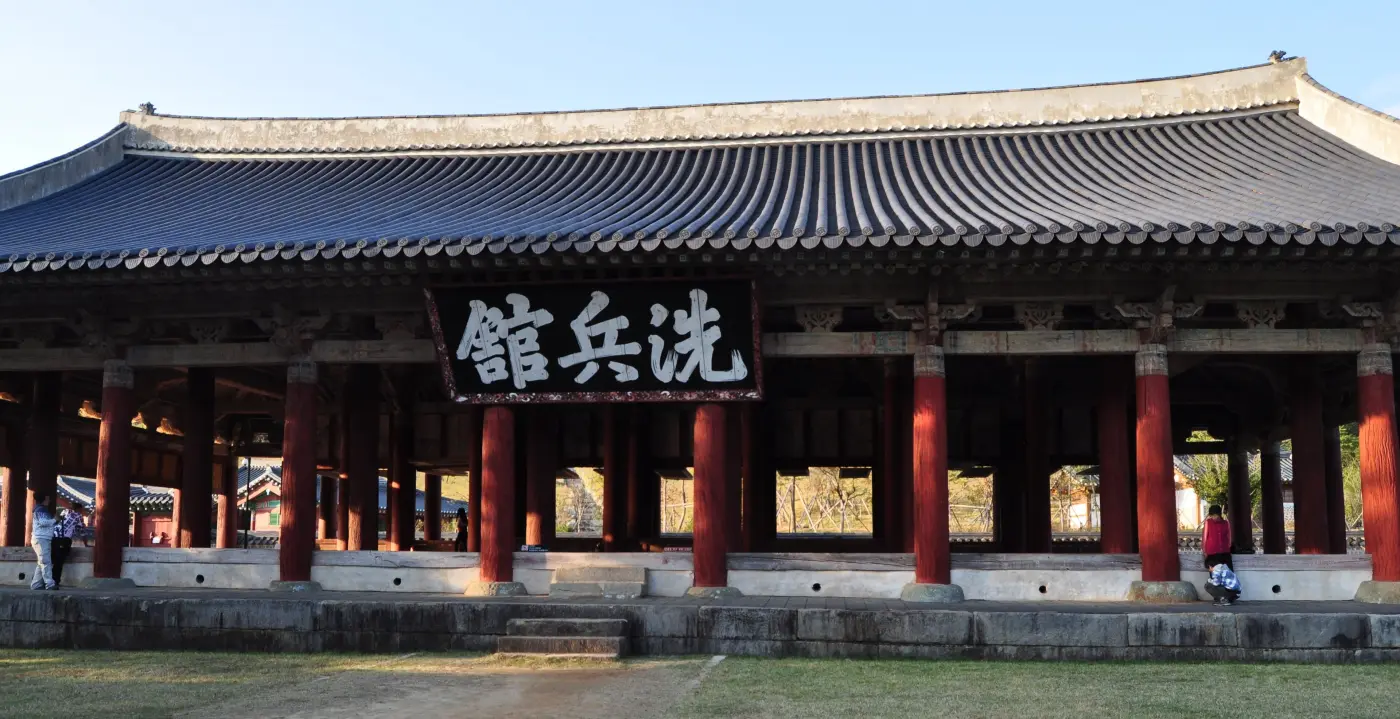
Sebyeonggwan was built in 1605. It is a single-storey hall nine bays wide and five deep, carried on 50 wooden pillars and open on all sides, with no walls or windows. The heritage listing counts it, together with Gyeonghoeru at Gyeongbokgung Palace and Jinnamgwan in Yeosu, among the largest buildings of its kind in Korea. Its name comes from a phrase about drawing down the Milky Way to wash the weapons clean; the board over the front was written by a later commander of the fleet.
Opening times on the city's pages start at 09:00. The Sebyeonggwan page gives a closing time of 18:00, and the page for the wider headquarters gives 17:00 on its winter schedule; the city also notes that the grounds are open only until sunset. No regular closing day is listed. Since 2021 the buildings have been lit at night, so if you arrive late you can still see them from outside. Jinnamgwan in Yeosu is the hall usually named alongside it, and our Yeosu guide covers it.
Admiral Yi Sun-sin on Hansan-do: Jeseungdang by ferry
The first naval headquarters was not in today's city but on Hansan-do, the island facing it across the bay. In August 1593, according to the city, Admiral Yi Sun-sin was appointed commander of the navies of the three provinces and set up his base here, building a command post where he planned operations with his officers. He commanded from Hansan-do until 1597; the building was ruined that year during the second invasion, and in the 18th century a later commander rebuilt it on the old site and named it Jeseungdang.
Today Jeseungdang sits within the Hallyeo Maritime National Park. Inside are documentary paintings of the Battle of Hansan and other sea battles of the war. A small islet on the way in was once used to grow bamboo for arrows, and a stone turtle-shaped lighthouse marks the entrance. The city lists opening hours of 09:00 to 18:00.
Ferries leave from Tongyeong Port Ferry Terminal in Seoho-dong, and the city says the crossing takes about 20 minutes. The city's island ferry page shows sailings to Jeseungdang through the day, from early morning to late afternoon, and notes that timetables change often; it refers travellers to the Korea Shipping Association's island ferry site for the current schedule. Check both the outbound and the last return sailing before you set off.
Island hopping: Bijin-do and Somaemul-do
Tongyeong has many islands, and the city's tourism portal groups them by area. Two of the best known for a day trip are Bijin-do and Somaemul-do, both reached by ferry from the same terminal in Seoho-dong. On the city's timetable, sailings to each run three times a day on weekdays, with extra departures at weekends; that makes a day trip possible but leaves little slack, so plan around the return sailing.
Bijin-do, about 13 km from Tongyeong harbour, is known for a 550-metre sandy beach at Oehang village, backed by pine trees more than a century old. The beach is narrow in the middle, like the waist of an ant, and the city notes that its shallow water makes it popular for swimming in summer.
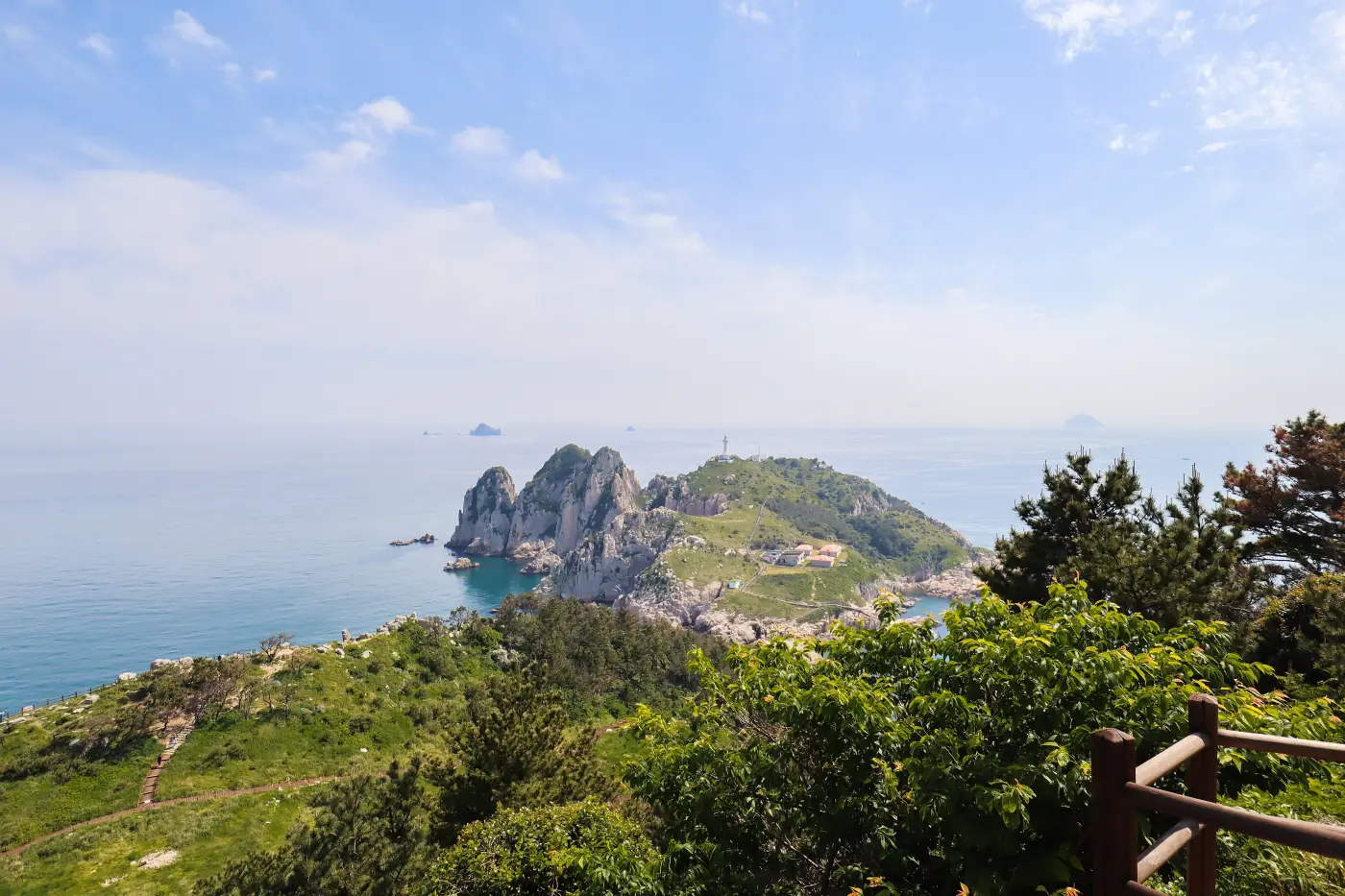
Somaemul-do is an island of steep rocks and clear water; the photograph at the top of this article shows its neighbour, Deungdaeseom, the lighthouse islet. The two are designated together as a Scenic Spot, and at low tide a pebbly strip of seabed appears between them so that you can walk across. Check the tide times as well as the ferry times before you go. Somaemul-do can also be reached from Jeogu port on Geoje, and the city's timetable lists that route as well.
What to eat in Tongyeong
The dish that carries the city's old name is chungmu gimbap. Tongyeong was called Chungmu from 1955 until it merged with the surrounding county in 1995, and the name lives on in small rolls of rice wrapped in laver with no filling at all. The city explains that leaving out the filling kept the rice fresh for longer; instead, the rolls come with radish kimchi seasoned with salted anchovy and spicy octopus or cuttlefish on the side.
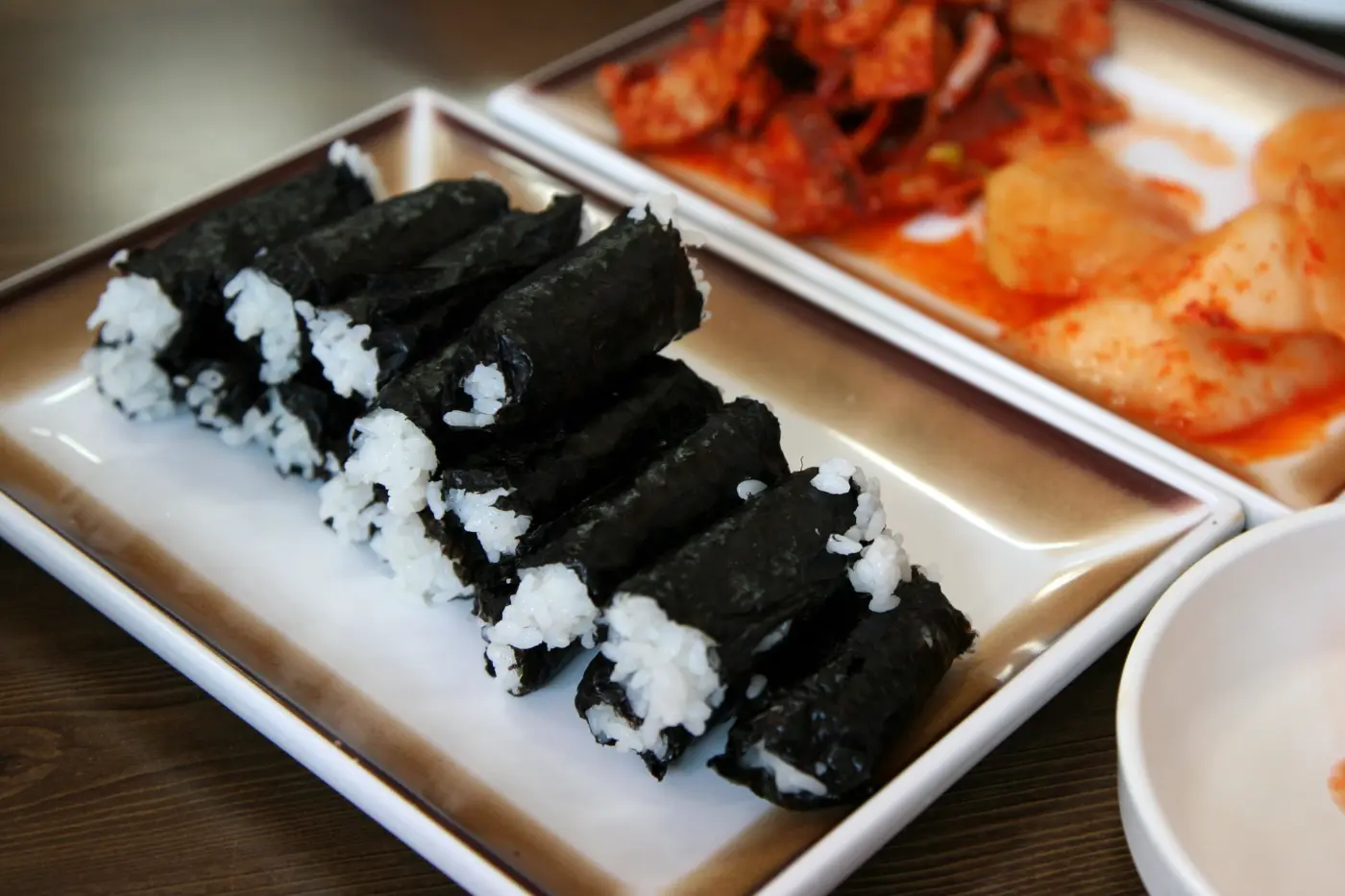
Oysters are the other headline. The city lists oyster rice, oyster stew and grilled, steamed and raw oysters among its local dishes, and says the waters off Tongyeong are certified as a clean area by the US Food and Drug Administration. The tourism portal also keeps a calendar of seasonal dishes: flounder and mugwort soup in early spring, sliced pike eel in summer, gizzard shad in autumn, and, from November to February, a clear soup of mulmegi, a soft-fleshed winter fish.
Two local habits are worth knowing about. Dajji restaurants, as the city describes them, have no fixed menu: you order drinks, and plates of whatever is fresh that day arrive with them. And kkulppang, sweet buns usually filled with red-bean paste and glazed with syrup, are common enough that the city's food directory gives them their own category. Prices vary from place to place, so check before you order.
A simple one-night, two-day plan
| When | Plan | Notes |
|---|---|---|
| Day 1 morning | Express bus from Seoul Nambu or the Seoul Express Bus Terminal | Take an early departure; the ride takes most of the morning |
| Day 1 afternoon | Sebyeonggwan and the Tongjeyeong grounds | The grounds are open only until sunset; closing is earlier in winter |
| Day 1 late afternoon | Walk up through Dongpirang to Dongporu | The city suggests the lookout just after sunset; keep voices low |
| Day 1 evening | Gangguan waterfront and dinner near Jungang Market | The turtle ships and the harbour are lit after dark |
| Day 2 early | Ferry to Hansan-do for Jeseungdang | About 20 minutes each way; check the day's timetable |
| Day 2 late morning | Bus 141 to the cable car and Mireuksan | Ticket sales can close well before the last ride |
| Day 2 afternoon | Chungmu gimbap lunch, then the bus back to Seoul | Book the return seat in advance at weekends |
With a second night, give a full day to Bijin-do or Somaemul-do and keep the cable car for a clear morning. Tongyeong also pairs well with Busan, which is about two hours away by bus; our Busan guide for first-timers covers the city, and the Busan PDF city guide goes further if you want something to carry. For the wider region, including Namhae and other parts of Gyeongsangnam-do, see our Gyeongnam regional page.
Comments
Sign in to leave a comment.
Sign in ·No account? Create one
Confirm your email address to comment — it takes one click.
No comments yet.